Is there a child today who has not been told the story of Newton sitting under an apple tree and the discovery of gravity? The story is entrenched in the folklore of science. In The Man Who Made Plants Write, Sumana Roy introduces the reader to another such story that deserves to be told just as much to every science student.
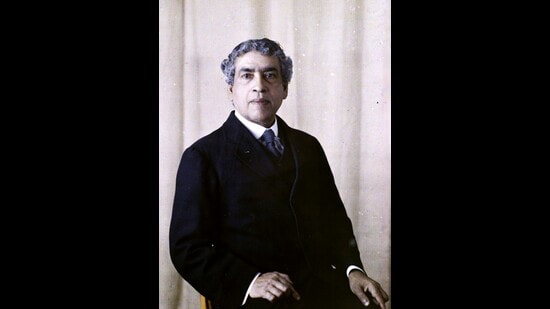
Roy tells us another story from science folklore: Jagadish Chandra Bose once stepped on a ‘touch-me-not’ (Mimosa pudica) plant. He immediately noticed the folding of its leaves and wondered how and why that response happened. The touch-me-not was his apple -- the impetus that led him to study plant responses and ways of communication!
Roy’s masterful translation of Jagadish Chandra Bose’s Abyakta, is similarly captivating. In lyrical prose that retains the local flavour, Roy takes us on a journey through Bose’s life, through the medium of his essays.
{{/usCountry}}Roy’s masterful translation of Jagadish Chandra Bose’s Abyakta, is similarly captivating. In lyrical prose that retains the local flavour, Roy takes us on a journey through Bose’s life, through the medium of his essays.
{{/usCountry}}Her own writing in the book gives the reader a sense of not just ‘Bose, the scientist’, but also ‘Bose, the writer, patriot, poet and thought leader’ with her translation capturing the Bengali essence of the original. Words like ‘jhankaar’ and sounds like the ‘thorr thorr’ of a tree’s rustling leaves are retained in her translation which makes the reader feel closer to the original tone of writing. In the soulful introduction, she tells the reader about Bose – his love for Bangla, his childhood education, rise to fame, his dreams and his challenges. While doing so, it becomes very clear that Roy herself is invested in the scientist’s life and work. Like Bose, she too is a ‘plant-mad parent’ as someone once called her. In keeping with Bose’s theme of interconnected life, Roy also ruminates on the legacy that childless people leave the world.
Abyakta – the unsaid – is not just a collection of science essays; it is an exploration of the poetic quality of science. Some of these pieces were written for children, some were lectures delivered to a largely layman audience, and one was addressed to the Bengali Sahitya Sammelani, a literature conference. Bose sees music in the susurration of leaves, in sounds that are audible and those that are beyond the human auditory range. Like Rachel Carson’s A Sense of Wonder (1965), written 43 years after Abyakta, these works seek to sow the seed of awe, love and regard for nature in the populace. It is only with love that one can understand the natural world, Bose says:
“Earlier, when I would go to the fields or mountains by myself, I felt an emptiness. I then learned to love plants, trees, birds, worms, and insects. I am able to understand many of their words that I couldn’t before. These trees that do not speak — that they have a life, that they eat like us, that they grow with time, I did not know any of this. I understand it now.”
The writing is full of interesting analogies: seeds are like a sleeping infant; pollination is a flowering tree that invites its dear friends, the birds and butterflies, over. He tells us of the special invitation trees extend to nocturnal insects. Since they cannot venture out in the day, he says, the trees release fragrances to guide the insects to the party at night!
The housewife is not forgotten – while explaining how a zigzag cut is more injurious to a plant than a straight one, he makes a tongue-in-cheek comment about how this may be applied while cutting a koi fish!
The essays also convey a deep sense of patriotism; a wish to make science accessible to the masses and the eventual establishment of the Bose Institute in Calcutta. The scientist recalls instances where he was treated with thinly-veiled contempt by colonial peers. Even when he was appreciated, he was often singled out as an outlier in a largely uneducated, uncreative Indian population. His writing is a vindication of such views.
His writing shifts the anthropocentric focus of contemporary science and turns its attention towards plant life. A polymath and a proponent of interdisciplinary science, he set up the Bose Institute as a way for specialists in different disciplines to come together and work towards solving common problems.
Quite contrary to the scientific mindset of the era, he he did not shy away from showing his love for his test subjects. Like Jane Goodall sought to name the chimpanzees she studied, Bose, in an earlier era, spoke lovingly about his plants and chose to explain the science behind them by using human emotional analogies. An unsurprising quirk considering he is the inventor of the crescograph – metaphorically, an instrument that made plants write.
Yashodhara Sirur is a part-time writer and full-time IT professional based in Mumbai.