
 E-Paper



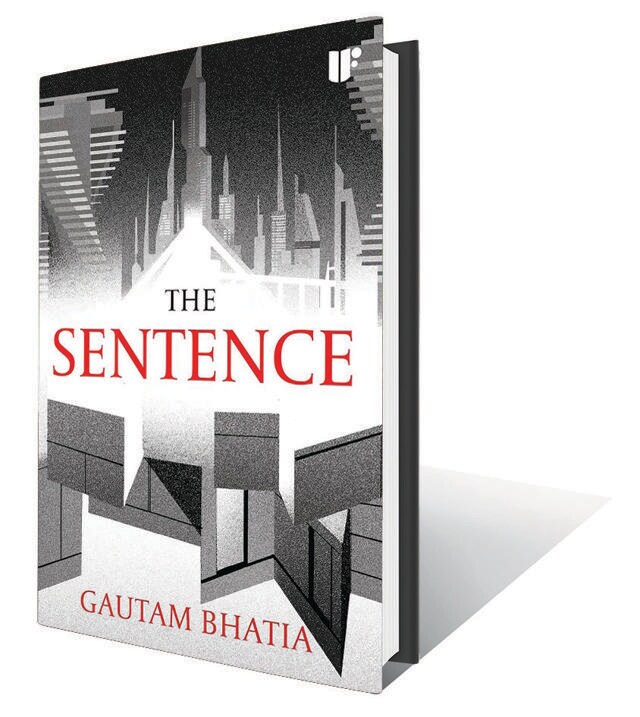
Review: The Sentence by Gautam Bhatia
Set in 498AE, this work of speculative fiction, shot through with its author’s knowledge of constitutional law, pushes the reader to examine the notion of justice itself

 Prefer HTon Google


The fall of the imperial Perumal empire marks the beginning of a new calendar in The Sentence by Gautam Bhatia. This fall also marks the proclamation of the Independent Republican City of Peruma. The reader is told that every few generations, a “violent and ruinous clash” takes place whose outcome “fundamentally alters society.” These points in Peruman history are known as the inflection points. Five centuries old, Peruma has witnessed a great class struggle. In the year 398, Director Purul along with his secretary Milana Maran had flown down to the Unity bridge on the river Urai that connects the high town to the low one. The moment he steps onto the bridge, there’s a great blast. Then appears a young man, Jagat R, who says, “In the name of the Commune unborn, die.”

The proclamation and the assassination birth an anarchist revolution. Peruma is divided into the High Town and the Commune. The violence that follows is controlled by the signing of a compromise document, the Charter of Peace And Unity, that will not be amended for a hundred years, the Pact of Forgetting what happened in that week, and the creation of the Confederation of Guardians. The guardians are a body of law, who are trained to be impartial and cannot choose sides in their practice. On the day of Purul’s assassination, Jagat is punished to the sleep of death or The Sentence, wherein his body will be frozen in stasis in a cryobox for a hundred years before he is unplugged.
The novel opens in 498AE, a hundred years after the assassination. Mila M, a pupil of the Confederation is eagerly looking forward to being selected to the committee that will debate the upcoming amendment to the Charter of Peace and Unity. Despite the Mandalium Agreement that said the revenue from the mines would be divided equally between the Commune and the High Town, it is the latter that benefits leading the commune to economic ruin. Peruma is on the verge of its fifth inflection point. In an unexpected turn of events, when Mila M isn’t selected to the committee, she receives a private brief from Ani, the great-granddaughter of Jagat R, who claims he is innocent. She requests Mila to take on the case.
Jagat R is an important figure in the history of both sides of Peruma. For the high town, he is the terrorist who killed their beloved Director. For the Commune, he is their very existence. The reader learns that, in the history of the place, all worker’s revolts have been suppressed. The supposedly unplanned killing of Purul brought into existence an anarchist state that turned the low town into the Commune. As Mila, who is from the Commune, investigates the case with her chambermate, Maru, from the High Town, baffling yet substantial arguments and counterarguments are presented. The pace of Bhatia’s third novel, which clearly weaves in his experience as a constitutional lawyer, doesn’t allow the protagonist or the reader to slack off even for a moment.
The brilliance of The Sentence lies in the premise of Jagat R’s plausible innocence. At first, things look quite straightforward but complexities emerge with every turn of the page. Which side will benefit? Why is the great-granddaughter interested in rescuing from capital punishment an ancestor she has never met? Why would the commune want to save the martyr on whose silence they have built an anarchical society for the first time in history? Why would the high town want to begin the retrial of a terrorist? The story presents every aspect of the situation and questions the law, including how its guardians are trained for seven years.
Apart from other things, this is a sublime portrayal of the sustenance of an anarchist society. The Commune “was a city without centre, without fixity, a city that moved like breeze upon the water.” It began as an “unplanned, undirected, formless revolution.” It continues to remain formless, changing every day, as a revolt against a world governed by structures. In a narrative that intersects class history with criminal law, Mila’s position under the impartiality oath is even more interesting as both sides try to influence her to be partial towards her home, the Commune. But as a truly impartial guardian, she argues that “crime and punishment are based on individual responsibility, not class conditions.”

The reader’s introspection and internal debates aren’t lost amidst the revelations and strong arguments by all parties involved. Consider, for instance, the validity of ‘The Sentence’ or the sleep of death. In Peruma, capital punishment was banned because there was no way to bring back people from death in case, they are later proven innocent. In reinstating capital punishment as the sleep of death, the law makes the case for reversal of the punishment in case the allegedly guilty person is proven innocent in a hundred years. At the same time, it is argued that a person revived a generation or two later won’t have the same quality life in the absence of their dear ones in a changed world. As a result, the sentence is no better than its earlier form, the death penalty. Readers are pushed to draw their own conclusions as they relate it to contemporary Indian society and politics.
Bhatia supplements the story with an exhaustive appendix, listing his inspirations and sources for creating this imagined world. Author M John Harrisson has stated that “Every moment of a science fiction story must represent the triumph of writing over worldbuilding.” Bhatia’s work definitely does this. The Sentence is an impactful read that questions the very notion of justice.
Akankshya Abismruta is an independent writer.


