Academia has been the subject and the backdrop of many a satirical literary work. Two novels on this year’s Booker longlist, Black Bag by Luke Kennard and The Vivisectors by Missouri Williams, return to the genre of the campus novel. While Kennard’s satirical take is a commentary on the ongoing technocratic capitalist nightmare that we inhabit, Williams’s gothic campus love story uses a more surrealistic approach. The Vivisectors is set in an unnamed city with a prominent ancient university (it
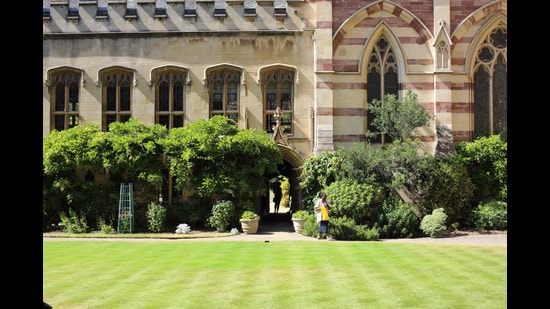
Academia has been the subject and the backdrop of many a satirical literary work. Two novels on this year’s Booker longlist, Black Bag by Luke Kennard and The Vivisectors by Missouri Williams, return to the genre of the campus novel. While Kennard’s satirical take is a commentary on the ongoing technocratic capitalist nightmare that we inhabit, Williams’s gothic campus love story uses a more surrealistic approach. The Vivisectors is set in an unnamed city with a prominent ancient university (it could be Oxford or Cambridge but the reader never knows for sure) where the academics are at war with the gardeners who are very powerful as the city has been entirely overtaken by foliage.
The novel’s narrator-protagonist Agathe, who has had a traumatic childhood (the details of which are shrouded in mystery) chooses to live here with her reclusive uncle after falling out with her parents. Her sparse life includes working for a university professor whom she doesn’t respect but tolerates. On the insistence of her boss, she befriends the mysterious international student Adam, who, in turn, has had a falling out with a star young professor. Told from the old colonial centre of the globe, the frame narrative about the gardeners and Adam’s conflict within it allow the author to make interesting observations about where humanity is headed.
At the beginning, Agathe shares her uncle’s advice that “it was best to use the first person” when you had something negative to write on someone. He says it “was the safest of all forms” because “to mix up the author and their narrator was the most cardinal of literary errors”. At the risk of committing this sin, which sounds both like a warning and an invitation to the reader, this reviewer found many interesting observations on the craft of writing itself that seemed to be more Williams than her narrator protagonist. For instance, Agathe, whose uncle is a renowned literary critic and whose father is a celebrity editor and author, often ruminates over how abysmal contemporary works of literature are a result of the times that we live in. She states that the problem was “that writers were trying to approach a dead world with a lost language”. Apparently, we are now experiencing reality through a digital screen and so, human beings, according to Agathe, “did not speak the language of the word but the language of the image, and the image kept changing”. She also ponders about the language of the city, ostensibly English, often calling it a “hostile language” or a “fallen language”. At many such probing moments, the reader is bound to wonder whether the narrative voice echoes that of Agathe, who is part of the city’s intellectual elite, or of Williams herself.
There are many such commentaries on the worlds of academia and publishing. While sharing her own experience as a student, Agathe notes how she and her batch mates used to make the most of the educational institution’s failing administrative structures. This included making up courses and adding credits from these without any fear of being caught. There is a sense here that every structure meant to uphold any sense of ‘ethics’ in the contemporary world is barely (if at all) surviving.
There are some stand out moments in this surrealist satire on the state of the academic world and on the publishing output of countries from the Anglophone Global North. At one point, in their support of Adam, international students voice the ways in which they feel unsupported by the university. Agathe eavesdrops on a rant by these students, one of whom recounts the song that the festering mould in her room sings. It all makes the reader visualise the material state of the crumbling university and by extension, of a crumbling civilisation.
The novel gets its title from a scene that, for the Indian reader, recalls Chief Justice Surya Kant’s remark comparing this country’s youth to cockroaches. Agathe’s incompetent boss claims the younger generation are like vivisectors who analyse any situation until they have proven “the presence of evil”.
Apart from the overpowering natural imagery that haunts it, what makes Williams’ novel a true romantic gothic tale is the protagonist’s journey towards an understanding and acceptance of love. And perhaps it is love alone, Missouri Williams seems to suggest, that can offer the ultimate escape plan.
Simar Bhasin is a literary critic and research scholar who lives in Delhi.
One Subscription.
Get 360° coverage—from daily headlines
to 100 year archives.
Archives
HT App & Website