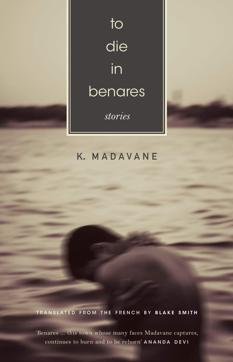
K Madavane’s stories are unlike anything you’ve read in a long time. They recall the supernatural horror of Poe and Angela Carter, the revulsion that rises at the end of The Visitor from Roald Dahl’s Switch Bitch, the sickening sudden lurch towards death in RK Narayan’s The English Teacher, and the impossibility of escape in Somerset Maugham’s Appointment in Samarra. Originally written in French – the book flap says the author went to school at the Lycee Francais de Pondichery – and translated into English by Blake Smith, the seven stories in this slim volume, all somehow connected to the city of Banaras, Benares, Kashi, Varanasi, the eternal gateway to lives and worlds beyond, contemplate Fate, Death, the Inevitable.
The first story, A Paperboat on the Ganges, begins at the Lycee in Pondicherry detailing petty racism in the class room and on playing field. For a rigidly realistic writer, this would have provided enough material. Madavane is interested in deeper truths and the reader becomes conscious of her increasing dread as she’s drawn into Fougerre’s story with its unbearable loss and descent into madness. Fougerre calls to mind the relentless suffering of Job in the Old Testament so it feels logical that the next story, Your Kingdom for a Lie, is about Raja Harishchandra, the legendary king, the plaything of Indra and warring bad-tempered sages, who wouldn’t utter a lie though his honesty leaves him bereft of family and social standing, reduced at last to an outcaste washing bodies in the Ganga before burning them:
All day long, Harishchandra, in the company of these animals, watched the flames devour corpses that split in the heat… His eyes were fixed intensely on these pyres, in which he found a new world dancing before him. A word of tears and flames. It sometimes happened that he thought of his kingdom and his family, which now seemed distant and unreal. Death alone was his final, his only truth.
{{/usCountry}}All day long, Harishchandra, in the company of these animals, watched the flames devour corpses that split in the heat… His eyes were fixed intensely on these pyres, in which he found a new world dancing before him. A word of tears and flames. It sometimes happened that he thought of his kingdom and his family, which now seemed distant and unreal. Death alone was his final, his only truth.
{{/usCountry}}The most authentic writing leads the reader inward, to an examination of beliefs, to an honest confrontation of her own fears. The titular story recalls a long-ago conversation about death rites with a working class Italian. “So you will be burnt after you die?” he asked horrified. Like Kamini in To Die in Benares, you had always assumed your body would be licked clean by flames. The sense of dread in the story, then, rises from the protagonist willing herself to die even as she realizes she has no control over what will be done to her remains.
Madavane’s writing, suffused with the everyday horror of life, is simultaneously poetic and dramatic, and the translator’s note at the end informs the unsurprised reader that he began his career as a scholar of Eugene Ionesco: “Madavane discovered that Ionesco’s apparently absurd works concealed profound meditations on death.”
A keen sense of the absurd lifts A Holy Cow in Varanasi, a wicked piece about a Frenchwoman’s brief visit to the city:
- Did you see what the passersby did after we left? I asked to provoke her.
- No. I didn’t see anything. – Her surprise was sincere, almost adorable.
… - As soon as you were on the other side of the sacred cow some of them rushed to pick up the animal’s droppings with their own hands…
- What? That can’t be. What do they do with it?
-They make cakes.
- Cakes? – Still more horrified.
… - You are probably unaware that we faithfully use these droppings to brush our teeth. We have no interest in your industrial, tooth-destroying products. We rub our teeth vigorously with powder made from these droppings. That’s the secret to our solid, white teeth. Look at mine – aren’t they white? I showed her all my dentistry, molars and all…
Read more: 6 best short and scary stories
While Francoise T is judged for “bursting with Western, Cartesian superiority, mixed with genuine curiosity and barely hidden contempt for other civilizations...” the reader recognizes, with a shock, that she shares the nameless narrator’s withering Hindu scorn and the perverse postcolonial’s urge to torture the once-dominant-other.
In an era when much fiction bears the standardized stamp of writing programs, all eccentricity and individuality erased, K Madavane’s short stories are original, startling, magnificent.