Roopa Pai’s Cubbon Park: The Green Heart of Bengaluru (2022) will appeal to anyone who loves trees, cares about public spaces, worries about gentrification, and enjoys a hyper-local story of citizens rallying around their beloved park.
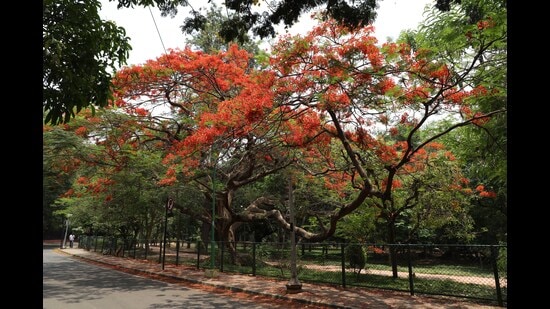
Pai writes, “Cubbon Park is not just a neighbourhood… It’s a universe in and of itself, a consistently large-hearted, always contested, uniquely Bangalorean ecosystem fashioned as much of trees and flowers and insects as of hearts and souls and minds.” Her affectionate prose, dipped in nostalgia, would speak to those who are drawn to the outdoors and are always looking for an excuse to play in the sunshine with the gentle breeze caressing them. Few places can boast of fine weather throughout the year, and Bangalore is one of them.
She waxes eloquent about the “silence and birdsong and dappled shade”. On one occasion, she even calls the park a “green cathedral”. What is so special about this place? After all, it’s just a park, right? If Pai’s enthusiasm sounds excessive, visit Cubbon Park and you will know why it is such a big deal for Bangaloreans. I have lived there for a year, so I can empathize. However, I am less sure about what Pai calls “the intrinsically liberal nature of the native Kannadigas”. Karnataka, like any other state, has people who are hostile to newcomers.
While the official name is Sri Chamarajendra Park, thanks to the 19th century Maharaja of Mysore, most Bangaloreans use the older name – Cubbon Park. Sir Mark Cubbon (1775-1861) came to India at the age of 25 and “proceeded to distinguish himself in both military and civil appointments”. He served as Commissioner of Mysore and Coorg. Read Pai’s book to find out why how this officer from the Isle of Man earned the respect of locals in India, and why they decided to honour his contributions with an equestrian statue cast in bronze.
{{/usCountry}}While the official name is Sri Chamarajendra Park, thanks to the 19th century Maharaja of Mysore, most Bangaloreans use the older name – Cubbon Park. Sir Mark Cubbon (1775-1861) came to India at the age of 25 and “proceeded to distinguish himself in both military and civil appointments”. He served as Commissioner of Mysore and Coorg. Read Pai’s book to find out why how this officer from the Isle of Man earned the respect of locals in India, and why they decided to honour his contributions with an equestrian statue cast in bronze.
{{/usCountry}}Readers interested in the symbolic and functional aspects of built heritage would enjoy Pai’s account of how the physical park – along with the idea of the park – has transformed since 1870 when it was founded. She writes about influential men who have directly or indirectly shaped the park’s history including Kempe Gowda I, Sir Richard Hieram Sankey, Sir Richard Meade, Kumarapuram Seshadri Iyer, Sir M Visvesvaraya, Gustav Hermann Krumbiegel, Otto Koenigsberger, Dr Edward Balfour, Maharaja Nalvadi Krishnaraja, Ganpatrao Mhatre, Sir Mirza Ismail, Sir CV Raman, Dr M Jagadeesh, Mahantesh Murgod, and Rajeev Chawla. There is a woman too – the Maharani of Bahjang, a principality in Nepal – but she remains unnamed in the book. She funded the construction of a “fairy fountain” in Cubbon Park.
It is home to government offices, a public library, an exclusive membership-based club, and a dog park. It has a significant presence in the oral histories of queer and trans people, who used it as a cruising spot for years before the Supreme Court read down Section 377 of the Indian Penal Code. The park is also dear to immigrants looking to belong, the indie music scene and the animal rights movement. At the same time, this place is also associated with crime, drug peddling and commercial sex work in the public imagination. Pai showcases how these varying, and sometimes competing interests, make Cubbon Park what it is for Bangaloreans.
The idea of writing this book was born during a conversation with editor Sudeshna Shome Ghosh. She wanted to commission writing on neighbourhoods rather than cities. Pai, who identifies as a “Bangalorean”, and is the co-founder of a company called Bangalore Walks, zeroed in on Cubbon Park for personal reasons. It reminds her of “the popcorn-and-cotton-candy Sundays” of her childhood; it also happens to be the place where she was “successfully wooed” by the man she married. The park welcomed her when she returned to Bengaluru after years “in other cities and continents”. She used to go there frequently with her children. When they grew up and flew the nest, her “dog-child” began to accompany her.
Pai’s intimate relationship with her material has helped her write a book that is bursting with love. It captures why Cubbon Park is often referred to as a “people’s park”. It brings together the voices of fitness enthusiasts, musicians, activists and lawyers who have fought to protect this space when it has been threatened by exclusionary interests. The same set of facts would have landed differently if they were not suffused with emotion, the joys of community, and a desire to reclaim leisure in “a global technological hub humming with frenetic activity”.
READ MORE: Excerpt: Cubbon Park by Roopa Pai: ‘meeting place, sanctuary and thoroughfare’
The book introduces readers to numerous initiatives that have sprung up thanks to Cubbon Park – a group of environmentalists who carried out an informal census of the flora and fauna in the park, a walkers’ association, a running and breakfast club for gay men, food and health care for stray dogs, pet adoption, a queer-friendly yoga group, nature education initiatives for children, and workshops for artists. However, it does not give readers an opportunity to learn about what the changing nature of this public place means for sex workers, beggars, trans women, and homeless people when the well-off impose their ideas of respectability.
It takes a skilled writer to come up with a non-fiction book that not only provides information but also raises consciousness. It encourages readers to think about disabilities in the context of design, the well-being of non-human species, the role of media in supporting citizen-led campaigns, and the perils of ignoring nature in the rush to designate and design smart cities.
Chintan Girish Modi is a freelance writer, journalist and book reviewer.