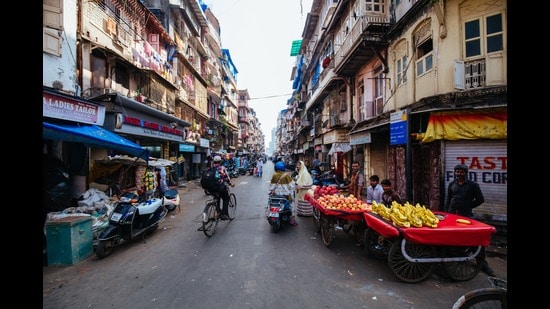
I grew up in Parel, a Mumbai neighbourhood, which, in the 1990s was largely filled with mill workers, wholesale-cloth traders and people in low-rung, fiercely-cherished corporate jobs. Come Christmas, New Persian Bakery down the street would open up its huge, wood-fired ovens, so that local Christians could bake their cakes there for a small fee. Homi, the owner, would assess each pan before it went in. “Mrs D’Costa!” he’d scold my grandmother, “again, your batter is so heavy. The centre won’t cook”. And we’d have to split it across two pans. The bakery also extended the service for Maharashtrian chiroli-topped biscuits at Diwali and Muslim nankhatai at Eid. No one thought twice about an Iranian oven’s role in Hindu, Muslim and Christian festivities. Or that we passed Muttu’s now-viral Rajinikant-dosa stall and a dabeliwala to get to the bakery. It’s just how Bombay rolled.
Flip to the back of Pronoti Datta’s book to see how this cosmopolitanism plays out in her food history of Mumbai. In her acknowledgements, Datta lists people of various faiths, multiple religions. Her eight chapters cover everything, from the fishy stench of the seven islands that the Portuguese handed over to the British in 1661, to why Café Mommy Joon, a five-year old Iranian restaurant doesn’t serve falooda.
This is the third in a series, following food-histories of Kolkata and Delhi. And it’s hard to believe that a book like this hasn’t been attempted before. Mumbai, after all, is serious about its food. As is Datta. She spells the local bread as ‘pao’, not ‘pav’, acknowledging its Portuguese ancestry. She avoids the gushing tone that bloggers and content creators use when they talk food. Instead, there’s a light sense of humour. Datta describes the island of Mahim (one of the original seven) as a curved bacon rasher. I can’t unsee it now.
{{/usCountry}}This is the third in a series, following food-histories of Kolkata and Delhi. And it’s hard to believe that a book like this hasn’t been attempted before. Mumbai, after all, is serious about its food. As is Datta. She spells the local bread as ‘pao’, not ‘pav’, acknowledging its Portuguese ancestry. She avoids the gushing tone that bloggers and content creators use when they talk food. Instead, there’s a light sense of humour. Datta describes the island of Mahim (one of the original seven) as a curved bacon rasher. I can’t unsee it now.
{{/usCountry}}There’s plenty to learn and love here. It turns out that the city’s first respectable hotel wasn’t in the fort but in the then-suburb of Mazagaon. It was possible, in 1839, to sit down to a breakfast of pomfret and rice. Our colonisers ate carpetbag steak and green-turtle bisque in Bombay; Anglo-Indians dined on such delights as Duck Ding Ding and Pish Pash; and at least one restaurateur was arrested for being too generous (to be fair it was 1949, and Bonaveglio, who worked at Churchgate’s Ritz Hotel, was violating post-war ration rules).
There are stories of enterprise and grit. Consider how, when imports were restricted in the 1960s, the Goan head chef at the Taj would mimic the flavour of truffle with walnut and brinjal, and make French sauces not with wine but Sosyo, a fizzy drink. Or how many enterprising young men have left their villages with nothing, worked their way up from dishwashers in Bombay, and built modest restaurant empires. Or how the vada pao rose from workman’s snack to key player in the city’s politics.
Datta charts the backstories of several communities with a historical presence in Mumbai. She points out the fine difference between a Malwani and Mangalorean gassi, and notes that Kolis use white pumpkin only as an offering to the gods. The Konkani Muslims cook fish biryani in layers but never mix it, serving each layer side-by-side in the plate. There is such a thing as a banana-shrimp cake (the Pathare Prabhu dish, mumbra, recipe included) and a banana-egg preparation beloved by Parsis. East Indian kheer, cooked on All Souls Day, is called atole (literally, ‘remembrance’). And unlike Jews elsewhere, the Bene Israeli do not view fish as meat.
One detail pops up over an over: The restaurant owners, home cooks and recipe writers featured in the book are remarkably nonchalant about their cuisine and the history it carries. It’s a shrug-and-get-on-with-it quality that echoes how the city views itself. Datta captures it well.
Where the book flounders is in managing its own ambition. One simply does not know what to do with all the facts. We learn that the Yacht Club may be the only place in the city that serves the Melton Mowbray pie, but aren’t told how that British pork staple fits into the city’s story. We’re told that the Byculla Club was the first physical club, but not what that means. The history of the East Indian Christians goes on for six pages before it gets to the food, with sixish more for Goan Christians. In contrast, the entire chapter on the Sindhis – food and all – wraps up in five. It seems, at times, like a heritage walk you must endure for the snacks at the end.
The language is uneven. I spotted words like compunctions, unctuous, eschewing, simulacrum, gueridon trolley, louche, apotheosis and eidos – in the first 50 pages alone. But Koli masala, essential to the cuisine and not found in stores, is unhelpfully described as “rich and complex”. I don’t know if the plural of Bombay duck, the bombil fish of the title, is duck or ducks. Both appear, at different times, in similar descriptions. And Mumbai diners will be quick to point out that Konkan Café and Thai Pavilion, both beloved restaurants, are not at the Taj Mahal hotel but at a different Taj hotel, the President, two kilometers away.
The bigger errors are of omission. The book makes no mention of Scheduled Caste communities or their cuisines. What do the potters of Dharavi’s Kumbharwada and Ambedkarites eat? And it sidesteps how politics shapes what the city eats: The 2015 beef ban gets a passing mention in the epilogue; the story of how Gujarati Bhatias (already residing in Matunga) opposed a meat market as the neighbourhood was laid out, isn’t developed at all. In the parts about Irani cafes, there’s no mention of Naaz, a favourite from 1944 to the 1990s, or the 60-odd cafes that were vandalised in the 1992-93 riots.
No street food, no history of Mumbai’s markets. We do not know what Mumbai’s Sindhis and Gujaratis cook at home. There’s mention of the city’s few Mangalore stores, but none of the competitive snack empires such as Chheda and Avarya.
Worryingly, the book’s idea of Mumbai doesn’t go as north as Mumbai does. We hear about Matunga’s famous Café Madras founded by Gopal Kamath in 1940, not the family’s other restaurant named after him, running in Malad since 1936. The wonderful thing about Café Irani Chaii isn’t just its Irani-revival vibe, but that its second outpost is in the unlikely suburb of Chembur. Borivali, Kurla and Andheri didn’t spring up overnight, out of nothing. Surely, they have lore worth exploring.
Perhaps Datta might consider a sequel? Homi from New Persian Bakery has passed away. My grandmother has too. But the Mumbai story has more than enough batter for two cakes.