The unique ways in which you introduce your characters — ‘I stalk a woman on the internet who is sleeping with the same man as I am’ or ‘the man I want to be with’ — not only centralise the point that the story of the unnamed protagonist of I’m a Fan can be anyone’s story but also how self-referential neoliberalism had made people. Please tell us your thoughts on the characterisation.
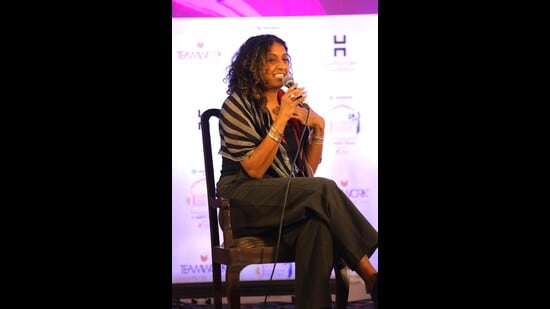
I didn’t really make a choice. When I
The unique ways in which you introduce your characters — ‘I stalk a woman on the internet who is sleeping with the same man as I am’ or ‘the man I want to be with’ — not only centralise the point that the story of the unnamed protagonist of I’m a Fan can be anyone’s story but also how self-referential neoliberalism had made people. Please tell us your thoughts on the characterisation.
I didn’t really make a choice. When I sat down to write, the story just came out like that — that she didn’t have a name, that nobody else had a name, or if they did, they’d be minor characters. You’re right that every character is in relation to her because she’s so powerless. This is her way to exert power: to rename everybody. But it also takes away these people’s agency; they’re never allowed to have their internal worlds. However, I didn’t think of all that while writing the book. I didn’t realise what I was doing. Initially, I felt it might get a bit tiring, mentioning these long names, but it didn’t. And if it did, I didn’t care. All I did was to try to create these new archetypes for the modern world: there’s this influencer you hate-follow but are jealous of, then you want this man who’s powerful yet unattainable. These are all very old images by the way; this totem that has gone through history. The only new thing is the Internet here.
It feels like the protagonist alters herself from one chapter to the next, presenting different viewpoints for the same thing. Then, there are vignettes that give the book a momentum. Did you leverage this sort of structure to propel the story?
What I was doing with each section was to move the truth. For example, in one [chapter], she appears wise, in another she’s a victim but in the next chapter she’s the perpetrator. I wanted to keep the sympathy with her always unstable. So, if I was trying to do something with one chapter, I did the opposite with the next. It’s like in the telly; it’s really a lot like a script. Each scene is built in this way. It’s up to the reader to stitch it together and make up their minds about what’s going on and how they want to feel about these people.
Also, time moves fluidly throughout the novel. There are a lot of flashbacks and flash-forwards. I wanted the reader to be quite active. The same way you’re stitching scenes together while watching something, an activity that seems quite passive. Another thing that I did with this book was that I did away with what books usually have — a lot of exposition and scene-setting, description of the room and what-not. I didn’t want to do all that.
You say that you wanted the truth to move. However, truth gets corrupted by myth-making and misinformation? What then becomes of truth?
It’s too big a question for me to answer. But I think we’ve seen the fracturing of the media with the traditional media collapsing. Now, you’re getting medicinal advice from influences, who say things like ‘They’re NOT going to tell you this …’. It’s a weird way to nudge someone’s behaviour, but we used to have one narrative [earlier] and now we’ve so many of them, we even have narratives underneath narratives. I think each of these is competing for our attention because attention is profit. So, it’s like where your eyes go [on the screen], they make money for someone, so that’s probably where the truth has gone — it has gone into profit maybe.
There’s a double irony to the book: it’s like when you meet an influencer whom you hate-follow but you say, ‘I’m a fan, can I have a picture with you’. Then, there’s this messiness to the unnamed narrator: she is conscious of racism and the erasure of women but she aspires to have the aesthetics of the Insta influencer. She’s critiquing the consumerist culture yet it has a visible impact on her given how she engages in it despite despising it. While creating this character, what sort of dialogues did you have with yourself?
You’re within the system that you hate. And you do the stuff that you do because this is the world we live in. This isn’t an idealised world but you can work towards it. So, in a way, we’re complicit in everything [that’s going wrong]. For example, you raised someone up so high that they ended up hurting somebody else, so you’re complicit in affecting that harm. And fandom became like this image to explore that.
The character is going on about the lifestyle of this woman but she wants it too. The critique in itself looks like she’s trying to ape it, and all this is messy because I wanted it to be. White girls get to be messy; I wanted to be messy too. Also because I find goodness and perfection so boring. I find them so oppressive because they really are related to colonialism, and I wanted to break out of that. I wanted to do away with this clean-and-presentable girl aesthetic. Why should you be pressured to be the best? Then, the claustrophobia of the book is from the pandemic. And there’s this feeling of loneliness too, which is something I lean towards too. So, essentially I did something that other stuff also does, I just made it brown I think.
During your Jaipur Literature Festival session with Ira Mathur, which was moderated by Cauvery Madhavan, there was a discussion on hyphenated identity. Do you grieve the Indian part of your identity given that you perhaps had no connection with it until now?
I’ve never really given any thought to India to be honest before [this trip]. It just didn’t exist for me in a way. I had no connection to it. Nor did I want to know about it. For me, it was like, I’m British, and that’s how I’ve always thought of myself and my brownness in relation to whiteness. Before coming here, I was very scared because I was coming all by myself and have no family here, but I have this sort of family through literature and books.
I’m a Fan was longlisted for the 2023 Women’s Prize for Fiction, shortlisted for the Dylan Thomas Prize, and won the British Book Awards: Discover Book of the Year. Your thoughts on the recognition you’ve received.
I would have obviously preferred to win one of the literary ones because that would have been much nicer. It was incredible to be in the room with all of the UK publishing industry for someone like me, who wrote in her bedroom never thinking she’d ever be there. So that was amazing. I’m not kicking dust in that, but really it felt like I got the Brown Award; it felt a bit tokenistic, though I was very happy to win it.
It’s a weird thing to be within the system of a thing that you’ve called out in a book, but it was worth it. This book completely changed my life. And I’m grateful for it.
Working with Nina [Hervé] and Will [Burns] at Rough Trade Books was a project in art and friendship. It’s meaningful to me. And, you know, this book could’ve won no prizes at all but it’s the best book I could’ve put out, so I stood fully behind it. I took the most amount of risks in the things that I wanted to say. I was absolutely terrified of it coming out. I risked something deep and dark and serious in publishing it. And so did Nina and Will. I did feel like I pushed what was acceptable to say. But when I see books coming out that have the same design as that of my hardback, I see a richer legacy to the book. Wherever I go in the UK, that’s how I’m introduced now: ‘She wrote I’m a Fan’. It’s incredible; the book steadied my life. And I feel that happened because it was important for me to create a space for something darker and a bit less forgivable within the stories that we tell.
Saurabh Sharma is a Delhi-based writer and freelance journalist. They can be found on Instagram/X: @writerly_life.
One Subscription.
Get 360° coverage—from daily headlines
to 100 year archives.
Archives
HT App & Website