
 E-Paper



‘The Sea Captain’s Wife’ Review: When She Took Charge
On Sept. 5, 1856, Mary Ann Patten became the first woman to captain a merchant clipper. She’d have a storm to contend with.


 Prefer HTon Google


Mary Ann Patten is 19—petite, pretty and pregnant—when her husband, the captain of Neptune’s Car, the clipper ship she’s on, is struck down by disease and delirium from the tuberculosis that will ultimately kill him. The year is 1856 and they’re near Cape Horn, the most dangerous passage on earth. Below decks, in irons, is a violent thug of a first mate who is bent on instigating a mutiny. If this were fiction, throwing in a hurricane now would be a little over the edge. But this isn’t fiction, so cue the 50-foot waves and 60-knot winds of “an 18-day howler.” Patten knows that Mr. Keeler, the first mate, will likely kill the couple if the mutiny succeeds. She also knows celestial navigation and how to plot a course. The decisive moment is now. She calls an all-hands meeting on deck and tucks a pistol into her oilskins.
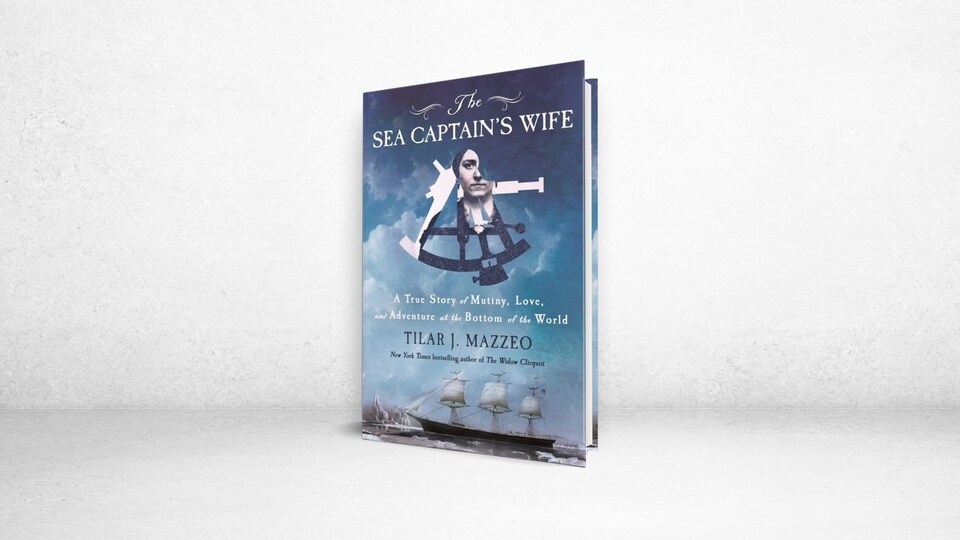
On deck, she reminds the crew that the captain, who may yet recover, ordered Mr. Keeler restrained. She lists the many infractions the first mate committed and defies any among them to countermand her husband’s orders. She asks the crew to accept her as captain and leaves them to make their decision. But before she has taken more than a few steps, a “crack split the air and then a cry.” It is the crew, applauding amid shouts of “Captain Patten.” As Tilar Mazzeo tells us in “The Sea Captain’s Wife” (St. Martin’s, 288 pages, $30), the younger seamen will later recount “how the old salts among them had tears in their eyes.” On Sept. 5, 1856, Mary Ann Patten becomes the first woman in history to captain a merchant clipper.
Clippers were the fastest, most complex and most beautiful wooden sailing vessels the world had ever seen, designed for speed and speed alone. It’s almost impossible today to comprehend how such ships seized the popular imagination during the vessels’ heyday, which began in 1848, lasted scarcely a decade and vanished as completely as the Great Auk.
In Boston, more than a third of the city’s population—50,000 cheering people—turned out in 1853 for the launch of the 400-foot Great Republic. The captains of such ships were the rock stars of their day, consummate seamen who risked their lives on the open oceans for wealth and fame. Transporting passengers to the gold fields of California and racing to get the first spring tea from China to New York and London drove the rise of extreme clippers. “When it had to be there and fast,” Ms. Mazzeo writes, “it had to be clipper.”
One Massachusetts captain, having smashed the New York-to-Liverpool record with a time of 13 days, arrives to find that no pilot boat would brave the fog to guide him into the harbor. In a feat that would become an instant legend, the captain blithely sails the ship into dock, then backs her into her berth while still under sail. In addition to preternatural skill, you need icewater in your veins to do that.
Ms. Mazzeo is the kind of accomplished literary figure who makes you wish you’d paid better attention in school. She is author of six other books of nonfiction, a professor of literary and cultural history who has taught at multiple universities, and an internationally recognized wine writer and a winemaker. The difficulty a reader faces in “The Sea Captain’s Wife” is that it takes half the book to get to the action. Ms. Mazzeo alternates between the macro and micro, now giving us detailed genealogies, now discussing the shipbuilding industry and the place of women in 19th-century society. There are important insights here—such as how easily a woman with postpartum pre-eclampsia might have been involuntarily committed to a lunatic asylum at the time, or how the average New England mother in 1830 would bear six children, two of whom would die before the age of 5—but it’s not enough to keep the ship moving forward. Readers may find themselves skipping ahead to get to the action, which is undeniably one of the greatest stories of a bygone era.
Part of that action is Patten’s realization that the sailor’s standard storm tactics—including reefing, heaving-to and lying a-hull—will not work in such an intense blow. When navigation is impossible, the only hope, Ms. Mazzeo tells us, is to try to “follow the curve of the wind out of the storm system and abandon any idea that you are in charge of where nature will take you.”
As the storm that threatened Neptune’s Car raged on, this is what Patten did. The ship is blown southeast, toward Antarctica and its ice fields. For three sleepless days, they inch along past icebergs 200 feet high, knowing that any collision will sink the ship. At last, the ice fields end and the winds abate. Two months later, on Nov. 15, 1856, Neptune’s Car, gleaming and shipshape, enters the harbor of San Francisco.
Maintaining a ship requires constant work, and the vessel’s appearance would have signaled the close partnership between a skilled, respected captain and a proud crew. In short order, the story of Mary Ann Patten becomes a sensation in San Francisco, then in New York, then internationally. She quickly becomes a household word, a symbol of something quintessentially American. “It is difficult to overstate,” Ms. Mazzeo writes, “the fame of Mary Ann Patten in the late 1850s and into the 1860s.” Nearly two centuries afterward, the U.S. Merchant Marine Academy still teaches cadets the story of Mary Ann Patten taking a clipper ship around Cape Horn.
Mr. Heavey is the editor at large of Field & Stream magazine.


