Fifteen years after Katniss Everdeen walked out of the arena, readers are still walking back into Panem.
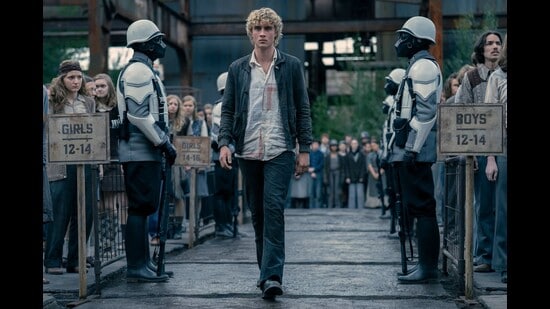
When Sunrise on the Reaping, Suzanne Collins’s latest return to her dystopian world, arrived in March 2025, it became the fastest selling book in the series. More than 4.4 million copies sold within months, and were followed with illustrated editions, collector’s editions, and boxed sets. This November, Haymitch Abernathy’s story reaches the big screen, the sixth film in a franchise that has
Fifteen years after Katniss Everdeen walked out of the arena, readers are still walking back into Panem.
When Sunrise on the Reaping, Suzanne Collins’s latest return to her dystopian world, arrived in March 2025, it became the fastest selling book in the series. More than 4.4 million copies sold within months, and were followed with illustrated editions, collector’s editions, and boxed sets. This November, Haymitch Abernathy’s story reaches the big screen, the sixth film in a franchise that has already grossed more than $3.4 billion worldwide.
Most blockbuster series end up becoming a part of nostalgia. Panem hasn’t. It continues to attract new readers even as those who first met Katniss in 2008 return to the books. Not because Collins’ imagined future seems closer than ever before, but because the questions she asked feel even more relevant now.
“I don’t write about adolescents,” Collins said in an early interview. “I write about war for adolescents.”
That explains why The Hunger Games has outlived the wave of dystopian fiction it inspired. Collins wasn’t building an escapist fantasy; she was exploring how societies normalise violence – and who pays the price.
Katniss Everdeen’s story wasn’t just about survival or romance. The arena gave Collins a way to write about power, propaganda, inequality, and the uneasy relationship between violence and entertainment.
The idea came from a singular moment. In a video interview for her publisher, Scholastic, Collins recalled channel-surfing late one night, moving between reality television and footage from the Iraq War. The two streams of images began to blur and led to the idea of Panem, a country where state violence wasn’t simply exercised; it was packaged, televised, and consumed.
That premise felt chilling in 2008. Today, it feels uncomfortably familiar. For her stories reiterate what we have always known: whoever controls attention often shapes the story.
Late in the trilogy, Plutarch Heavensbee finally explains to Katniss where her country’s name comes from. It is derived from the Latin phrase panem et circenses (bread and circuses). Coined by the Roman satirist Juvenal, it described rulers who kept citizens content with food and spectacle while political power quietly concentrated elsewhere.
Collins built an entire political system around the literary reference.
The Capitol keeps the districts alive, but barely. Food is a bargaining chip. Children are forced to put their names into the annual reaping additional times in exchange for grain and oil. The Hunger Games, meanwhile, turn punishment into entertainment. Capitol citizens choose favourite tributes, place bets, celebrate victors, and eagerly await the next spectacle, without questioning a system that demands children kill one another for the nation’s amusement.
Not surprises that for panem et circenses, full bellies, and entertainment, people give up political responsibilities -- and therefore their power.
War never really ends
Every new book in the series looks at the same world from a different angle, raising a fresh set of questions about power, violence, and their aftermath.
The Ballad of Songbirds and Snakes, released in 2020, spotlighted a young Coriolanus Snow, exploring how fear, ambition and compromise turned to authoritarian rule. “If history teaches you anything, it’s how to make the unwilling comply,” he says.
Sunrise on the Reaping put the focus on Haymitch Abernathy, the weary mentor we first met in District 12, long before drink became his refuge and sarcasm his armour. Readers know the man Haymitch is; Collins reveals how he becomes who he is. Why he says: “Nobody ever wins the games, period. There are only survivors.”
His story isn’t simply another Hunger Games. It’s about the damage the Hunger Games leave behind. The arena may crown a victor, but nobody really walks away untouched. That has always been one of Collins’ major concerns. She’s less interested in the battle; more in the scars it leaves on the people who survive.
In a 2013 interview with Time, Collins described the trilogy as an exploration of war’s recurring nature. The first arena, she said, resembles a gladiatorial contest. By the second book, it becomes the one place where every district is watching together, allowing rebellion to take shape in full view of the nation. In Mockingjay, the Capitol itself becomes another arena. The setting changes, but violence persists.
“It’s cyclical. It’s that cycle of violence that seems impossible for us to break out of,” Collins said.
Much has changed since The Hunger Games was published in 2008. Our relationship with information has transformed. Wars are streamed in real time. Politicians broadcast directly to millions. Algorithms decide what we see and, just as importantly, what we don’t. A humanitarian crisis, a celebrity controversy, and a viral dance trend often compete for space on the same screen.
Collins didn’t predict this world; she recognised a pattern that predates smartphones and social media. Panem owes as much to ancient Rome as it does to reality TV. The gladiatorial contests, the Capitol’s concentration of wealth and power, the poor districts – they all point to a world that we have lived in.
For a generation raised on livestreams, creators, influencers and more, Katniss’ struggle feels surprisingly contemporary. She isn’t just trying to stay alive; she’s also learning how to be watched. In her world, every act is part of a larger narrative. Every decision is interpreted. Sympathy brings sponsors; visibility can mean survival.
But Collins never lets the spectacle overshadow the people at its centre. Despite the inhuman world she’s part of, Katniss repeatedly refuses to let go of what makes her human. She volunteers for Prim, honours Rue, and constantly chooses compassion in a world designed to reward cruelty. And she’s right when she says: “No one will forget me. Not my look, not my name. Katniss. The girl who was on fire.”
Why has the Hunger Games endured when so many of its contemporaries have not? Perhaps because Collins was never trying to write the future. She was writing about power and war. About the stories governments tell, the stories people choose to believe, and the dangerous comfort of confusing spectacle with truth.
When Sunrise on the Reaping reaches cinemas this November, audiences will return to familiar districts and characters, and another brutal arena. But the real draw of Panem, especially in today’s world, is that it brings up questions that refuse to stay on the page.
Teja Lele is an independent editor and writes on books, travel and lifestyle.
One Subscription.
Get 360° coverage—from daily headlines
to 100 year archives.
Archives
HT App & Website