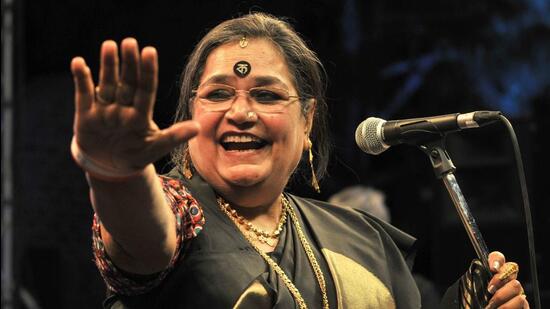
Usha Uthup’s very existence is a slap on the face of both misogyny and ageism. The 78-year-old singer, whose roaring voice combines sensuality with playfulness, had audiences at The Sacred Amritsar struggling to keep up with her energy. At this festival of culture and heritage held from February 20-22, she belted out her most iconic numbers including Hari Om Hari, Ramba Ho, Koi Yahan Aha Nache Nache, Dum Maro Dum, Doston Se Pyaar Kiya, and Darling and had people of all ages dancing to her tunes.
Minutes after she got off the stage, and eased into a conversation with me in the green room, she broke into a children’s rhyme: “My name is Madhavi, I am from Alleppey / I speak Malayalam, but I am just like you.” These are the opening lines of Just Like You, probably the most popular song from the Karadi Rhymes series written by Shobha Viswanath, and set to music by the band 3 Brothers & A Violin. When I had mentioned how much I loved those rhymes, I hadn’t expected the Padma Bhushan awardee, loved by adults and children, to sing one for me!
“I loved making up songs for my grandchildren,” she said, “but through the nursery rhymes, I was able to reach kids all over the world.” It is a lively song, meant for children barely old enough to read. Karadi Tales, the publisher that commissioned it, specializes in audio books. The Karadi Rhymes series was born out of a conviction held by Shobha Viswanath, its publishing director and co-founder, that Indian children deserve rhymes that are rooted in their own world.
“Schools were still singing Jack and Jill and Humpty Dumpty,” said Shobha, over a WhatsApp voice note. “It bore no context to our own childhoods. We did not want to simply reproduce the colonial-era rhyme culture. We wanted an Indian idiom, sensibility, rhythm and contexts.” All the rhymes are rooted in Indian soundscapes, accents, humour and daily life. There are songs about mangoes, cricket, monsoons, kites, auto-rickshaws and wedding feasts.
{{/usCountry}}“Schools were still singing Jack and Jill and Humpty Dumpty,” said Shobha, over a WhatsApp voice note. “It bore no context to our own childhoods. We did not want to simply reproduce the colonial-era rhyme culture. We wanted an Indian idiom, sensibility, rhythm and contexts.” All the rhymes are rooted in Indian soundscapes, accents, humour and daily life. There are songs about mangoes, cricket, monsoons, kites, auto-rickshaws and wedding feasts.
{{/usCountry}}The series needed the right voice. “We were looking for a female voice with clarity, warmth and musicality,” recalled Shobha. “We needed someone who could both speak and sing beautifully in English. There is really no one quite like Usha Uthup.” What clinched it, beyond her magnificent voice, was something few people might know. Shobha said, “Usha began her career as a kindergarten teacher. Her experience with young children gave her narration that rare instinct which comes with being a teacher. She understands how children listen and respond.”
Usha’s connection with the world of children is innocent, mischievous, and far deeper than most people realise. In recent years, she has become the subject of two picture book biographies for young readers anchored in a defining moment from the singer’s childhood. As a young girl, Usha was rejected from her school choir. Her music teacher claimed that her voice was too loud, hoarse and unconventional. This moment could have broken her spirit. But she was a fighter.
In Mamta Nainy’s book That Big-Voiced Girl, illustrated by Asuma Noor and published by Puffin Books, little Usha’s face turns pale and tears roll down her cheeks. She skips lunch, and sulks. Her mother tells her, “Why do you want to fit in when you can stand out? You’ve got a voice like none other.” Her sisters take her to Radio Ceylon, where she sings for a radio show.
Pearl D’Silva’s book, Rockstar in a Sari, illustrated by Vasundhara Arora and published by Jugnoo Prakashan — an imprint of Ektara Trust — treats the moment of rejection differently. Usha speaks directly to the reader, saying, “Did I let that squash my dream of doing what I loved most? No. I stuck out my chin and continued doing just that, singing wherever I could.”
Together, the two books offer a powerful portrait of a legend as she is rarely seen: as a child who was cast out for being a misfit but chose not to dim her own light. That evening, in Amritsar, Usha told me, “I always tell children to never give up, to follow their dreams, just like I did.”
Sohini Mitra, Publisher (Children’s Books), Penguin Random House India, loves That Big-Voiced Girl because it does not adopt a reverential tone. “What stands out for me is that it doesn’t position its subject as extraordinary from the start,” she said, over email. “It shows a child — unsure, curious, sometimes dismissed — who slowly grows into her voice.”
She felt that the idea of embracing oneself unapologetically would resonate with young readers negotiating “societal gaze, pressure and judgement”. The book belongs to the Magic Makers series, which “reframes biography as possibility.” She added, “These books aren’t saying, ‘Look how great this person was.’ They’re saying, ‘Look what is possible when you keep going.’”
Usha said that she too was once an avid young booklover. “As a child, I enjoyed Enid Blyton but I read more comics than anything else: Little Lulu, Archies, Donald Duck, Uncle Scrooge,” she said. A glimmer of this little Usha was seen in her childlike hunger for adulation, which came across as unpretentious and endearing. When she found her listeners low on energy, she instructed them to put their hands together. “Aapki har taali mere liye aashirwaad hoti hai (Every clap of yours is like a blessing for me),” she told them.
Working on That Big-Voiced Girl felt personally meaningful to Mamta Nainy. “I wanted to write about someone who had shaped my own childhood imagination but may not occupy the same cultural space for children today,” she mentioned, over email. Usha’s voice, “and the comfort she seemed to have in her own skin,” made a strong impression on Nainy. She wanted children to approach the book as “a doorway” into Usha’s life rather than a comprehensive account.
Usha’s rejection from the choir became a conversation starter about “the cost of not fitting in and the courage it takes to persist anyway.” The book does not put Usha on a pedestal but it emphasizes that “you don’t have to shrink yourself to fit someone else’s idea of excellence.”
For Pearl D’Silva, writing Rockstar in a Sari was a humbling experience. She wanted to recreate the experience of attending one of Usha’s concerts,” she shared over email, recalling an electrifying performance that she witnessed at Bandstand in Mumbai several years ago.
Usha’s career is “synonymous with resilience — from her mastery of jazz and soul to her prolific playback singing in dozens of languages,” she pointed out. “I want children to realize that their own natural voice is a gift, and like Usha’s, it has the power to change the world.” The book celebrates the fact that Usha has sung in 15 Indian and eight foreign languages.
Like the authors, the illustrators too made equally distinct choices. Vasundhara Arora, the illustrator of Rockstar in a Sari, chose poster colours and gouache because “the pigments speak very directly, and there’s no confusion, no diplomacy.” She added, “They always retain a certain opacity that felt aligned with her boldness and firmness.” She decided to use colour pencils in spreads where Usha is figuring things out for herself, such as the scene where she cuts out bits from her Kanjeevaram sari and glues them onto her sneakers to embrace her idiosyncratic style.
Asuma Noor, who illustrated That Big-Voiced Girl, went ahead with a palette that uses pastels and subtle shades — not what you might expect for a subject as vivid as Usha. “Keeping the colours softer allowed the focus to remain on her expressions and physical presence, which are the real carriers of her energy in the book,” Asuma explained. She was most interested in body language: “the lift of her chin, the openness of her arms, the sparkle in her eyes.” The gajras adorning Usha’s hair complete the look.
Both books arrive at the same understanding: that Usha’s story is about a refusal to be cowed down by naysayers, and about having the gumption to wear one’s uniqueness with pride and script one’s own creative destiny.
In a world that expects children to fall in line, Usha’s advocacy for gentle rebellion is much needed. I left her with a packet of pinni prashad that I picked up at the Golden Temple. It was a mix of roasted wheat flour, ghee, sugar and nuts. She placed it on her forehead, and closed her eyes.
Chintan Girish Modi is a journalist writing about books, music, art and films. He previously worked on educational outreach using folk music at The Kabir Project, and has contributed to anthologies such as 101 Indian Children’s Books We Love (2013), Borderlines: Volume 1 (2015), Clear Hold Build (2019), Fearless Love (2019), and Bent Book (2020).