
 E-Paper



Review: The Garden of Tales by Vijaydan Detha, translated by Vishes Kothari
Love, wisdom and folly, deceit, and the lust for power are the themes explored in this collection of Vijaydan Detha’s stories featuring saints, sinners, insecure deities, friendly ghosts and chatty animals

 Prefer HTon Google


In his opening note to the book, Vishes Kothari reflects on the five years he spent translating Vijaydan Detha’s stories, writing that his time in the author’s universe was “full of whimsy, déjà vu, and delight”. That’s the feel-good vibe most readers will get as they traverse through this masterfully translated collection of Rajasthani folklore.

Noted writer of Rajasthani prose, Detha (1926-2013), fondly known as Bijji, was deeply saddened when his mother tongue Rajasthani was left out of the Constitution’s 8th Schedule. Taking a cue from his gurus, Anton Chekhov, Sarat Chandra Chatterjee and Rabindranath Tagore, who wrote in their mother tongue, Bijji decided to write in his mother tongue and preserve the magic of Rajathani folklore.

It was a radical choice for his time, writes Kothari, who himself takes a keen interest in preserving the folk and oral traditions of the region. “I share Bijji’s belief in the right of the people of Rajasthan to have their officially recognised language, and the act of translation thus also became an act of assertion,” he adds.
Bijji’s quirky stories in this collection feature potters and cowherds, saints and sinners, insecure gods and goddesses, friendly ghosts and chatty animals. Though these earthly and cosmic folk tales are as old as time, the themes are contemporary. Love and desire, innocence and cunning, wisdom and folly, greed and deceit, and the lust for power.
A notorious thief who swears to never lie again (The Truthful Thief), a coy bride who cannot resist the charms of a traveller (Lajwanti), and beautiful women trapped in a palace in the clouds (Aasmaan Jogi) all find a place in this collection of 18 short stories, a couple of which (The Dove and the King and Only I Can Say No) are only about two pages long.
These stories successfully capture the socio-cultural milieu of Rajasthani society and are a commentary on gender, power and hierarchy. To quote Kothari, “This world is set in timescales that are immediate and yet eternal, and in spaces that are limited to the village and the lake just outside but at the same time cosmic.”
The book opens with New Birth, a story of intense greed that is the only one with a modern-day setting. The narrator, a writer, misses his bus and seeks cover from a rainstorm, when he overhears a Baba telling the story of a greedy potter couple. The potter couple’s inadvertent journey from being the most magnanimous and honest couple in their village to becoming the pillars of greed sets the tone for this incredible selection of folklore.
Aasmaan Jogi’s abduction of beautiful women in his invisible vimaan (chariot) and then their caging in his Cloud Palace, which has pillars of flowers, a floor of saffron encrusted with diamonds and pearls, ceilings of kumkum decorated with rubies, golden beds, and golden doors, may sound incredulous. However, it is difficult to disengage from this engrossing tale and not feel outraged at the cunning Aasmaan Jogi.
The longest story in the collection, Double Lives, is a magical fable about two women in an arranged marriage with each other. Beeja and Teeja are unwilling to give up on each other when the village discovers the truth about their genders. Declared outcastes, they are harboured by friendly ghosts. Even as they lead a happy and content life, Beeja decides to turn into a man to conform to society’s norms. However, in just a day of Beeja becoming a man, he unleashes his manhood on Teeja. “Then, dragging her by the hair, her husband yelled, ‘I am not made of such stuff that I’ll care for the whims of my woman!”
Detha’s deeply layered writing is powerful and his favourite weapon is sarcasm, which is especially evident in Double Lives in which Beeja eventually gives up his manhood. From then on “20 miles this way and 12 miles that, for 24 miles around, not even the shadow of a man would dare to approach (Beeja and Teeja)!”
The author is adept at exploring social hierarchies and the politics of gender in the 800 stories to his credit. In Aasmaan Jogi, spurned by his beautiful women captives, Aasmaan Jogi thinks to himself: “Pigs and women have the same nature… as pigs can be taught, so can women. If I had waited for them to smile and make love, I would have suffered all my life! Now, I like weeping, wailing, morose and suffering women.”
Women, especially, find a voice in Detha’s writing. In stories like The Creed of Crows, the author turns moral judgements on their heads. Here is how the rules of the flesh trade are explained to the protagonist: “All the women in this world have the very same fate – to be cheated by men, and then to spend their lives paying for this thuggery! No woman has been saved by this destiny.”
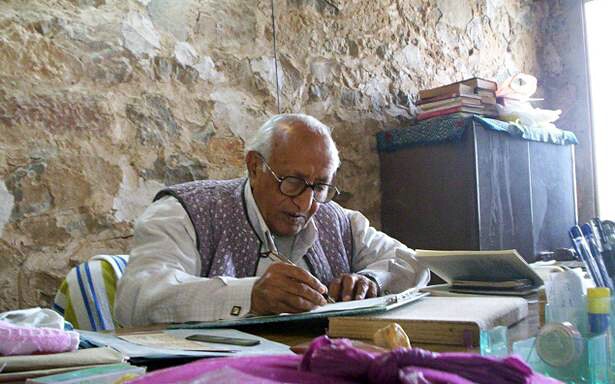
A recipient of the Padma Shri, Sahitya Akademi Award and Sahitya Chudamani Awards, Detha was nominated for the Nobel Prize in Literature in 2011. A member of the Charan caste, a community of bards that was primarily patronised by royal courts and feudal lords, Detha’s grandfather was a well-known poet. Kothari informs the reader that though Bijji was conscious of his literary inheritance, he rebelled against the traditions of his caste.
Considered the “Shakespeare of Rajasthan”, Detha’s stories have been staged as plays and made into movies. Paheli, a story about a ghost falling in love with a newly married woman, was made into a film starring Shah Rukh Khan and Rani Mukherji while Charandas Chor became part of dramatist Habib Tanvir’s repertoire and was also later made into a movie.
In works steeped in a culture, the translator’s role is especially significant. “I felt it my duty to communicate... the unique quirks and cadences of the language, its sounds and rhythms,” Kothari writes in his introductory note. It would be fair to say that his translation is as effortless as Bijji’s writing.
Lamat R Hasan is an independent journalist. She lives in New Delhi.


