Some books leave you open-mouthed. Amit Pasricha’s India at Home is one of them. Shot over eight years, it features pictures of people from across the country ensconced in their homes. From grand nawabi palaces to rural homesteads to lavishly decorated tribal houses, ostentatious Chhattarpur farmhouses and minimalist apartments, the book presents incredibly rich snapshots of life in early 21st century India.
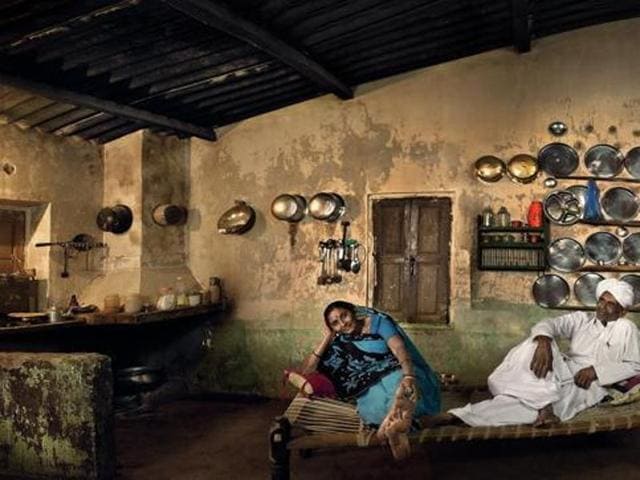
“It’s a cosmos inside everyone’s home. We’ve got objects that we’re attached to, objects that have come down from generations,” says Pasricha, who was driven by the documentarian’s urge to capture evanescence.
“Everyone’s moving forward; everyone’s seen a saas-bahu set; everyone’s wanting to suddenly come up to speed into modern living… So a lot of things are changing,” he says. “Several of these homes are no more; several have changed dramatically. People tire of their homes also, and their economics is constantly in flux… People are migrating. With rural-urban migration, what happens to those homes? They are locked up or destroyed,” he says adding that the aim was to find homes that told a part of a larger story.
Read more: The Monumental India Book
{{/usCountry}}Read more: The Monumental India Book
{{/usCountry}}So each picture segues into the next: Kunwar Lav Bhargava’s colonial mansion in Lucknow, with its stuffed tigers shot by an ancestor, is followed by one of a uniformed Jija Hari Singh, former Director General of Police, Karnataka, complete with gun in her living room with faux animal skin sofa throws. The next image features Sushma Iyengar and Sandeep Virmani’s sustainable house in Bhuj, Kutch, with its many live gamboling cats. The reader follows the multiple threads in these pictures and emerges with fresh insights into contemporary India.
The nation is Pasricha’s favourite subject and he returns to it compulsively. His earlier books, The Monumental India Book and The Sacred India book can both be viewed as part of his ongoing exploration of the country. And like all committed photographers he has a neurotic need to hold on to the minutiae, to capture multiple stories within a frame. As a panoramist, he stuffs in even more information into his pictures so that the viewer is drawn into the lives in the portraits, even arriving at an imagined understanding of their relationships with each other and the depth of their feeling for their living space.
You are particularly taken by Kalka Bhura’s wonderful circular Meghwal Bhunga house with its pile of exquisite handmade rugs piled atop clay cupboards. The sense of wonder is immediately followed by the troubling thought that, in a world moving towards homogeneity and a global culture, such structures will inevitably be relegated to museums. The thought has struck Pasricha too. “It’s a world that’s disappearing and as a documentative photographer I’m thinking, ‘What a world we’re sitting on and not documenting! The start of 21st century living!’”
He then moves to the larger idea of the essential futility of the attempt to grab the moment and the photographer’s need to click on nevertheless. “These 10 years I’m documenting constitute just a speck in an ocean of continuous living,” he says. Amit Pasricha’s India at Home is, in a sense, a heroic attempt to seize quicksilver Time, to freeze the moment so we can look back in wonder. It is this impulse that makes these pictures so appealing. It is what will make them endure.