A fortnight ago, in solidarity with a recently married friend who was getting grief from her in-laws about not changing her last name to that of her husband's, I tweeted, "If a woman chooses to retain the surname she was born with, it is her choice surely? Why should anyone else get their knickers in a twist?"
It is a testament to our highly politicised times that most people chose to read this as a 'spirited defence' of Priyanka's decision to be known as 'Gandhi' rather than 'Vadra'.
This was such a bizarre extrapolation that I didn't quite know how to respond. First off, Priyanka Gandhi (or Vadra, if you will) was nowhere on my inner radar when I wrote this. I was purely motivated by the irritation of my friend who didn't quite know how to get her in-laws off her back; and by my annoyance that in the 21st century, such an absurd demand was being made of a woman. And then there was that other minor detail: that Priyanka Gandhi had, in fact, embraced the surname Vadra as her own from the moment she got married.
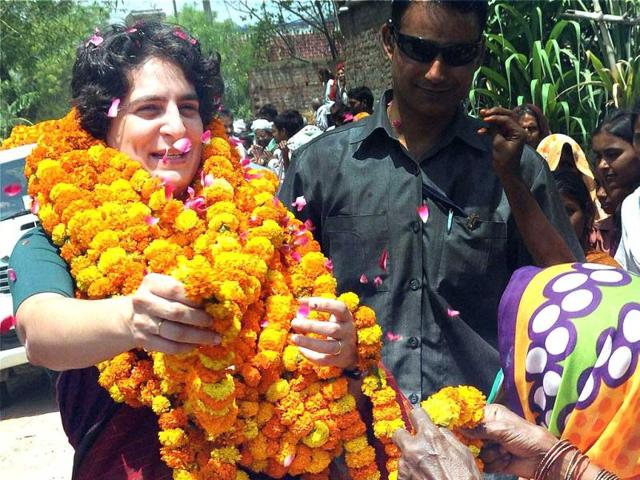
I was a witness to that at a diplomatic reception held soon after. Introduced to an American diplomat as 'Priyanka Gandhi' she shook her head firmly and said, "It's Priyanka Vadra now." And that's how she has chosen to style herself ever since. Which is why I have been mystified by the fact that Smriti Irani has been getting flak about addressing Priyanka as "Mrs Vadra" during her campaign in Amethi. Irani may well be doing it to make a political point, but my guess is Priyanka doesn't regard being called by her married name as some sort of mortal insult.
But the kind of responses that my tweet elicited got me thinking about the politics of changing surnames after marriage. On the whole, women from famous political families don't tend to do that. Benazir Bhutto may have tagged on Zardari after her name but she would always be known by the name of her famous father. The Aung San in Suu Kyi's name comes from her father; the Burmese leader has never been known as Mrs Aris (after her English husband, Michael). Chelsea Clinton is still known as 'Clinton' rather than by her married name of 'Mezvinsky'.
And no matter how many times Priyanka may say she is 'Mrs Vadra', the only people who refuse to address her as 'Gandhi' are her political rivals.
But even outside of the sphere of politics, the politics of name-changing rules. Adopt your husband's surname when you get married and the feminist brigade looks down upon you as a traitor to their cause. Keep the surname you were born with and the traditionalists frown upon your choice. (Both Hillary Rodham and Cherie Booth were forced by the demands of electoral politics in USA and the UK to restyle themselves as Hillary Clinton and Cherie Blair.) If your birth surname is a famous one (like Bhutto or Gandhi, for instance) you are accused of trading on your lineage. If your husband's last name is more famous than yours (Murdoch rather than Deng) then your name change is put down to opportunism.
No matter what choice you make, which name you adopt, or which one you keep, there will always be someone on the sidelines cribbing about it, and sidling up to you to tell why you have got it completely wrong.
Actually, now that I think about it, that's a pretty darn perfect metaphor for being a woman, isn't it? There is always a ready supply of people to tell you how you should be living your life: when you should get married; at what age you should have children; how long you must breast feed them; how to best balance work and family; how to please your husband; how to keep the in-laws happy; and so on.
The only way to retain your sanity in the midst of this avalanche of (often contradictory) advice is to let it wash over you, and then go ahead and do exactly as you please. And that applies to name changes as well. Stick with your maiden name if that's what works for you. Take your husband's surname if that feels right to you. Add his surname on to yours to make a double-barrelled name of your own. Call yourself Bananahammock if you like.
Work with whatever works for you. I don't think retaining your birth surname is the equivalent of making some sort of feminist statement. Equally, I don't think taking on your husband's last name is a blow to the feminist cause. Either way you are adopting a man's name as your own: either your father's or your husband's. But what you need to remember is this: no matter which name she goes under, at the end of the day, it is the woman who matters.
From HT Brunch, May 18
Follow us on twitter.com/HTBrunch
Connect with us on facebook.com/hindustantimesbrunch
No matter what choice you make, which name you adopt, or which one you keep, there will always be someone on the sidelines cribbing about it, and sidling up to you to tell why you have got it completely wrong.
Actually, now that I think about it, that's a pretty darn perfect metaphor for being a woman, isn't it? There is always a ready supply of people to tell you how you should be living your life: when you should get married; at what age you should have children; how long you must breast feed them; how to best balance work and family; how to please your husband; how to keep the in-laws happy; and so on.
The only way to retain your sanity in the midst of this avalanche of (often contradictory) advice is to let it wash over you, and then go ahead and do exactly as you please. And that applies to name changes as well. Stick with your maiden name if that's what works for you. Take your husband's surname if that feels right to you. Add his surname on to yours to make a double-barrelled name of your own. Call yourself Bananahammock if you like.
Work with whatever works for you. I don't think retaining your birth surname is the equivalent of making some sort of feminist statement. Equally, I don't think taking on your husband's last name is a blow to the feminist cause. Either way you are adopting a man's name as your own: either your father's or your husband's. But what you need to remember is this: no matter which name she goes under, at the end of the day, it is the woman who matters.
From HT Brunch, May 18
Follow us on twitter.com/HTBrunch
Connect with us on facebook.com/hindustantimesbrunch