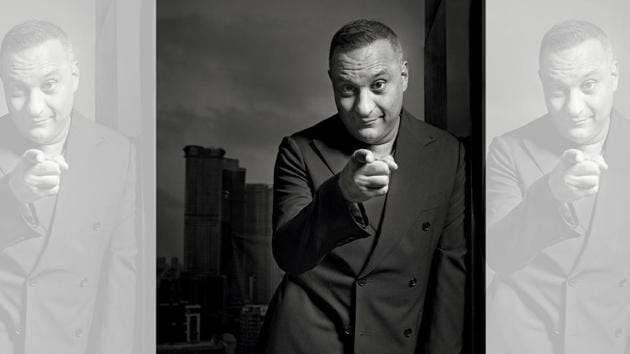
I must confess, I have an uneasy relationship with stand-up comedians. You will never find me at those stand-up nights. Don’t get me wrong – I am not a laughter atheist. Like cat videos and baby videos, I can watch stand-up comedy all day on TV or YouTube. But I have proximity issues with all of the above.
So, when I got an interview with Russell Peters, I had mixed feelings. The Indian-origin Canadian comedian of international repute has been featured on the Forbes list of the world’s highest-paid comedians multiple times and was the first Indian-origin guy to make it big in the international comedy scene, paving the way for South Asian comedians like Aziz Ansari, Kumail Nanjiani, Lilly Singh, Hari Kondabolu and Hasan Minhaj. So this would be a big interview. But a large chunk of Peters’s comedy is about exploiting stereotypes and culture clichés and mocking accents, mostly those of Indians. How is that funny?
Sample this: “…I will be looking at an Armani shirt or a high-end designer and flip the tag and I see made in India, I’m stuck with a real dilemma. I’m like ‘S**t, do I buy this shirt or do I call my uncle. I wonder if he knows where this factory is.’”
{{/usCountry}}Sample this: “…I will be looking at an Armani shirt or a high-end designer and flip the tag and I see made in India, I’m stuck with a real dilemma. I’m like ‘S**t, do I buy this shirt or do I call my uncle. I wonder if he knows where this factory is.’”
{{/usCountry}}And: “I am s**t on a computer. An Indian guy saying I am bad with computers is like a black guy goin ‘I got no rhythm’!”
Laughing at oneself is one thing, but being made fun of in public, which is a regular occurrence in his shows, isn’t my idea of entertainment. But then, this is an interview. And I really wanted to interrogate him. Why does he choose to make fun of his own kind? Why has he chosen to do that for three decades? Isn’t this just too much of the same thing? Will we ever see him talk about contemporary social issues in his acts?
Racial, not racist
The meeting, of course, doesn’t go as planned. I bump into Peters in the elevator of St. Regis, the hotel where he is staying in Mumbai. I introduce myself and tell him we have an interview and shoot scheduled later in the day. He catches my accent in my first sentence and asks if I am from Kolkata before imitating my accent and laughing out loud, visibly amused at catching me off guard! His quick and astute observation skills can impress even his harshest critics, and his mimicry is as impromptu as it is spot on. In fact, he is so good at his craft that you forget to feel offended.
“My job is to make people laugh. I never set out to do a particular kind of comedy or start the day thinking I need to do a racial joke,” Peters says when we meet later in the day and I point out his obsession with racial and cultural stereotypes.
He explains that his brand of comedy is mostly observational and is rooted in his Anglo-Indian upbringing in Canada and the racial discrimination he faced first-hand while growing up.
“As a first generation immigrant Indian in Canada, I faced a lot of bullying and racism. That’s what shaped the kind of comedy I do. I was constantly reminded that I was not like other Canadians. I was made to feel that there was something wrong with being an Indian. I was made to think that there was something wrong with our people,” he recalls.
But when he learnt more about India and Indians, Peters began to feel a sense of pride. “I decided to flip the situation and make them pay me to laugh at us. I include us as well so that they’re not laughing at us, but with us! And when they see the Indians are also laughing at the same jokes, they are confused. For them that takes away the whole fun of making fun of us!” he laughs.
In one of his skits, he takes a jibe at the daily racism at American airports where brown people are often harassed as terrorists, even as he makes a punching bag of Indian stereotypes: “Terrorists hate Americans. Indians hate Indians. Terrorists blow up airports. Indians love to work at airports! That would be counterproductive.”
At a time when people are offended so easily, the way Peters has managed to avoid the racist tag is admirable. “It’s always about the intention in your words and where your heart is. When you read something, you might find it offensive as it’s very easy to take it out of context. If you read any of my acts, you’d think I am a horrible human being. But when I say the same thing, the audience finds it funny,” he says.
And hence you will find that while he often calls Indians ‘cheap’ and makes fun of their thrifty nature in his skits, he ends it with: “But that doesn’t mean you are cheap and I am not! The difference is now I have money. So I am just cheap in better stores!”
No offence!
It is hard to do comedy with today’s easily-offended snowflake generation as the audience, Peters admits. “People are dealing with anxiety these days. When we were growing up, we didn’t have anxiety issues. Now people have one bad day and they are like, ‘Oh what’s happening to me!’ Every day is not supposed to be a great day. If you expect that, then it is you being unreasonable,” he says. “I often hear people say, ‘I need help.’ No, you don’t! You’re quite capable of figuring out your problems. Use your head, put things in perspective. People don’t need medication for everything. They’ve stopped thinking and solving problems for themselves. They are always looking for validation. Suppose I say something and you find it funny, you still need other people’s endorsement. If someone says, ‘Hey, that’s offensive!’ you’d lie, ‘Yes, of course, it is.’ I don’t care if people get offended. Because it is on them and not on me. I’ve never faced an audience that’s been traumatised by my content. People that fragile should stay at home.”
Winds of change
Peters points out that a large part of this newfound hypersensitivity is media created. “I think the media is focusing too much on the trolls. No one really takes that much offence in real life.”
But since freedom of speech is currently being discussed passionately all over the world, he also acknowledges that certain jokes are now avoidable.
However, he points out: “Growing up in the ’70s and the ’80s, mine was possibly the last generation that enjoyed true freedom of speech,” says Peters. “We could say exactly what we wanted. The shows that were made then would be banned now. Today, truth has become politically incorrect. Also, political correctness can work if you give people time to change. Not if you just wake up one day and declare that you can’t say this because it is politically incorrect.”
Given these views, would Peters ever begin to comment on political issues? After all, America has a long tradition of politically-inclined stand-ups – for instance, Bill Mahar, Stephen Colbert, Lenny Bruce, George Carlin, Lewis Black, John Oliver, and D.L. Hughley. “I don’t do political jokes because I’m not a political person. It’s not something I relate to or care about,” he says. “Also, these days you have so many people already doing it – Hasan Minhaj is doing a great job. What’s the point of me doing the same? I’m not going to do it any better!”
Comedians, like all human beings, should be socially responsible, he adds. But that doesn’t mean it is the duty of a comedian to make people socially or politically aware. “The job of a comic is to make people laugh. It is as simple and as difficult as that. There is a difference between a social or political commentator and a stand-up comic.”
Join the conversation using #RussellPetersOut
Read: Comedy as dissent is going to be our last safety valve...Varun Grover writes
Read: As long as a comedian is funny, who cares about what the topic might be?...Sorabh Pant writes
Follow @ananya1281 on Twitter
From HT Brunch, September 15, 2019
Follow us on twitter.com/HTBrunch
Connect with us on facebook.com/hindustantimesbrunch