
Thelma: You awake? Louise: Guess you could call it that; my eyes are open. Thelma: I’m awake too. I feel awake. Louise: Good.Thelma: I feel really awake. I don’t recall ever feeling this awake. You know? Everything looks different now. You feel like that? You feel like you got something to live for now? Two women trapped in pointless and intellectually stifling lives escape into a world of possibilities as they take to the road in Ridley Scott’s genre-defining 1991 film Thelma & Louise. Feisty and now free, the road for them throws up endless opportunities and numerous dangers for them. It’s hard to forget that last scene as they ‘fly’ over the Grand Canyon in a Ford Thunderbird convertible, their final act of liberation, a decision taken with eyes wide open.
ROAD MOVIES IN HOLLYWOOD
Going all the way back to Homer’s Odyssey, taking in Miguel De Cervantes’s Don Quixote and Jack Kerouac’s On the Road along the way, the journey has long been a metaphor in literature, pop culture and cinema. Over the years, the road movie has become a stand-alone genre – a screenwriting vehicle to represent the coming of age (psychological, mental, personal and emotional) of a character or characters. Think of road movies and the names that immediately spring to mind are Bonnie and Clyde, Easy Rider, It Happened One Night, Duel – there are too many to name.Over the years, the road movie has spawned sub-genres – the Western, horror, thriller, comedy, romance, action-adventure, gangster and crime, among others. But all the films have common characteristics – the open road, a quest, an escape, a discovery or rediscovery, inner strength or redemption. For all its success in the West, the exploration of this genre has been relatively limited in Hindi cinema. Bombay To Goa, Zindagi Na Milegi Dobara and Highwayhave immediate recall.
But with four new films exploring the open road and its cathartic or frightening possibilities this year, you could wonder: is the road movie coming of age in India? Because Finding Fanny, Mumbai 125 KM, NH10 and Jia Aur Jia have one thing in common: the message that a journey ends not with a destination, but with destiny.
{{/usCountry}}But with four new films exploring the open road and its cathartic or frightening possibilities this year, you could wonder: is the road movie coming of age in India? Because Finding Fanny, Mumbai 125 KM, NH10 and Jia Aur Jia have one thing in common: the message that a journey ends not with a destination, but with destiny.
{{/usCountry}}, director of Finding Fanny, has often spoken of how travel has defined him. "I can tell you from my experience of being a vagabond for over a decade in my life – travel is the best educator," he says. "It shreds the security blanket that shrouds you in the comfort of a familiar environment. It changes your world view. It also makes you experience, in a positive way, how small and irrelevant you are in the bigger scheme of things."
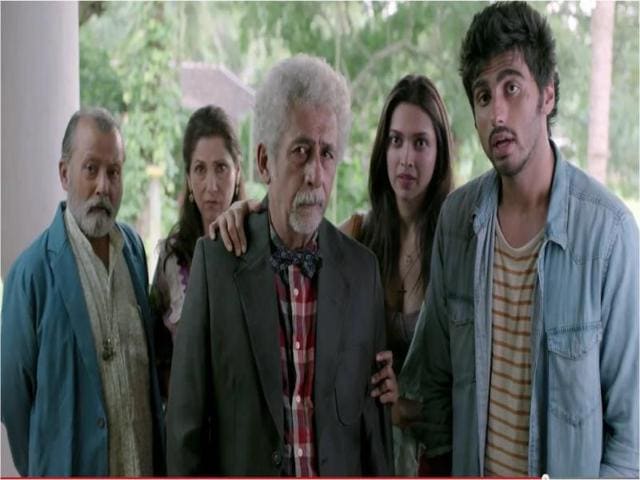
But Adajania is loathe to describe the experiences of five dysfunctional characters in a Dodge automobile searching for Stephanie, which is the story of Finding Fanny, as a road movie.
"It isn’t a road movie because I do not see that as a genre. I guess there’s a physical journey that the audience becomes part of and enjoys, a ride that is unknown to the characters as well. It’s also the fun of getting to know characters as they are put into situations which neither they nor the audience can predict."
Author Marty Rubin famously said, "Travel doesn’t become adventure until you leave yourself behind." And that’s precisely what Navdeep Singh, director of NH10, uses the road trip to symbolise. While he recalls childhood holidays on the road, "feeling warm, safe and cocooned" in the family Fiat, he sums up his film NH10 as a "woman in peril, a road trip gone wrong" story. "The road serves as a metaphor for life, danger and getting out of one’s comfort zone," says Singh. "The car connotes notions of freedom and mobility."
That’s a feeling most people can identify with. The open road symbolises a number of things: promise, threats, freedom, fear, change, challenges and space in which to think, to enjoy silences and reflect. As you set out on the road, you put distance between your past and your future. The road offers perspective. “The road movie narrative gives characters time to peel off layers,” says filmmaker Sanjay Gupta who frequently takes to the road in a car or on a motorcycle. “It’s a process of self-discovery as you knock off the miles and head towards your destination.”
A road movie’s characters have endless possibilities of encounters – with places and people – that may change them forever. These possibilities have been harnessed by filmmakers such as Navdeep Singh, Zoya Akhtar, Imtiaz Ali (Jab We Met, Highway), Dev Benegal (Road, Movie) and Hemant Madhukar (Mumbai 125 KM). “There’s poetry and passion in the genre,” says Dev Benegal. “A man and a woman. A vehicle. Nature. For me, these raw elements are the essence of cinema.”
Three of Imtiaz Ali’s films (Jab We Met, Rockstar and Highway) have captured journeys and explorations of people and places. His fascination with expeditions began with train journeys between Delhi and Jamshedpur as a student. “I would look out of the window and it was both exhilarating and confusing,” he had said earlier this year, talking about Highway. “Those journeys gave me a lot of time to know the people around me. Your imagination starts opening up, and those things find themselves in my stories.”
The freedom to stop anywhere, the excitement of the unexpected and the sense of stillness attractto road trips. After her brother Farhan Akhtar’s Dil Chahta Hai, which begins with three friends driving from Mumbai to Goa, Zoya’s Zindagi Na Milegi Dobara, the story of a group of friends driving through Spain, has become the quintessential Bollywood road movie.
"Being on the road is the best way to see a country, but it can also be very lonely. You are stuck in a box for hours, mostly with the same people," says Akhtar. "You are often left with no choice but to stop speaking and start listening to yourself. There is no road trip from which you don’t return affected in some way." While there are films that end in catharsis, others see the road as a point of no return. Movies like Steven Spielberg’s Duel and Dominic Sena’s Kalifornia, for example, portray the road as a foreboding place. That’s the feel Hemant Madhukar gives his horror film, Mumbai 125 KM."At night a run on a highway will either be something you enjoy or be a little afraid of," he says. "In my film, five friends are caught in an accident on the highway. The question is, will they survive?" Meanwhile, Jia Aur Jia, which was shot in Sweden, experiments with another under-explored sub-genre – the ‘girls on the road’ film. The only thing Kalki Koechlin and Richa Chadda’s characters have in common is their name. Yet these two unlikely travel companions find themselves on a journey together. "Jia Aur Jia is about living life in the moment," says Koechlin. "Road trips help put your life into perspective and help you realise that there’s much more out there than just your problems."
Apart from the human characters, the mode of transport itself often plays a character in the road movie. It was a convertible in ZNMD, a truck in Road, Movie, a Volkswagen microbus in Little Miss Sunshine, a bus in Almost Famous and an SUV in NH10.
“There must be a reason the vehicle is often retro, classic. Maybe it’s nostalgia? But it is a tool that takes on a character,” says Abhay Deol who acted in both ZNMD and Road, Movie. “An Ambassador is like a friendly old man. A Porsche 911 a beautiful female sprinter. A truck is a struggling veteran while the convertible is cool and laidback.”
Though you couldn’t say Hindi cinema had road movies in the ’50s and ’60s, songs sung in cars became a conduit for conveying romance, angst and absolution. “In Bollywood, love stories have often used this device of self-exploration. The road also lends itself to a great soundtrack. Like Thelma & Louise, characters who were dying a little every day, but who got out and lived,” says Gupta. Author Sam North wrote: “The irony of the road movie is that the weak leave, but only the strong survive.” Another point of view suggests that while on a journey, characters undergo such a transformation, they never really reach the destination, because along the way they’ve become different people. As Dev Benegal says, “The characters in a road movie are not just on a trip of the mind, but also of the soul."
From HT Brunch, August 17Follow us on twitter.com/HTBrunchConnect with us on facebook.com/hindustantimesbrunch