
Sign in

Black money: India ranked 8 among 150 countries

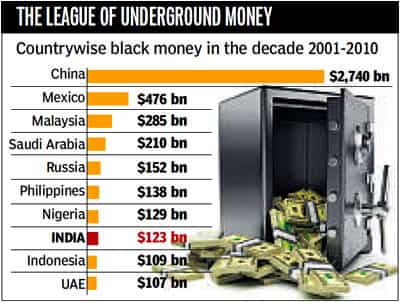
India is among the top 10 developing countries in the world with a black money outflow of $1.6 billion ( Rs. 8,720 crore) in 2010, a report by Global Financial Integrity (GFI) said. Chetan Chauhan reports. The league of underground money

Updated on: Dec 18, 2012, 11:16:56 IST
Hindustan Times | By , New Delhi
Share
Share via
  • facebook
  • twitter
  • linkedin
  • whatsapp
Copy link
  • copy link

India is among the top 10 developing countries in the world with a black money outflow of $1.6 billion ( Rs. 8,720 crore) in 2010, a report by Global Financial Integrity (GFI) said.
Article image

The report, to be released on Tuesday, said the total outflow of black money from India since independence until 2010 was $232 billion, generally in the form of corruption, bribery and kickbacks. The cumulative value of illicit assets held by Indians during the same period is estimated to be $487 billion.

In the post-reform period of 1991-2008, deregulation and liberalisation accelerated the outflow of illicit money from the Indian economy, the report by Washington-based GFI,
Article image

Illicit Financial Flows from Developing Countries, said.

“Almost three-quarters of the illicit assets comprising India’s underground economy — which has been estimated to account for 50% of India’s GDP (around $640 billion in 2008) — ends up outside of the country,” the report’s author and former economist with IMF Dev Kar, said.

The earlier edition of the report has been quoted by the government in its white paper on black money.

The report found illicit financial flow in 2010 from these countries was $858.8 billion, just below the all-time high of $871.3 billion in 2008.

Maximum outflow of illicit money was from China with India ranked eighth.

The report said that astronomical sums of dirty money continue to flow out of the developing world and into offshore tax havens and developed country banks, meaning that the poor in source countries are being deprived of their right to development.

There is a statistical correlation between larger volumes of illicit flows and deteriorating income distribution in the developing countries, the report said.

The finding that only 27.8% of India's illicit assets are held domestically supports the argument that the desire to amass wealth illegally without attracting government attention is one of the primary motivations behind the cross-border transfer of illicit capital.

Opportunities for trade mispricing grew and expansion of the global shadow financial system - particularly island tax havens - accommodated the increased outflow of India's illicit capital flight, the report said.

The government has, however, claimed that it has taken several steps including signing treaties with foreign countries to know about Indian black money stashed in foreign banks.

It also claimed that the Income Tax department had initiated action against persons regarding whom information has been received from these countries.

  • Chetan Chauhan
    ABOUT THE AUTHOR
    Chetan Chauhan

    Chetan Chauhan is the National Affairs Editor looking into all aspects of news and features from across India. A Chevening scholar with over three decades of experience in reporting and news management, Chetan has extensively covered all important aspects of the social sector, political economy, environment and climate change nationally and internationally. He did a journalism course at the Reuters Institute of Journalism in Oxford and Digital Media training at Nanyang Technological University in Singapore. He started as a reporter with The Statesman in 1996 and joined the Hindustan Times in 2000 in the metro bureau covering environment, crime and Delhi politics. He covered hot local news, from the Jessica Lal murder case to the rebellion of Delhi Congress MLAs against then Chief Minister Sheila Dikshit, to the replacement of toxic vehicle fuel with cleaner compressed natural gas (CNG) in the national capital. Some of his stories on air pollution became part of the Supreme Court’s landmark MC Mehta versus Government of India case in the National Capital Region (NCR), forcing the government to take corrective measures. As part of the national political bureau since 2004, he covered important central sectors such as environment, education, social justice, labour, rural development, water resources, renewable energy, agriculture, broadcasting and the Planning Commission for more than a decade producing several exclusive and investigative breaking stories. His specialisation is the environment, having covered at least a dozen United Nations global conferences on climate change, biodiversity and wildlife including climate summits in Paris, Copenhagen and Bali. He also covered India’s two five-year plans ---11th and 12th and reported on drafting and execution of right based laws such as Right to Education, Right to Information and rural job guarantee law, MG-NREGA, now being introduced in new format as VG-RAM-G Act. He has in-depth knowledge of social sector issues. He was one of the first to report on tigers vanishing from Sariska and Panna wildlife reserves in 2004 and 2008, respectively, leading to the setting up of the National Tiger Conservation Authority (NTCA) and the introduction of stringent penal provisions for poaching. He has written extensively on the rising human-animal conflict in India and the degradation of India’s biodiversity hotspots because of mining and other activities. Since 2004, Chetan has covered Parliament comprehensively and participated in training on the nuanced coverage of Parliament proceedings. He has travelled extensively across India to cover national and provincial elections since 1998, especially in the Hindi heartland states, considered India’s road to power. He writes a regular column for Hindustan Times, Ecostani, on important national politics, economy, Himalayan ecology and environmental issues. His other responsibilities include providing inputs for edits and edit page articles for the publication, apart from managing news flow from across India.Read More