With the Prime Minister launching the second module of the Ujjwala Yojana from Mahoba, Uttar Pradesh, the Bharatiya Janata Party (BJP) has, in a way, started its election campaign for the crucial state which goes to the polls in early 2022. That the BJP has decided to invest significant political capital behind rebranding Ujjwala, an already existing and successful scheme – a petroleum ministry report estimated 99.8% LPG coverage on April 1, 2021 – shows the political importance it places
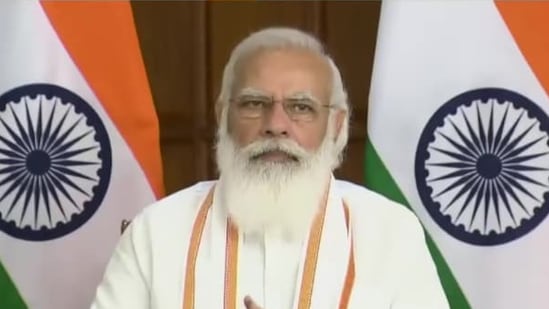
With the Prime Minister launching the second module of the Ujjwala Yojana from Mahoba, Uttar Pradesh, the Bharatiya Janata Party (BJP) has, in a way, started its election campaign for the crucial state which goes to the polls in early 2022. That the BJP has decided to invest significant political capital behind rebranding Ujjwala, an already existing and successful scheme – a petroleum ministry report estimated 99.8% LPG coverage on April 1, 2021 – shows the political importance it places on welfare schemes.
Such an approach also raises an important question vis-a-vis India’s political economy landscape today: can such targeted welfare benefits compensate for a weak macroeconomic performance? The answer to this question isn’t an easy one.
Elections are hardly fought on one issue and final results are also a reflection of the organisational prowess of the participants.
1. Schemes such as Ujjwala are designed to bring more ‘bang for the buck’ for govt
The underlying philosophy behind such schemes is not about the government doing some big-ticket spending. They are about the government (and the political party in power) winning political support by opening up a service hitherto considered out of reach for those at the bottom of the pyramid.
The budgetary allocations for Ujjwala, which is listed as money for “LPG connections to the poor” in the ministry of petroleum’s budget, was just ₹21,365.81 crore between 2016-17 and 2020-21. The Union government spends far more money on schemes such as the rural employment guarantee programme every year. But the political appeal of the scheme lies in its target (women), and the fact that the Prime Minister has come to be closely associated with it. Indeed, he has spoken of his lived experience, earlier in life, as an underprivileged, when his mother had to cope with the smoke from cooking on wood-stove.
2. Ujjwala - type schemes may not have brought parity between the haves and have-nots
Like most flagship schemes of the current government, Ujjwala is also a one-time endowment model. In the earlier version of the scheme, eligible households were given a one-time benefit of ₹1,600 which included the cost of connection, an interest-free loan to buy a gas stove and the first refill. In the revamped scheme launched on August 10, the government will also pay for the gas stove.
While the Ujjwala scheme has been remarkably successful in expanding LPG coverage in the country, the jury is still out on whether it has really achieved an effective transition to clean fuel-based cooking. Statistics on LPG consumption and coverage offer the biggest proof on this count. According to a ministry of petroleum report, LPG coverage (defined as active domestic LPG connections of PSU OMCs divided by estimated households) increased from 56% on April 1, 2015 to 99.8% on April 1, 2021. This is an increase of 78.2%. Domestic LPG consumption, however, went up by just 53.3% between 2014-15 and 2020-21.
When read with the fact that poorer households have a bigger household size than rich ones (which should translate into more cooking), the trend in consumption with LPG coverage expanding among the poor (whom the Ujjwala targets) should have shown greater increase.
The only logical explanation for this fact can be that Ujjwala beneficiaries might be using their LPG cylinders to complement rather than substitute their erstwhile methods of using unclean fuel for cooking.
LPG subsidy to consumers has been coming down
What must have hurt the Ujjwala beneficiaries is the fact that the price of an LPG cylinder has increased significantly in the past year, as the government has almost done away with LPG subsidies. This is best seen from the fact that the government’s LPG subsidy per domestic connection has fallen sharply in the last few years. According to the Indian Oil website, the price of an LPG cylinder with or without subsidy was the same, ₹834.5 in Delhi on August 10. LPG consumption by Ujjwala beneficiaries is likely to suffer the most when prices go up. It was to tap this section that the second United Progressive Alliance (UPA) government increased the number of subsidised cylinders available to one household from nine to 12 in January 2014.
3. The larger economy is in bad shape
The Indian economy started losing momentum much before the pandemic. India’s GDP growth fell every year between 2016-17 and 2019-20, from 8.3% to 4%. The pandemic inflicted India’s largest ever economic contraction of 7.3% in 2020-21. The Reserve Bank of India expects 2021-22 GDP growth to be 9.5%. Whichever way one looks at it, the Indian economy, especially its informal stakeholders, are in a precarious position. Consumer sentiment remains at the weakest ever levels, inflation is expected to be high going forward and inequality has likely increased significantly. RBI’s latest consumer confidence survey shows that rise in price of essentials is forcing people to cut down on non-essential spending, which is what matters for restoring aggregate demand and growth.
With the Modi government refusing to reduce taxes on petrol-diesel or restore subsidies on LPG cylinders, at least at the moment, the messaging seems to be that it is confident of sailing politically by using welfare handouts such as the revamped Ujjwala scheme. The success of such a political-economy strategy, where the prime minister is invested in seeking a personal connect with every welfare beneficiary – they can now be easily identified using the Jan Dhan-Aadhaar-Mobile trinity – to target political gains for the BJP would not have been possible in the pre-JAM subsidy/welfare regime. Political scientists Neelanjan Sircar and Yamini Aiyar have rightly termed this the politics of vishwas (trust).
Such a strategy, if it succeeds in Uttar Pradesh, would create a new template for Indian politics, which, so far, has always been very sensitive to inflationary concerns.
One Subscription.
Get 360° coverage—from daily headlines
to 100 year archives.
Archives
HT App & Website