Driverless taxis are a common sight in Chinese cities these days. So, increasingly, are delivery drones. But to see one of the heaviest autonomous machines ever deployed, head to the grasslands in China’s far north-east, to the Yimin coal mine, a giant hole in the earth spanning 42 square kilometres. Travel to the bottom and you will find around 100 lorries each capable of carrying 90 tonnes of coal—without a human in sight. Large black boxes filled with batteries sit
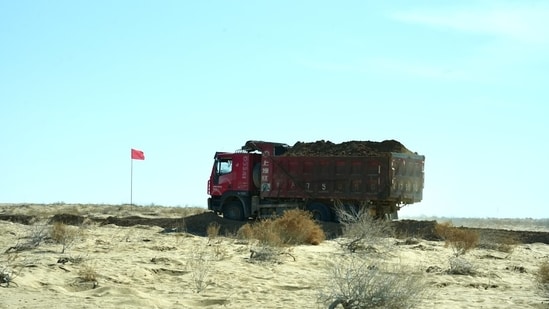
Driverless taxis are a common sight in Chinese cities these days. So, increasingly, are delivery drones. But to see one of the heaviest autonomous machines ever deployed, head to the grasslands in China’s far north-east, to the Yimin coal mine, a giant hole in the earth spanning 42 square kilometres. Travel to the bottom and you will find around 100 lorries each capable of carrying 90 tonnes of coal—without a human in sight. Large black boxes filled with batteries sit where the driver’s cabins should be.
Zhao Yaozhong, a manager at Huaneng, the state-owned power utility that operates Yimin, says the deployment of driverless lorries has led to 120 workers being reassigned to posts outside the pit—thus removing them from the dust and danger of the mine. The vehicles also do far more work without a human driver. They run through the night and in poor weather conditions, and even change their own batteries. If all goes to plan, most humans will disappear from the pit over the next three years as another 300 autonomous lorries are added.
The operation at Yimin offers a glimpse into the expanding “enterprise” division of Huawei, a Chinese technology giant better known for its telecoms equipment and consumer electronics. In 2021 Huawei, whose core business had been hit hard by American sanctions, announced that this division would create a collection of new teams—referred to as juntuan (Chinese for army corps)—that would focus on applying expertise and technology from across the business to specific groups of enterprise customers, from airport operators to oil-and-gas companies.
The mining corps shows this integrated approach in action. Huawei’s telecoms base stations, which are visible throughout Yimin, cover the area with 5G, allowing the lorries’ autonomous-driving system to function. That system was based on one developed by Huawei’s automotive division, but was tailored to suit the size and weight of the lorries and the conditions within a mine. The interface used to control the mine’s operations runs on an operating system called MineHarmonyOS, which was developed by the same division that makes Huawei’s smartphones and other consumer gadgets. In a number of underground mines, an artificial-intelligence model created by Huawei’s cloud division is used for interpreting geological data and remotely monitoring equipment.
Huawei, which is privately held, has not made it easy to understand how its enterprise division has fared. Revenue was last broken out in 2022, at which point it accounted for a fifth of total sales and was the fastest-growing part of the group. Andy Wu, who runs the mining unit, says his business is profitable, but that margins are extremely thin.
Nevertheless, the enterprise division is set to play an increasingly vital role for the company. On August 31st Huawei said that its net profits fell by 37% year on year in the first half of 2026, even as revenue grew by 10%. Margins in its consumer division have been squeezed by the surge in memory-chip prices resulting from the data-centre boom. Huawei has also been investing heavily in research and development—which gobbled up a quarter of revenue in the first six months of the year—as it looks to replace American technology it has lost access to, including the most advanced semiconductors.
Concern that Huawei’s products could be used by China for snooping has led many Western governments to impose restrictions, causing the company’s foreign sales to shrink over the past decade. That has made it all the more important to find new avenues for growth at home, particularly now that the build-out of the country’s 5G network has largely concluded. Fortunately for Huawei, China’s government is enthusiastically championing real-world applications of AI in domains from manufacturing and transport to the operation of electricity grids. Huawei’s enterprise corps stand ready.
To track the trends shaping commerce, industry and technology, sign up to “The Bottom Line”, our weekly subscriber-only newsletter on global business.
One Subscription.
Get 360° coverage—from daily headlines
to 100 year archives.
Archives
HT App & Website