Ethanol producers and the poultry, dairy and starch industries could face a sharper contest for maize in the next ethanol supply year (November-October), after the government barred oil marketing companies (OMCs) from procuring ethanol made from sugarcane juice, sugar syrup and B-heavy molasses, shifting the burden of meeting fuel demand towards grains.
A tender issued by Bharat Petroleum Corp. Ltd (BPCL) on October 16 seeks bids for about 11 billion litres of ethanol for the November 2026-October 2027 supply year (aka Ethanol Supply Year or ESY). The government directed on October 16 that sugar diversion for ethanol production be reduced to zero, citing concerns over domestic sugar availability. C-heavy molasses, a by-product left after sugar extraction, remains eligible for ethanol production but will do little to help.
B-heavy molasses is an intermediate which has more sugar (sucrose) content; C-heavy molasses has very little sugar.
Competition over maize produce
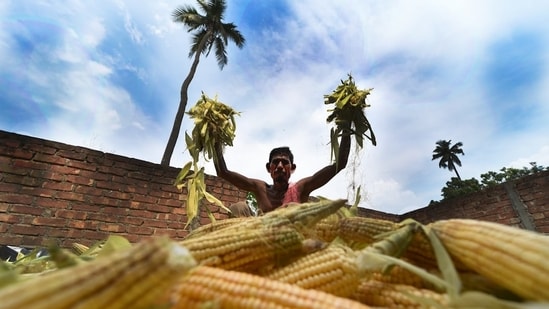
The move to maize is problematic; already, demand from ethanol distilleries, poultry-feed manufacturers, starch makers and other industrial users has pushed up prices of maize. This has, in turn, pushed up prices of both eggs and milk. And poor rainfall and the impact of this on crop yields is likely to tighten supplies, leaving industries competing for the same grain.
Industry estimates suggest that ethanol production could require about 16 million tonnes of maize in the next supply year, about 22% more than the roughly 13 million tonnes estimated to have been used in the current supply year.
{{/usCountry}}Industry estimates suggest that ethanol production could require about 16 million tonnes of maize in the next supply year, about 22% more than the roughly 13 million tonnes estimated to have been used in the current supply year.
{{/usCountry}}Rice can meet only part of the requirement. The government has capped the use of surplus rice held by the Food Corporation of India (FCI) at 7.2 million tonnes. At an assumed conversion rate of 450 litres of ethanol per tonne of rice, this would yield about 3.25 billion litres.
Damaged foodgrains could provide another source. Agricultural markets expert GK Sood estimates that production from this category could rise from about 700 million litres in the current supply year to a maximum of 1.25 billion litres in 2026-27, depending on availability.
That still leaves a substantial gap against the 11-billion-litre tender.
C-heavy molasses could fill part of the gap, but supplies are unlikely to be enough to meet the entire shortfall, said Sood.
“Since neither [cane] juice nor B-heavy molasses is being diverted for ethanol, C-heavy molasses production will rise. But, the increase is unlikely to exceed about 400 million litres of ethanol,” Sood added, estimating that ethanol production from C-heavy molasses could rise from about 2.2 billion litres in the current supply year to around 2.6 billion litres in 2026-27.
Also Read I US pitches maize for India’s E85, SAF ethanol push
The catch is that not all of this output will be available to oil marketing companies. C-heavy molasses is also used by the alcohol and other industries, and its relatively low cost could intensify competition for supplies and is likely to leave only about 0.5 billion litres for OMCs, compared to the 0.17 billion litres used in 2025-26.
That still leaves a shortfall of around 6 billion litres.
Feed prices' vulnerability
For ESY 2026-27, OMCs will pay ₹57.97 per litre for ethanol sourced from C-Heavy molasses, ₹64 per litre for that from damaged food grains, ₹60.32 per litre for that from surplus rice procured from FCI, and ₹66.07 per litre for that from maize.
At a conversion rate of 380 litres of ethanol per tonne, a shortfall of 6 billion litres would require about 16 million tonnes of maize.
Deepak Pareek, founder of HnbY, an agri consulting firm and advisory, said the shift towards grain-based ethanol could intensify competition for maize at a time when El Nino threatens to reduce output. Maize accounted for around 4.1 billion litres of ethanol in the current supply year, making it the largest single feedstock, he said. With maize accounting for over 55% of poultry feed (roughly 60% of domestic maize consumption goes towards the poultry), the additional demand from ethanol distilleries could push feed prices higher. “Poultry faces a genuine survival risk unless maize or ethanol imports bridge the gap for the E20 programme,” Pareek said.
In absolute numbers, this would mean an additional 3 million tonnes of maize, even as the market is bracing for production to be 15% (or 8 million tonnes) lower than the 55 million tonnes produced last year.
The potential squeeze is already reflected in market concerns. Maize prices in key mandis were hovering at ₹26-28 per kg on Monday, higher than the minimum support price of ₹24.1 per kg. Industry representatives say maize prices of ₹30-31 per kg are also being reported in some markets, depending on location, freight and other costs.
For the poultry industry, the concern is that ethanol demand will compete directly with a feed ingredient that is difficult to replace entirely.
Ricky Thaper, joint secretary of the Poultry Federation of India, said the market could face a prolonged period of tight supply and elevated prices if crop losses materialise in key maize-producing states.
The poultry industry estimates that maize demand for poultry feed alone will reach 21.26 million tonnes in 2026 and exceed 22 million tonnes in 2027. The starch industry uses about 6.5 million tonnes annually, while dairy-feed demand accounts for another 5-6 million tonnes, according to industry estimates.
Overall maize demand, including feed, ethanol, starch and other uses, could rise to about 55.7 million tonnes in 2027 from an estimated 49-50 million tonnes in 2026. “This shift in ethanol sourcing will have consequences beyond the fuel market,” Thaper said.
Sustainability of E20 programme
Feed accounts for an estimated 65-70% of poultry production costs. Higher maize prices can therefore squeeze farmers’ margins or feed into the prices of eggs and chicken if producers pass on the additional costs.
Thaper said the policy challenge is to ensure that the ethanol programme does not place an unsustainable burden on other users of maize.
Poultry associations have asked the government to consider allocating about 5 million tonnes of broken rice and suitable damaged foodgrains from FCI stocks to the poultry sector at an affordable rate, subject to quality and food-safety standards. The associations argue that this would help reduce feed costs while making better use of surplus stocks and easing pressure on storage infrastructure.
Also Read I Centre halts sugarcane-based ethanol purchases for 2026-27 supply year, citing price pressures
FCI held about 84.38 million tonnes of foodgrains on October 1, 2026, comprising 38.10 million tonnes of rice and 46.28 million tonnes of wheat, against a prescribed buffer norm of 30.77 million tonnes.
India’s ethanol-blending programme was intended to reduce dependence on imported crude oil and expand the use of domestic feedstocks. However, the shift away from sugar-based ethanol has raised questions about India’s ability to sustain its E20 (20% ethanol-blending in petrol) programme, which has already come under fire for reducing the life and fuel-efficiency of vehicles, most of which are not E20 compliant.