It is important to make one thing clear from the outset: ever since Samsung got going with the flip-style foldable smartphone format in 2020, it’s never received a massive overhaul, and theme’s have centred around generational, incremental changes. A design tweak here, a display improvement there. Compared with last year, this year’s Samsung Galaxy Z Flip7 is again following that theme. With good results, mind you, because the baseline set last year was already very high in terms of performance and experience. Refinements this time give us a slightly wider foldable display(6.7-inch to 6.9-inch may not seem much, but it is tremendous in terms of comfort with typing), a larger and therefore more utilitarian cover screen and a larger battery. For Samsung, the Galaxy Z Flip proposition has always been about a different style foldable, that also doesn’t burn a hole in the wallet.
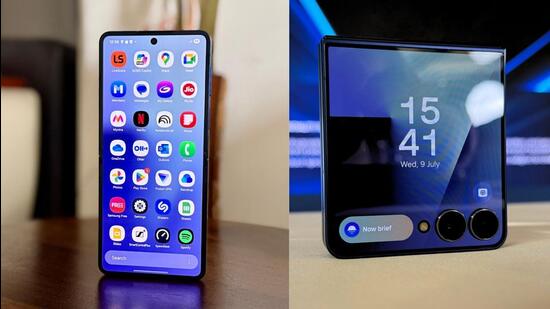
In that regard, it still does it to an extent, though comparative value is subjective. The prices of the Galaxy Z Flip7 start around ₹1,09,999 and the silver lining is, this is the same as last year’s Galaxy Z Flip6 launch price. In comparison, the larger book-style foldable, the very impressive Samsung Galaxy Z Fold7, is priced ₹1,74,999 onwards. Two foldable styles, two distinct choices. That’s not where the contrasts finish either.
Questions will inevitably be asked of Samsung’s choice of the chip, which is their own Exynos 2500 silicon. Last time around, it was Qualcomm’s Snapdragon 8 Gen3, maintaining parity with the larger Galaxy Z Fold of that generation. The conversations on social media, if you’d have seen those, would lead you to believe Qualcomm good, Exynos bad. That is absolutely not the case. Real users, every day, do not get into benchmark scores and flexing numbers before heading out for work. As a phone, and the performance levels you’d expect, the Exynos 2500 in the Galaxy Z Flip7 more than delivers as you’d expect from a flagship-esque phone that costs as much. There is 12GB memory to assist it along, and at no point in mythology testing, did the Galaxy Z Flip7 fall short either on snappiness of response, or any sort of stutters.
If you’d still want a point of comparison, think of this as very close to last year’s Snapdragon 8 Gen3, and not the newer Snapdragon 8 Elite that powers its larger foldable sibling instead. What would you define as a flagship-grade chip? One that simply works? The Exynos 2500 does, more than convincingly so. Another positive emerging from this, is the combination of a slightly larger battery (4300mAh instead of 4000mAh), helps eke out an hour and a half more of screen time (that’ll range between 7.5 hours and 12 hours, depending on variables) with regular usage every day. That means lesser charge anxiety, if it’s been a long day for you at work. Samsung has done the thermal layer quite well too.
{{/usCountry}}If you’d still want a point of comparison, think of this as very close to last year’s Snapdragon 8 Gen3, and not the newer Snapdragon 8 Elite that powers its larger foldable sibling instead. What would you define as a flagship-grade chip? One that simply works? The Exynos 2500 does, more than convincingly so. Another positive emerging from this, is the combination of a slightly larger battery (4300mAh instead of 4000mAh), helps eke out an hour and a half more of screen time (that’ll range between 7.5 hours and 12 hours, depending on variables) with regular usage every day. That means lesser charge anxiety, if it’s been a long day for you at work. Samsung has done the thermal layer quite well too.
{{/usCountry}}The one area where Samsung has missed a trick is with the cameras as the 50-megapixel main wide cameras and a 12-megapixel ultra-wide are carried forward from last year’s model. Despite image processing updates that you’d expect in the time that’s passed since, imaging results will still largely retain parity. Which between us, may largely not be enough. There are improvements to detailing on photos captured with some level of zoom, and a general clean-up of noise in shots with variable lighting. However, colours could still do with some fine-tuning, and the shadows still retain far too much light in results you’ll access from the gallery.
A genuine advantage of this form factor (and how Samsung has been able to take advantage of it) is the ability to use the primary camera for recording a video or taking selfies, utilising the cover screen. For this to be a successful journey with vlogging, you’ll need good lighting around you — otherwise some noise will begin to show. Speaking of the larger cover screen, that’s grown from 3.4-inches to 4.1-inches, which helps in this scenario. At some point with future generations of this foldable form factor, I’d expect Samsung to unlock more in terms of what this display real estate can do, which is still largely limited to widgets, some apps and limited customisation.
The key takeaway from the Samsung Galaxy Z Flip7 is that while it is not a big generational step forward as the Galaxy Z Fold7 (perhaps Samsung’s reserved that for next year), it is nevertheless an improvement in many respects. The screens being more usable and ergonomically on point, should hold the greatest weightage. As should a bigger battery that lasts longer, and a slimmer design that’s easier to pocket. Most of you may not have realised how refined Samsung’s One UI 8 is, and that’s a generational effort over the past few years, which adds to the Galaxy Z Flip7’s usability proposition. The addition to the DeX desktop-esque mode is great if you know how to get the most out of it.