Both Sensex and Nifty crashed after finance minister Nirmala Sitharaman's Budget presentation on Sunday. As of 12:37 pm, Sensex crashed 1,521 points to 81,048.69 and Nifty dropped by 453 points to 24,965.45.
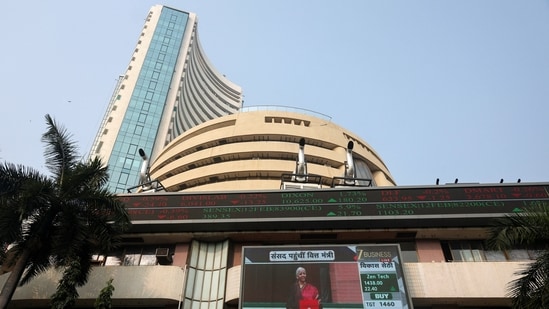
Nirmala Sitharaman is displayed on a screen outside the Bombay Stock Exchange (BSE) ahead of her budget speech (REUTERS)
{{^htLoading}} {{/htLoading}}
According to news agency Reuters, 46 of the Nifty 50 constituents declined, with heavyweights such as Reliance and SBI losing 2.5% and 5%, respectively.
The development came shortly after Sitharaman ended her much-anticipated Union Budget speech in Parliament.
In her speech, Sitharaman announced a hike in STT (Securities Transaction Tax) on Futures and Options to 0.05% and 0.15%, respectively. The move is likely to impact derivatives trading costs.
While STT, a government tax applied to market transactions, was already in place, the hike in its charge means that Futures trading will be now be costlier. While the increase may help curb excessive short-term speculation and boost tax revenue, it also reduces net profits for active futures traders.
{{^htLoading}} {{/htLoading}}
{{^usCountry}}
Shareholders will now be taxed on all buyback proceeds as capital gains.
{{/usCountry}}
{{#usCountry}}
Shareholders will now be taxed on all buyback proceeds as capital gains.
{{/usCountry}}
Sitharaman also announced the restructuring of the two state-run entities - REC Ltd (formerly Rural Electrification Corporation) and Power Finance Corporation (PFC), as part of the government's public sector financial institution strengthening.
In a first, the Union Budget was presented on Sunday this time. Sitharaman's speech covered many areas, including India's expansion of the rare earths scheme, the semiconductor mission and a revised timeline for ITR filing.
Follow the latest breaking news, major developments and agenda-setting stories from India and around the world with the newsdesk at Hindustan Times. Operating round the clock, the desk brings together experienced editors, reporters and correspondents to deliver fast, accurate and contextual reporting across subjects that influence public policy, governance, business, society and international affairs. The HT News Desk covers politics, elections, government policies, the economy, business and markets, science and technology, the environment, law and order, infrastructure, education, climate issues and geopolitics, while closely tracking developments across states, institutions and global capitals. The team also leads coverage of major breaking news events, policy announcements, court proceedings, natural disasters, public emergencies and significant international developments. Reports published by the newsdesk are based on information gathered from reporters on the ground, official statements, government agencies, court records, regulatory filings, recognised institutions and other authoritative sources. Stories undergo editorial scrutiny and verification processes to ensure accuracy, fairness and relevance, and are updated as events evolve and additional information becomes available. Whether covering a key political decision in New Delhi, an economic policy shift affecting millions, a landmark court ruling or a major global event, the HT News Desk aims to provide readers with reliable, fact-based journalism that delivers not only the latest developments but also the context and analysis needed to understand their wider implications.
Track live Stock Market Today updates and check your NSE IPO Allotment Status Today. Stay informed with the latest business news like N Chandrasekaran, petrol and diesel prices, gold and silver rates, income tax updates, and major economic developments across India and globally.
Track live Stock Market Today updates and check your NSE IPO Allotment Status Today. Stay informed with the latest business news like N Chandrasekaran, petrol and diesel prices, gold and silver rates, income tax updates, and major economic developments across India and globally.
Home/Business/Sensex crashes after Nirmala Sitharaman's derivative announcement in Budget 2026
{{^htLoading}}
Advertisement
{{/htLoading}}
SHARE THIS ARTICLE ON
{{#usCountry}}{{/usCountry}}
Notifications
Get breaking alerts directly from the newsroom
Notifications are on!You'll be notified when news breaks