
 E-Paper



The state of play on inflation and its wider implications
The recent fall in headline inflation; it fell from 7.61% in October 2020 to 4.06% in January 2021, before rising to 5.03% in February, was largely a reflection of a moderation in food inflation, which fell sharply from 11% in October 2020 to just 1.96% in January 2021.

 Prefer HTon Google


Retail inflation, as measured by the Consumer Price Index (CPI), grew at 5% in February 2021 on an annual basis. The February numbers also entail a reversal of the falling trajectory of inflation from November 2020 to January this year. What does this mean for the larger macro economy? Here are four charts that put the latest inflation numbers in perspective.
1. Non-food prices were rising for a while, only food prices reversed their trend now
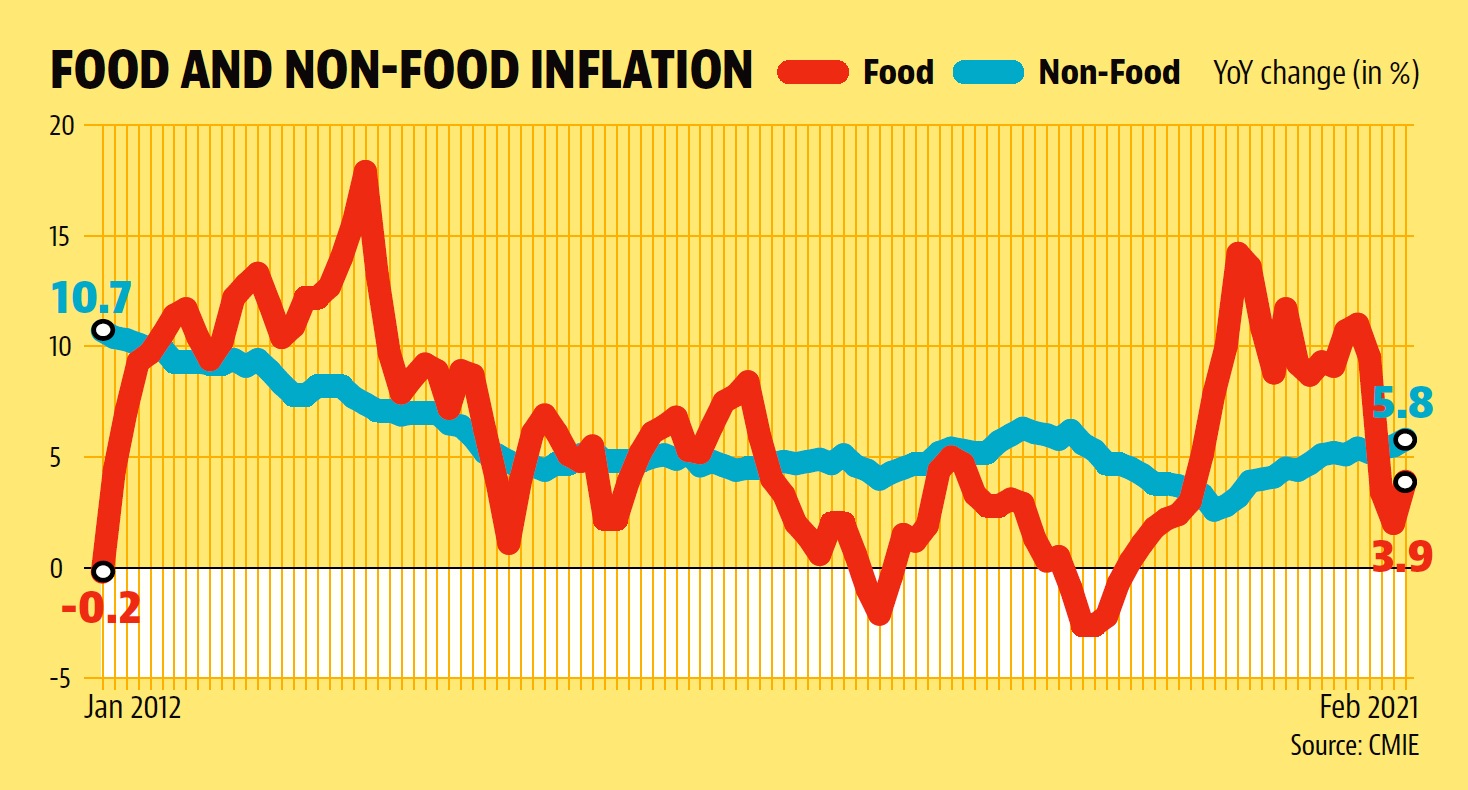
39% of India’s CPI basket comprises of food items. This means that the headline inflation number is extremely sensitive to what is happening to food prices. The recent fall in headline inflation; it fell from 7.61% in October 2020 to 4.06% in January 2021, before rising to 5.03% in February, was largely a reflection of a moderation in food inflation, which fell sharply from 11% in October 2020 to just 1.96% in January 2021.
Also Read: Factory production contracts in January inflation hits 3-month high
Prices of non-food items never really moderated during this period. The non-food basket of CPI grew at 5.39% in October 2020, moderated slightly to 5.23% in November 2020 and has been rising steadily in the last three months to reach 5.78% in February 2021. The February 2021 value of non-food inflation is the highest since October 2018.
2. What led to a rise in food inflation?
The more important question is what didn’t.
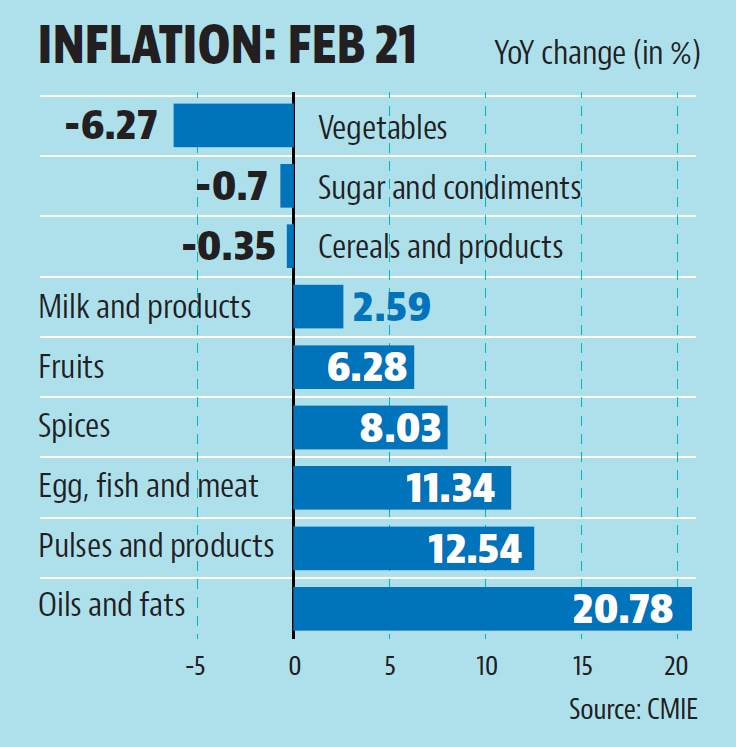
Prices of cereals and products, vegetables and sugar and condiments — these three sub-groups account for almost half of the CPI food basket — were lower in Feb 2021 than they were in Feb 2020. This is the first instance since Jan 2012, the earliest period for which data is available under the current CPI series, that inflation for cereals and products has entered negative territory. Vegetable prices continued to fall, albeit at a slower rate, largely because of a tightening in onion and tomato prices. The commodity group which has really experienced a sharp spike in its prices in Feb is the (edible) oils and fat category. At 20.78%, the inflation in this category is the highest ever since January 2012. This group is experiencing uninterrupted double-digit inflation since April 2020. Prices of pulses and meat, fish and eggs also grew in double digit in February, again a continuation of a long-term trend.
3. What is triggering non-food inflation?
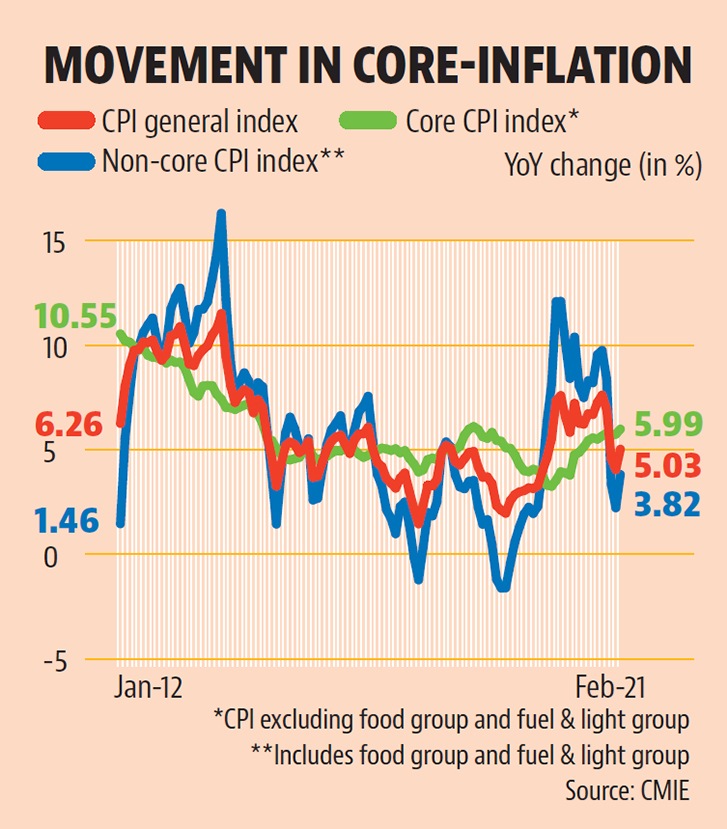
There is more to it than fuel prices. Core-inflation, which measures the trajectory of the non-food non-fuel basket of CPI, grew at 5.99% in February 2021, the highest since July 2018.
A look at the broad sub-categories of inflation shows that it is clothing and footwear and the miscellaneous category under the CPI; the latter has the largest weight of 28.32% after food, which show an increase in February compared to the previous month. A further disaggregation shows that prices of almost everything in the miscellaneous category, except personal care and effects, gained momentum in February. Transport and communication, which accounts for almost 30% of this category, re-entered double digit inflation zone. This basically means that transporters are passing on the pain of rise in fuel prices to the consumers. The trend in prices of these items is in keeping with what experts such as Pranjul Bhandari, the chief India economist of HSBC Securities and Capital Markets, have been saying about the possibility of a revival in services inflation once the economy opened up.
4. These are the broad inflation trends. But what does it mean for the economy?
It is bad news for rural demand.
For three consecutive months now, prices of non-food items have been rising at a faster pace than food items. This entails a worsening of terms of trade — ratio of prices of receivables and payables — for the farmers. As has been discussed above, the headline food inflation numbers do not capture the true picture of farmer headwinds for farmer well-being.
Also Read: Costly food, higher fuel prices take retail inflation to 3-month high of 5.03%
Cereals, vegetables and sugar (cane); the three food groups which have experienced disinflation in February actually account for more than half of the value of output in Indian agriculture. Whereas food items which have seen an increase in prices have a smaller weight in the overall production basket and a large import content. Simply put, farmers who grow cereals, vegetables and sugarcane have to shell out more money for buying things from the market, while they are getting a lower price for what they are taking to sell to the market. This is bound to put a squeeze on their purchasing power and hence demand.
Farm incomes are not the only variable to get hit by the current rise in inflation. We have rural wage data till December 2020. Average rural wages came out of contraction zone after four consecutive months in December 2020. This was largely due to a moderation in inflation. A simple comparison of annual real and nominal wage growth in November and December 2020 brings this out. Whereas real rural wage increased by 3.2 percentage point during these two months, nominal wage growth increased by just quarter of a percentage point. If inflation were to reverse its falling trajectory, like it has in February, it could generate strong headwinds for rural wages, and therefore demand as well.
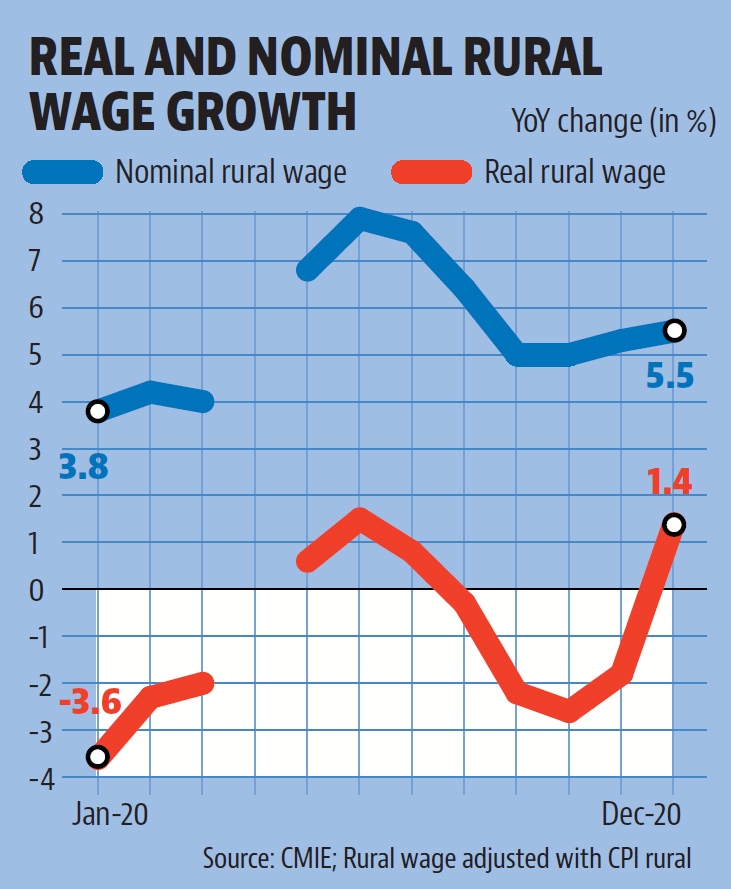
Obviously, rural demand will not be the only sector which will suffer because of growing inflation. There is a large consensus across the board that India’s post-pandemic economic recovery has seen a tilting of scales in favour of capital and away from labour, or what many have called a profit-led recovery. Private estimates such as the one by Centre for Monitoring Indian Economy suggest that labour force participation rates, which measures the share of working age people who are working or looking for a job, have not come back to pre-pandemic levels. India is also facing the possibility of a second Covid-19 wave at the moment. This has the potential to disrupt supply chains and trigger inflation once again. The Indian economy also faces international tailwinds to inflation; commodity prices, especially of crude oil, have been rising and expected to either maintain course or not come down anytime soon, as advanced country economies gather momentum, thanks to stimulus packages and vaccines. All these have a potential of putting a squeeze on real incomes and therefore aggregate demand.


