The charts that matter
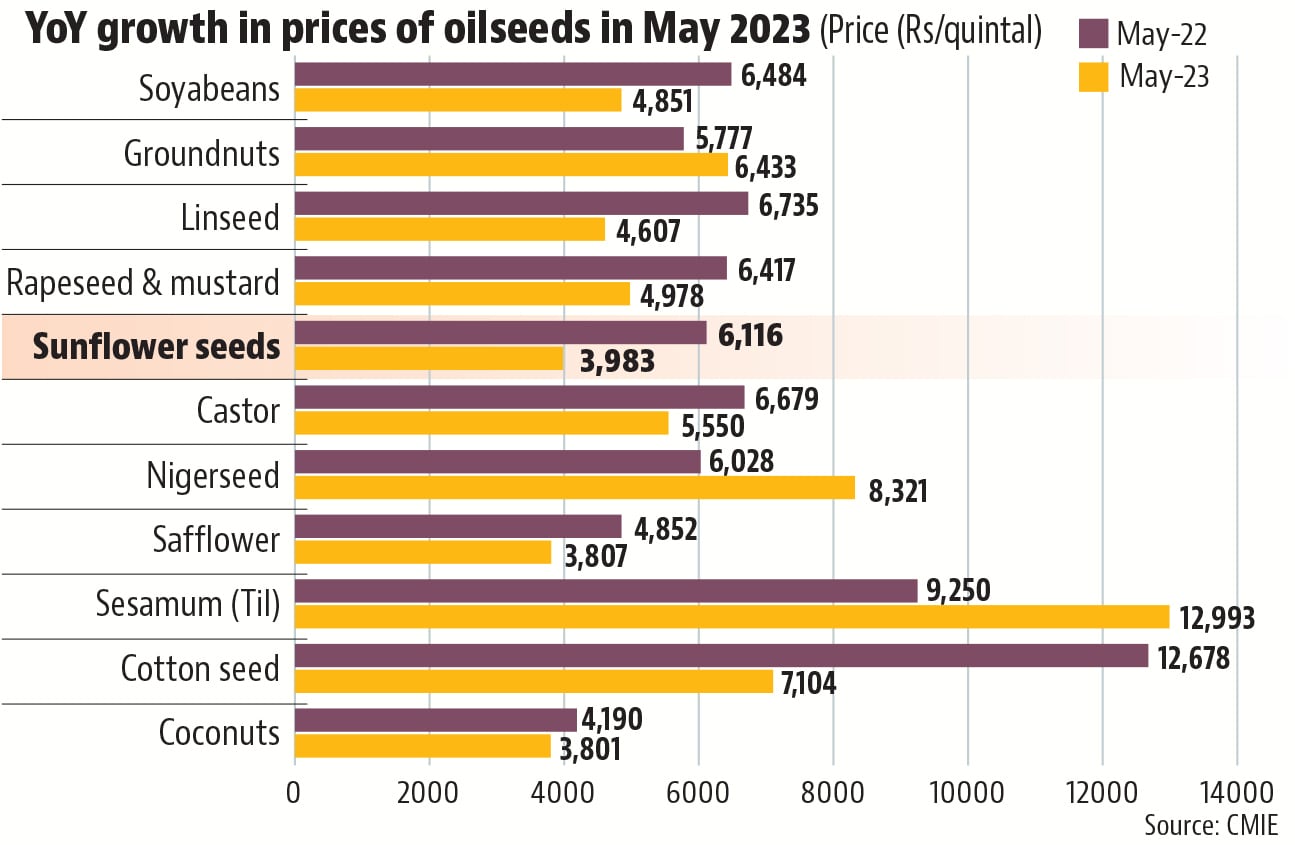 Sunflower seed prices, like those of most oilseeds, have crashed in the past yearData from the Centre for Monitoring Indian Economy (CMIE) shows that sunflower seeds were selling at Rs.3983 per quintal in May. This is 35% less than the price in May 2022 and 32% less than that in May 2021 . To be sure, the fall in sunflower seed prices in part of a larger trend of moderation in oilseed prices in the country. CMIE data shows that 8 out of 11 oilseeds for which price data is available have seen a fall in prices on an annual basis in May . While this fall in wholesale prices of oilseeds has helped a moderation in edible oil prices – CPI data for the month of May shows that edible oil prices fell by 16% on an annual basis -- and helped consumers, it is bound to have hurt farmers who grow oilseeds. Clearly, this is the biggest factor behind the protests.
- Haryana is the third largest grower of sunflower seeds in IndiaNational Account Statistics (NAS) and CMIE data on quantity and value of sunflower seeds shows that Haryana is the third largest producer of these in the country. In 2020-21, Haryana had a share of roughly 10% in the volume and value of sunflower seed production in the country. Haryana’s share in sunflower seed production is very small compared to Karnataka, which is the largest producer in the country and has a share of at least 50%, but the fact that Haryana is the only state demanding MSP procurement and no such protests are happening in Karnataka or Odisha (the second largest producer), suggests that farmers’ protests are also a function of the ability of farmers to politically mobilise themselves. It could also very well be the case the causality runs in the opposite direction and opposition parties are playing a major role in mobilising farmers for such protests
- Still, farmers are only asking for MSP procurement because the government announced MSP for sunflower seedsThis is where the government, either in Haryana or the centre, cannot claim an unambiguous moral high ground vis-à-vis the farmers. When the Commission for Agricultural Costs and Prices (CACP) announced its price policy report for the kharif season 2023-24 on June 8, it announced an MSP of Rs6760 per quintal for sunflower seeds as well. The recently announced MSP is 5.6% higher than last year’s MSP and given the fall in market prices of the crop (as has been discussed above), naturally an attractive proposition for the farmers. Irrespective of the politics behind the farmers’ protests, this has given the protests an objective basis.
- MSP notwithstanding, sunflower seed procurement has always been insignificantWhile CACP’s price policy report for the kharif and rabi seasons announces MSPs for 24 major crops, most of these are just notional in nature. India’s procurement operations are conducted largely for just rice and wheat. How much of sunflower seed production is procured at MSP in India? Data from National Agricultural Cooperative Marketing Federation of India (NAFED) shows that in procurement of sunflower seeds in volume terns has not been more than 3% of total production in the country since 2012-13 and this number was just 1.6% in 2021-22, the latest period for which procurement data is available. To be sure, farmers in Haryana, like in the case of rice and wheat, are used to a higher-than-normal procurement of sunflower seeds as well. NAFED’s annual reports show that Haryana was among the major states for procurement of sunflower seeds every year since 2014-15 whereas Karnataka, the largest producer of sunflower seeds did not figure in this list after 2012-13 and 2013-14. While the farmers can be blamed for using irrational means such as blocking highways to support their agitation, they do have a genuine grievance in demanding that the government match its MSP announcements with actual procurements.
All Access.
One Subscription.Subscribe NowAlready subscribed? Login
One Subscription.
Get 360° coverage—from daily headlines
to 100 year archives.
E-Paper
Full
Archives
Archives
Full Access to
HT App & Website
HT App & Website
Games
Track live Stock Market Today updates and check your NSE IPO Allotment Status Today. Stay informed with the latest business news like N Chandrasekaran, petrol and diesel prices, gold and silver rates, income tax updates, and major economic developments across India and globally.
Track live Stock Market Today updates and check your NSE IPO Allotment Status Today. Stay informed with the latest business news like N Chandrasekaran, petrol and diesel prices, gold and silver rates, income tax updates, and major economic developments across India and globally.
Advertisement
{{/htLoading}}{{#usCountry}}