E-Paper



Made-in-India Suzuki Fronx scores 1 star in ANCAP crash test
Suzuki Fronx crash tests reveal serious child occupant safety concerns, scoring poorly in restraint tests and rear seatbelt functionality.

 Prefer HTon Google


The Suzuki Fronx has undergone crash testing that was performed by ANCAP (Australasian New Car Assessment), and the results highlight significant concerns around occupant safety, particularly for rear seat passengers. While the crossover comes equipped with a long list of active safety features, its overall performance in structural and restraint-based tests leaves room for improvement. The crossover scored just one star in the crash test.
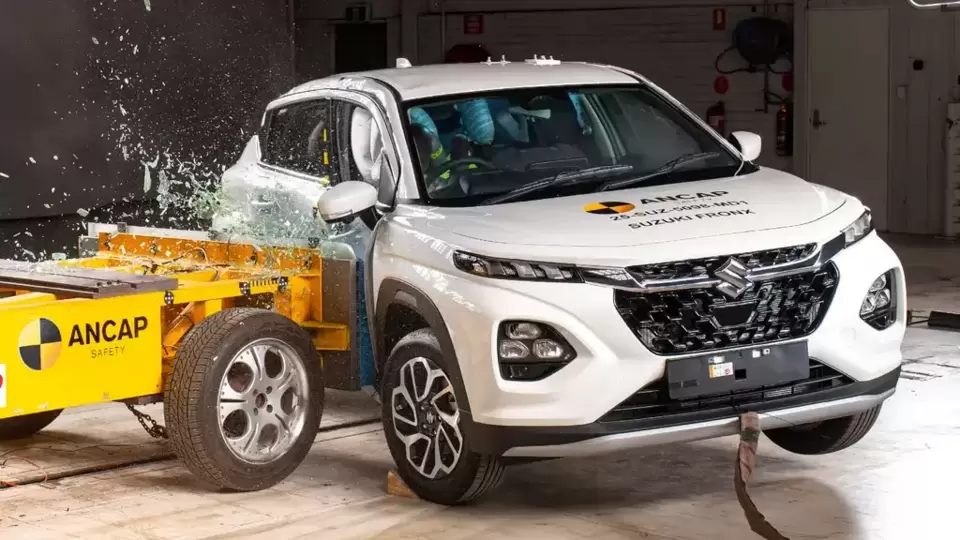
The Fronx recorded moderate scores across the four key assessment areas. Adult Occupant Protection stood at 48 per cent, Child Occupant Protection at 40 per cent, Vulnerable Road User Protection at 65 per cent, and Safety Assist at 55 per cent. Despite acceptable results in some crash scenarios, a critical failure during testing had a major impact on its safety rating.
Rear seatbelt failure raises alarm
The most serious issue emerged during the full-width frontal crash test. The rear passenger seatbelt retractor failed, causing the belt to release unexpectedly. This allowed the rear crash test dummy to move forward without restraint and strike the front seat.
Seatbelt failures are considered rare and extremely serious. Following this incident, ANCAP Chief Executive Officer, Carla Hoorweg, advised that adults and children should avoid using the rear seats of the Suzuki Fronx until the cause of the failure is fully investigated and corrective action is taken.
Adult occupant protection overview
In the frontal offset crash test, the passenger compartment remained structurally stable. However, protection for the driver’s chest was rated weak, while foot protection was marginal due to excessive pedal movement. The front passenger received better protection, with most body regions rated as adequate or good.
The full-width frontal test exposed major weaknesses for rear seat occupants. Chest protection was rated poor, and excessive forward movement of the dummy resulted in poor head protection. This outcome alone resulted in a zero score for this test. Side impact protection was more reassuring, with good results across most critical body areas, although chest protection was only adequate. In the oblique pole test, chest protection was marginal, while head and pelvic protection remained good.
The Fronx does not feature a centre airbag, and far side impact protection could not be evaluated due to missing supporting data.

Weak child occupant safety performance
Child occupant protection was another area of concern. The Fronx is not equipped with rear seatbelt pre-tensioners, which led to poor restraint of child dummies in both frontal and side impact tests. In the frontal offset crash, head and neck protection for both six-year and ten-year old dummies was rated poor, resulting in their scores being capped at zero.
In the side impact test, the head of the six-year old dummy made contact with the adjacent child restraint, leading to poor protection once again. Although the vehicle offers ISOFIX anchorages and top tether mounts for child seats, the absence of a child presence detection system further affected the overall score.
Pedestrian and vulnerable road user protection
The Suzuki Fronx performed better in tests focused on pedestrian, cyclist, and motorcyclist safety. The bonnet and windscreen provided mostly good to adequate head protection, though the windscreen pillars and bonnet edge recorded weaker results. Protection for the lower legs was rated good, while pelvis and femur protection remained poor.
The autonomous emergency braking system showed good performance in most pedestrian and cyclist scenarios and adequate performance for motorcyclists. However, the system does not operate when reversing, which affects its effectiveness in certain real-world situations.
(Also read: Maruti Suzuki Ciaz scores 1 star in Global NCAP crash test)
Safety assist and driver assistance systems
The Fronx comes equipped with a range of driver assistance features, including autonomous emergency braking, lane keep assist, emergency lane keeping, blind spot monitoring, and speed assistance systems. AEB performed well in car-to-car and junction scenarios, successfully avoiding or reducing the severity of collisions.
That said, the vehicle lacks head-on AEB functionality and does not offer a direct driver monitoring system. While seatbelt reminders are provided for all seating positions, occupant detection is missing for the rear centre seat.
Fronx exported from India
The model that was tested by the agency was made in India. In fact, the manufacturer makes the Fronx in India for over 80 international markets, including key regions in Latin America, the Middle East, and Africa. One of the most notable successes has been in Japan, where the vehicle has reportedly played a central role in driving up the model’s overall export numbers.