Nearly 70,000 financially challenged families in the city will get food grains and pulses delivered home from this week as part of the Pradhan Mantri Garib Kalyan (PMGK) scheme even as the UT administration started lifting stocks allocated to it by the Central government from Tuesday.
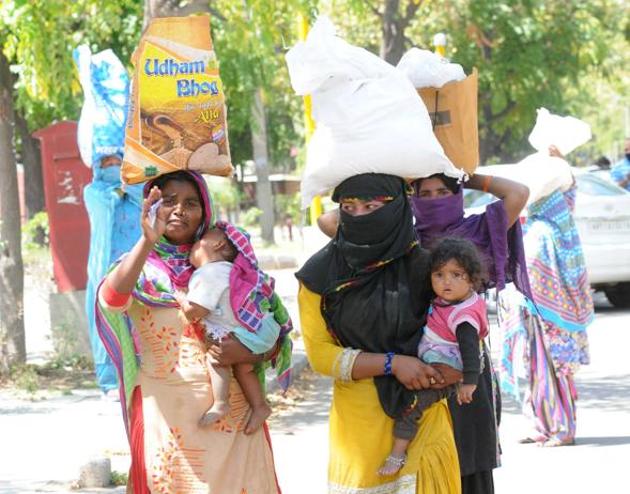
Each family will get 15 kg wheat per head and 1 kg pulses per family per month, an additional 5 kg, as part of the scheme for which food quotas were doubled for April, May and June following the India-wide lockdown after the Covid-19 outbreak.
Confirming the development, UT adviser Manoj Kumar Parida, said, “A list of families who are now getting direct ration money through direct bank transfer (DBT) scheme will get these wheat and pulses in addition to money.”
About 156 families under Antyodaya (AAY) and 63,457 priority households (PHH) here get food grains and pulses every month. More than 2.75 lakh persons are likely to benefit from the scheme.
For others, the administration will supply ration and food according to arrangements made during the curfew.
Door-to-door delivery
{{/usCountry}}Door-to-door delivery
{{/usCountry}}In Chandigarh the ration depots, traditionally used across the country for distribution of food grains to families under the public distribution system, were discontinued around five years ago. Instead, money was transferred directly to the bank accounts of the targeted beneficiaries.
“We will ensure door-to-door delivery of food grains and pulses with the recently introduced delivery system in the wake of the coronavirus outbreak. Our sanitised vehicles and staff will carry a list of beneficiaries and deliver it to their homes. Food grains and pulses will be cleaned and packed in five kg packs to be distributed,” Parida said.
To distribute the food stock the administration plans to use the door-to-door delivery system it put in place in the colonies and peripheral areas after the curfew.
Delay in lifting food grains
“The food grains and pulses were allotted four days back and we have started lifting these. To avoid delay due to the tendering process, we have given the job to National Cooperative Consumers’ Federation of India Ltd (NCCF). Unlike other states we do not have a network of fair price shops. We give ration money directly to banks and do not follow the usual PDS system as in the rest of the country. Hence while others may use existing infrastructure we have to create one,” Parida said.