The Karnataka government has set in motion a plan to expand the capacity of the Illegal Foreigners’ Detention Centre (IFDC) at Sondekoppa village in Nelamangala on the outskirts of Bengaluru.Though the construction was completed in 2019, the facility became operational in October 2020.
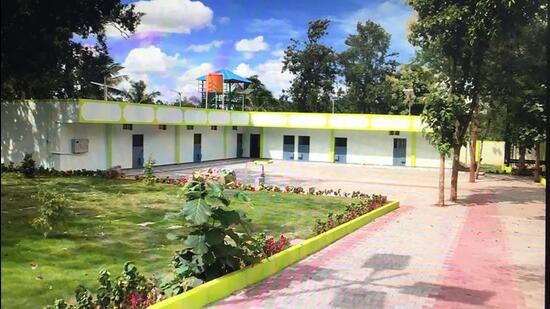
The Karnataka high court on August 12 had pulled up the state government over keeping illegal Sri Lankan immigrants in the central prison instead of the designated detention centre. Based on this, a multi-department meeting was chaired by Karnataka home minister Araga Jnanendra. During the meeting, Jnanendra had asked the state police and the social welfare department to increase the capacity of the detention centre.
The minister had even said that illegal immigrants and foreigners staying even after their visa expired need to be deported as “they pose a threat to national security by indulging in anti-national activities.”
A senior officer in Karnataka police on anonymity said: “With the expansion of the detention centre, there will be a renewed effort to deport illegal immigrants from the state.”
IFDC, which is state’s first detention centre, was built 40km outside Bengaluru to detain illegal immigrants and has a capacity for 30 to 40 people.
{{/usCountry}}IFDC, which is state’s first detention centre, was built 40km outside Bengaluru to detain illegal immigrants and has a capacity for 30 to 40 people.
{{/usCountry}}“Each (immigrant’s) case, whether it is the problem of African nationals who have been booked in drug-related offences or illegal Bangladeshis, about whom an intelligence report has been to the central government, is different,” said a senior IPS officer in the state, who requested anonymity.
He, however, added: “We are keen on the restarting the efforts to deport them.”
According to the IPS officer, the proposal for expanding the detention centre came after the Karnataka high court issued a notice to the Centre and the state on August 12 after hearing a PIL seeking arrangements to shift 38 Sri Lankan citizens, who were victims of human trafficking and had been languishing in the central prison in the city for over a year, to the detention centre.
The 38 Sri Lankan natives were apprehended in Mangalore without valid documents. They were promised to be taken to Canada, for which they had paid the concerned agents. Later, an investigation by the National Investigation Agency revealed that the people, who were initially booked as the accused in the first information report and were detained in the Bangalore Central Jail, were victims of human trafficking and hence are to be treated as witnesses in the case.
The petition was filed by Karnataka State Legal Services Authority (KSLSA) seeking directions to immediately set up sufficient number of detention centres with basic amenities in the state for the immigrants awaiting deportation.
A division bench of acting chief justice Alok Aradhe and justice S Vishwajith Shetty had issued the notice. The plea also sought a direction to the respondents to take immediate steps for the deportation of the illegal immigrants in the state, within the time limit that may be fixed by the court.
The plea stated that on May 12, the District Legal Service Authority member secretary had sent a report to KSLSA stating that despite the order passed by the trial court judge, the detention centres have not been set up by the deputy commissioner and all 38 victims are still in jail.
As the order came as an embarrassment for the government, the home minister asked the police to launch a crackdown on the illegal immigrants in the state.
The intelligence department of the Karnataka police is preparing a report on Bangladeshi citizens residing illegally in the state, said the officer citied above.
“The final report is yet to be completed and the final numbers are yet to be tabulated, but as per the findings, there are around 2.5 lakh illegal immigrants from Bangladesh living in the state. Out of this, close to two lakh are living around Bengaluru city,” said the officer.
Apart from the settlements on Bengaluru outskirts, migrants are also working in the estates of Chikkamagaluru and Kodagu districts, the officer added. “We are aware of the presence of illegal immigrants in the state, and police are taking the required steps. But the recent arrests have shown that a large number of Bangladeshis have obtained Indian documents such as Aadhaar cards and voter identity cards. So, this report will be the first step towards the remedial action,” he said.
The officer also added that even though the Foreigner Regional Registration Office’s (FRRO) records show there are more than 900 foreigners — whose visas have expired but are still staying in the city — with at least 43 being booked in criminal cases, less than 10 people have been deported in the past two years.
As many as 70 foreign nationals were arrested in 2020 under the Narcotics Drugs and Psychotropic Substances Act, 1985 (NDPS) in comparison to 44 in 2018 and 38 in 2019, according to Bengaluru police, while the number of arrested persons in 2020 under the NDPS Act increased by 200% last year, as per police records.
According to the officer, the biggest problem has been the legal complication in deportation. “In case of those who are overstaying or illegal immigrants with criminal background, once they are charge-sheeted, they have to be in the country till the hearing ends, which means we can’t deport them,” the officer said.
“In case of those who don’t have a criminal record, we can’t keep them in prison, as the court pointed out. So, if we have a large holding capacity for illegal immigrants, we will be able to speed up the deportation process,” the officer added.