It’s illegal. It’s risky. Yet pedestrians and motorists use it because it exists. And because they see others doing the same. Illegal shortcuts on roads – created by breaking the cemented median or cutting or bending the iron grilles – are tempting given that they help save on time and fuel, but also extremely dangerous, not just for those using it but also for the approaching fast-moving traffic.
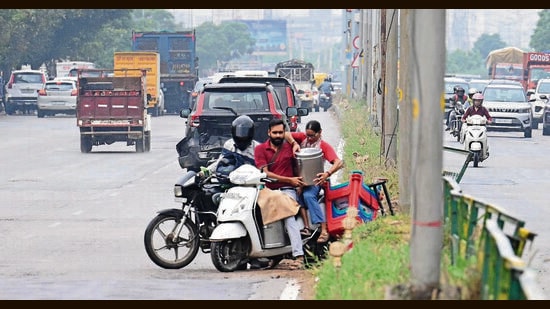
A drive along the Airport Road stretch from Gopal Sweets in Kharar to Chatt lightpoint area in Zirakpur revealed that there are at least 32 such gaps in the central median, which are commonly used by motorists and pedestrians alike. All this while the Greater Mohali Area Development Authority (GMADA), which is responsible for the maintenance of infrastructure on this crucial road, turns a blind eye to this glaring gap in road safety.
The Airport Road is a 200-foot-wide arterial highway that cuts across Mohali, connecting Kharar, Banur, Zirakpur, while providing a key route to the Shaheed Bhagat Singh International Airport. On an average, at least 20,000 vehicles, including heavy vehicles such as trucks, use the stretch on a daily basis.
The incidence of accidents is also high. In just four years – from 2017 to 2021, this nearly 14km stretch has claimed 73 lives in 176 accidents. Traffic police officials, however, say they haven’t compiled data on the deaths on this stretch in recent years.
{{/usCountry}}The incidence of accidents is also high. In just four years – from 2017 to 2021, this nearly 14km stretch has claimed 73 lives in 176 accidents. Traffic police officials, however, say they haven’t compiled data on the deaths on this stretch in recent years.
{{/usCountry}}Accidents & near-misses a daily affair
Commuters, however, say that accidents and near-misses are a regular phenomenon on this road. Dharmesh Garg, an IT professional who uses the road on a daily basis to get to work, says the unpredictable movement through these road cuts has changed the way he drives. “I use this road every day, but I always keep my vehicle in the middle lane because if I keep it on the right or left, anyone can appear at any time,” he said.
Road-safety expert Harpreet Singh says unauthorised median cuts pose a particular risk to two-wheeler riders. “Unauthorised cuts serve as high-risk points for fatal crashes, especially for two-wheelers as they try to benefit the most from these. No unauthorised cut should remain on any road in the city. This stretch has a huge volume of traffic and should have strict adherence to policy,” he said.
Singh suggested treating Airport Road as a zero-tolerance corridor for traffic violations and using it as a pilot project for road-safety enforcement.
Road-safety expert Harman Sidhu explains that unregulated openings create conflict points between vehicles moving in different directions. “Vehicles, mostly two-wheelers, suddenly come in front of fast-moving four-wheelers in the right-most lane. If the four-wheeler driver does not react quickly, it results in serious or fatal road crashes,” he said.
Risk higher during late nights, early mornings
According to road safety experts, the risk is higher during lean traffic hours, particularly late at night and early in the morning. Such cuts should be closed first, followed by a study to determine whether any were required at specific locations. If a study found a need, the openings should be redesigned with safety measures.
According to road-safety data cited by experts, vulnerable road users, two-wheeler riders, pedestrians and cyclists, account for 80% of victims, while 51% of fatal crashes occur between 9pm and 3am. The Airport Road corridor has also been identified as a road-safety concern, with 12 locations marked as black spots.
Traffic police said they are coordinating with the road-owning agencies to improve safety on the stretch.
Deputy superintendent of police (DSP, traffic) Karnail Singh said, “Our focus is to ensure smoother traffic movement and reduce conflict points. We will continue to coordinate with the road-owning agencies and take measures wherever required,” he said.
Despite several attempts, GMADA officials remained unavailable for a response. Chief administrator Sandeep Rishi could not be reached despite multiple calls and messages. Chief engineer Ajay Garg stated that he is not handling the PR-7 (Airport Road) project. The executive engineer concerned too refused to comment.