
 E-Paper



630 students attempt to bell the CAT in Ludhiana
As many as 182 students appeared for the CAT exam in the morning shift at the Ludhiana centre, while 232 and 218 took the test in the second and third shifts


As many as 630 students on Sunday appeared for the Common Admission Test (CAT) at the lone centre in the district at Guru Tegh Bahadur National College, Dakha. With a reporting time for the first shift of the test was 8.15 am, students could be seen braving the morning smog to line up outside the centre as early as 7 am.
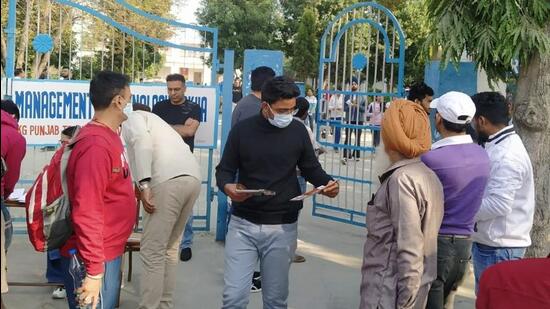
The test, which is the qualifying examination for admissions to the master’s in business administration at Indian Management Institutes (IMI) and top business schools in the country, was conducted in three shifts — from 8.30 am to 10.30 am; from 12.30 pm to 2.30 pm and from 4.30 pm to 6.30 pm, each shift had around 250 students.
As many as 182 students appeared for the exam in the morning shift , while 232 and 218 took the test in the second and third shifts.
As the examination centre was 12 km outside the city, several faced issues in arriving on time. In the second shift scheduled at 12.30 pm, four students reached the examination centre after 12.20 pm, but were not allowed to take the test for being late by five minutes.
Abhishek Rana, who works at a garment retail shop, said, “The motorbike I booked to travel to the college developed a snag while I was on my way, I could not get an auto rickshaw for 30 minutes. I had been preparing for the last year while working full-time.”
A resident of Moti Nagar, Abhishek added that with the exam being computerised, he was allowed to log in after 12.15 pm.
Echoing the sentiment, Harjit Singh, a parent said, “As the centre was located far away from the city, we had to arrive a day before the exam to avoid any last-minute trouble/ For students who are not familiar with the place, locating the centre will be an issue.”
Students who took the exam in the first shift said they found the pattern of verbal ability and reading comprehension (VARC) components different from previous years, adding that the questions left them flustered.
Speaking of the same, Jaskirat Singh, who had been preparing for the last year, said, “I found the first two parts of the exam a bit difficult and the exam was tougher than what I had expected.”
Neha Sharma who was taking the exam for the second time said the data interpretation part required students to prioritise the easier questions to score well, adding that the students who knew the small tricks could ace the quantitative aptitude part easily. Vinayak Budhiraja, however, found the quantitative aptitude difficult, “There were more questions from algebra, rest of the exam was moderate.”
The paper comprised 24 VARC questions, 20 from data interpretation and logical reasoning (DILR) and 24 from quantitative aptitude — with each carrying 3 marks.
The number of students who appeared for the exam from the district was noted to be lower than in some of the other parts of the country. Educationists have attributed the figures to the growing trend of the region’s youth wanting to move abroad.
Manish Dewan, an educator, said, “As the students in Punjab are more tilted towards moving abroad, the number of students who compete for CAT is low here compared to other states despite it being a gateway to a bright and prosperous future.”


