The Indian Railways is planning to extend the services of its sole hydrogen-powered train up to Delhi due to extremely low passenger turnout on the 89-km-long Jind-Sonepat section in Haryana where it is currently operating, officials said.
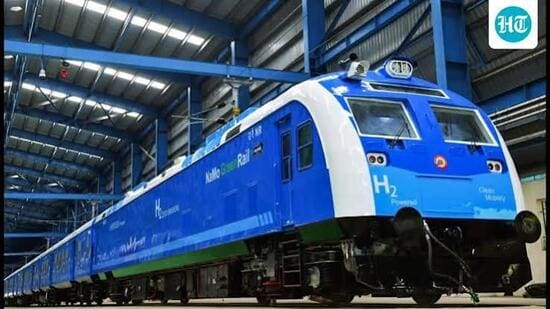
They said that although the train has a maximum carrying capacity of 2,600 passengers, only 40 to 60 passengers board the train during its entire journey between Jind and Sonepat. They also informed that due to the low footfall, it is making only one return trip daily though according to initial announcements, the train was supposed to make two trips between Jind and Sonepat.
“Its successful running by the Northern Railways for the last two months speaks volumes about the dedication and commitment of the team of experts involved in its day-to-day operation. They are working out all measures for its extension up to Azadpur Station near the wholesale fruits and vegetables market in Delhi,” a senior railway official said.
The launch of India’s first indigenous hydrogen-powered train on July 17 marked an important step towards adopting next-generation clean and sustainable transportation technology.
{{/usCountry}}The launch of India’s first indigenous hydrogen-powered train on July 17 marked an important step towards adopting next-generation clean and sustainable transportation technology.
{{/usCountry}}Railway officials said it is a pilot initiative that has not only demonstrated the vision of Atmanirbhar Bharat but has also placed India among a select group of countries - Germany, Japan, China and the United States - exploring hydrogen-powered rail transportation.
“A group of top experts are regularly monitoring its operation between Jind and Sonepat, as well as its trial runs for extension to Delhi. Since it is a new technology and passenger safety is paramount for the Indian Railways, a decision on its extension will be taken after due consideration,” an official said.
Railway staff said the hydrogen-powered train replaced a DEMU train that was previously operational on the route and which, too, received equally low passenger footfall.
“At present, besides the hydrogen-powered train, three other DEMU trains are operational on the route, and none of them has high passenger turnout due to the lack of office commuters or industry workers between the two cities,” a staff member involved in train operations said.
“There are hardly any office-goers or industrial workers on this route. Locals have also been demanding that it should be extended to Delhi for optimum utilisation,” the person added.
However, extending the service to Delhi poses other challenges, according to a section of experts. “It is a 10-coach train that can carry only 2,600 passengers, whereas trains operating from Delhi need more than 18 to 20 coaches to accommodate the large number of commuters due to capacity constraints on the railway tracks,” a senior official said, adding that fuel storage is not a problem as the train can run up to 250 km to 300 km on a full tank.
Officials said the train’s refuelling facility is currently available only at Jind. It can therefore cover 150 km in one direction, while the distance between Delhi and Jind is about 130 km.
Local passengers suggested that extending the train to Delhi would be ideal, but if there are operational constraints, its route could instead be realigned to cover Panipat and Safidon, creating a prominent circuit within Haryana.
“Currently, it operates from Jind to Sonepat and vice versa. So instead of moving in the UP and DOWN directions on the same route, this train can be extended to Panipat from Sonepat and, after covering Safidon, it can reach Jind, completing a circuit. Since Panipat is an industrial area, it will attract a lot of daily commuters,” a local passenger suggested.
“The train can start from Jind as usual and cover a distance of about 180 km via Sonepat, Panipat and Safidon before terminating at Jind. This will really help locals and improve the train’s footfall,” he added.