
 E-Paper



Central panel flags low contact tracing, vaccination coverage in Chandigarh
Suggests sero-survey across the city to know the extent of infection spread, during meeting with officials of the health department and admn, besides doctors of PGIMER

 Prefer HTon Google


A three-member central panel, in city to assist the UT administration with reining in the Covid-19 pandemic, has observed that contact tracing can be strengthened and vaccination coverage must be improved through rigorous information and educational activities.
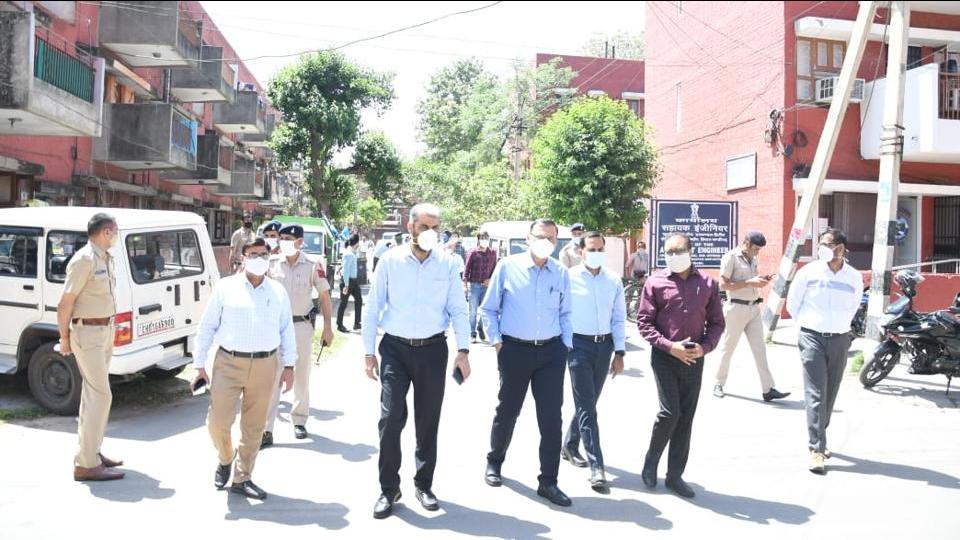
The team is led by Vijoy Kumar Singh, additional secretary and financial adviser, Union ministry of textiles, with experts drawn from Dr Ram Manohar Lohia Hospital, New Delhi, and Safdarjung Hospital, New Delhi.
The panel on Thursday held a two-hour meeting with officials of the health department and Chandigarh administration, and doctors from the Post Graduate Institute of Medical Education and Research (PGIMER) at the UT Guest House here.
Stating that the system developed by the authorities in Chandigarh was better than most places in the country, Vijoy said there was still a scope for improvement.
“In the contact-tracing exercise, the number of contacts currently stands at 13-15 persons. This can be improved to 20-25 persons,” said Vijoy, the chairman of the panel.
On the vaccination drive front, the panel took note of low response by health and frontline workers.
Even after over two months since the vaccination drive’s rollout on January 16, the coverage among healthcare staff and frontline workers was quite less, as compared to other states. Similarly, among the senior citizens, only 32,154 people had received the first dose through March.
“The vaccination coverage among the priority group of senior citizens has been less, and even if we assume that there are around 3 lakh senior citizens in the country, the coverage in one month is not encouraging,” said Arun Gupta, UT health secretary.
The panel also suggested that UT should conduct a sero-survey to know the extent of infection spread in the city, officials part of the meeting said.
Taking note of its steadily rising cases, the Union health ministry on Wednesday had asked Chandigarh to step up its test-track-treat strategy against the Covid-19 pandemic.
History of lapses
A team of experts, deputed by the central government in early September, had found that as the Covid-19 pandemic surged in Chandigarh in September last year, the administration was not able to get in touch with those testing positive within 24 hours of samples testing positive, which further delayed contact tracing.
The month saw a major surge in infections, with the highest single-day cases (449) being recorded on September 13, while the highest number of active cases (3,171) was reported on September 16.
After September’s 7,595 cases, the highest so far, March has the second-most infections at 5,229.
‘Make test results available sooner’
Second Innings Association, a civil society group, in a representation to the panel suggested that Covid-19 test results should be made available in the minimum possible time, so that the affected people can be isolated at the earliest.
“Presently, test results are received quite late, which delays the contact tracing exercise,” the association said. Emphasis should also be on taking strict action against those violating Covid norms and testing capacity should be enhanced at government institutes, it added.


