
 E-Paper



Centuries-old traditions come full circle at Ludhiana’s grandest Dussehra festivities on Daresi ground
With the Lord Ram- and Lakshman-led shobha yatra procession reaching the Daresi ground, Ludhiana, the 110-ft tall effigy of the rakshasa king Ravana will be set ablaze


The city’s grandest Dussehra setting at Daresi ground is set to delight a few thousands come Wednesday’s celebrations.
The iconic shobha yatra, which sets off from the near-three-centuries-old temple of Thakur Dwara Nauhria on the first Navratra before travelling through the old city till the day of Bharat Milap, has gone full throttle this year and will have as many as eight musical bands as part of the procession.
With the Lord Ram- and Lakshman-led procession reaching the Ramleela ground, the 110-ft tall effigy of the rakshasa king Ravana will be set ablaze before the sun sets over the horizon at around 5.30 pm — following which the procession will head back to the Thakur Dwara temple.
The 60-ft effigy of Meghnath had been set on fire on Tuesday, symbolising the battle with Lakshman.
Gaurav Dass Bawa, who heads the Thakur Dwara temple said “I am part of the 12th generation of my family’s temple traditions. We focus on following tradition and do not enlist actors for Ramleela. Instead, college students portray Ram and Lakshman. They don’t interact with the crowds once they adorn the robes.”
Chetan Bhardwaj and Umesh Vashisht, who will essay the roles of Ram and Lakshman this year are BA students at the SCD government college, while another BA student, Pawan Hanuman will portray Hanuman.
Speaking of the expected crowds, Shri Ramleela Committee Daresi president Dinesh Marwaha said, “Over 50,000 people are expected and two stages have been set-up for the Ravana dahan.”
Marwaha added that the Shobha yatra will pass through Chaura Bazar, Girjja Ghar Chowk, Partap Bazar, Shivala road and Ikbal Ganj Chowk.
Shouldering a century-old throne
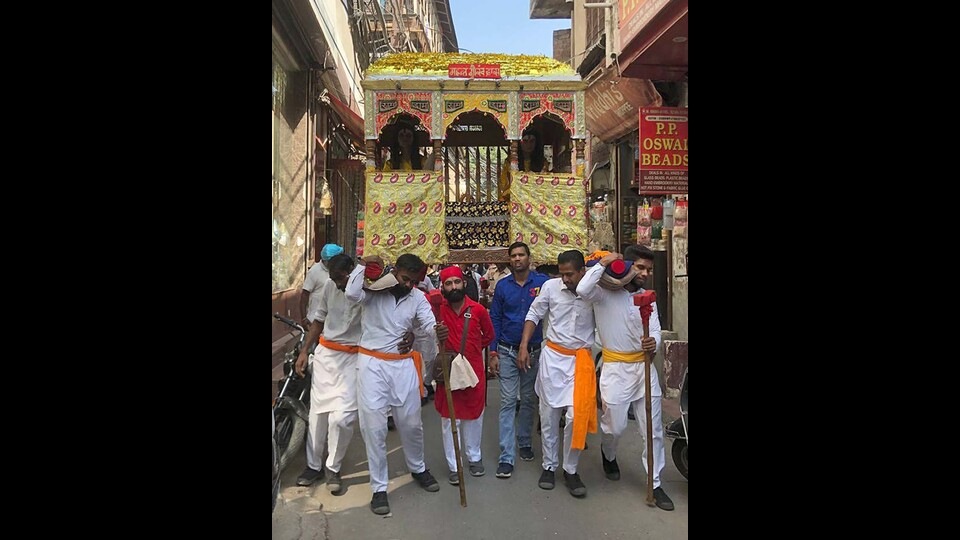
The throne that awaits Ram, Lakshman, and Sita at the Dussehra celebrations itself goes back over 100 years old. The people shouldering its weight, meanwhile, have spanned four generations.
The Mehra family from Sunet, Ludhiana, first took up the service in the late 1940s. “Our great grandparents started the service in exchange of a ₹5 payment and we have kept the tradition alive for generations. This year’s contract has gone up to ₹2 lakh rupees,” says Manpreet Singh, a resident of Pamal village.
“As the throne weighs over 10 quintals, it takes 10 people to lift. Carrying it for 5-6 hours is a herculean task, but following the tradition is a satisfying experience,” says Ricky, who is a plumber by profession.
Jagroop Singh Mehra, who heads a team of 12, details the complete experience, saying “As the streets are too narrow in the old city, we drag and tilt the throne as per the need.” He adds that children in the family also perform small duties, thus immersing themselves in the traditions.


