Even as the poll code of conduct was imposed in Panjab University (PU) from August 20 onwards owing to the Panjab University Campus Students Council (PUCSC) elections, the Lyngdoh Committee Guidelines which had come into effect from the same day itself are being flouted with impunity at the campus.
The Lyngdoh Committee Guidelines were recommended by a committee, headed by former chief election commissioner JM Lyngdoh, in 2005, the guidelines were accepted by the Supreme Court in 2006. PU has been following them since 2012 without any changes. They govern the student council elections and have laid different campaign guidelines during polls.
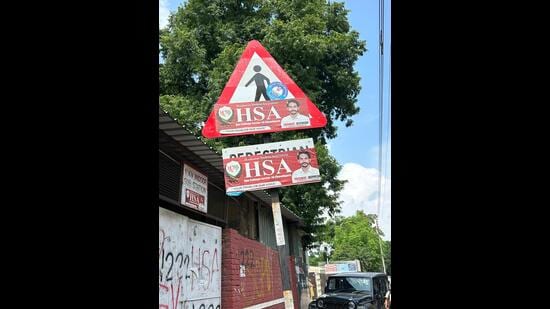
The use of printed stickers has been banned under the guidelines, however the ban is flouted on a daily basis during the campaigning. Hundreds of printed stickers for all the major parties are seen littered around major departments including University Institute of Engineering and Technology (UIET), University Institute of legal Studies (UILS) and near the Students Centre.
Further, printed posters are not allowed to be pasted on the walls of the university. This constitutes an offence under the Defacement Act, however stickers can be seen pasted at various places in campus. The wall of the UIET cafeteria is infamous for this, and in previous years has also remained covered with stickers as authorities turn a blind eye. It is also seen around other major canteens and near the Sector 14 market.
In case of defacement, action can be taken by police by registering a case under Section 3 of Delhi Prevention of Defacement Act 2007, which is followed in the UT. Offenders are liable to be punished with imprisonment which can extend up to one year and a fine up to ₹50,000. However, police officials said that complaints regarding this are never made by the PU authorities.
{{/usCountry}}In case of defacement, action can be taken by police by registering a case under Section 3 of Delhi Prevention of Defacement Act 2007, which is followed in the UT. Offenders are liable to be punished with imprisonment which can extend up to one year and a fine up to ₹50,000. However, police officials said that complaints regarding this are never made by the PU authorities.
{{/usCountry}}Stickers are also frequently seen pasted on cars around the campus, which is banned according to the Lyngdoh guidelines. While cars are checked at the various entry points of PU and the guards do make students take off such posters at the entry gates,but more posters are pasted after the vehicles enter the campus and nothing is done to deter such things inside the campus.
Entry of outsiders banned under election code
Car rallies are now being taken out by parties on a daily basis. For all candidate announcements, cavalcades of cars were seen moving near the Students Centre. When Association of Students for Alternative Politics (ASAP) announced their candidates, rallies were taken out from different parts of the campus leading to traffic jams inside the university, while MLA Sukhanand had come with his own entourage to support the students. For a National Students Union of India (NSUI) event as well, Deepinder Hooda had come to Students Centre in a similar fashion, even as PU authorities continue to maintain that entry of outsiders has been banned on campus following the declaration of election code. This also leads to traffic chaos for students and those who live near PU and its affiliated colleges.
Speaking about why the rules are broken year after year, a former Dean Students Welfare (DSW) on the condition of anonymity explained that a poll code committee is formed by PU to look into cases of violations of the Lyngdoh Committee guidelines. However, there is hardly ever any action taken in such cases, and at most, candidates can be fined a meagre ₹200 or ₹300 for such offences. The PUCSC poll candidates themselves are careful enough not to break rules, so action cannot be taken against them. Further, the fine amount cannot be increased, because as per the Lyngdoh Guidelines, poll expenditure has to be kept below ₹5,000 which itself is a mockery of the ground reality of such poll campaigns which can cost upto ₹40 lakh for the candidates.
When asked about what PU has done about poll code violators this year and whether they have received any complaints, Dean Students Welfare (DSW) Yogesh Rawal remained unavailable for comment despite repeated attempts to reach out to him.