Stalled in November 2019 after the Punjab and Haryana high court stay on cutting of roadside trees, the Tribune Flyover project, revived in May this year after the stay was lifted, is set to cost the central government 10% more five years later.
In a fresh project estimate prepared on the directions of the Union ministry of road transport and highways (MoRTH), which will fund the flyover construction work, the project cost has jumped from ₹183 crore to ₹203 crore in the past five years.
“MoRTH had approved ₹183 crore for the project in 2019, before the project was grounded due to the high court stay on cutting of trees. Five years later, the project cost has escalated to ₹203 crore. The revised estimate has been sent to the ministry for a fresh approval, following which the ministry will take a call on whether the project can be executed with the same consultant or a new one should be hired. We are hopeful of getting the approval soon and work on the project should begin within two or three months,” a senior UT officer, not wishing to be named, said.
The 1.6 km-long flyover is to be built from near the GMCH-32 roundabout up to the railway overbridge on Dakshin Marg after passing over Tribune Chowk. Then UT administrator VP Singh Badnore had laid the foundation stone of the project on March 3, 2019.
{{/usCountry}}The 1.6 km-long flyover is to be built from near the GMCH-32 roundabout up to the railway overbridge on Dakshin Marg after passing over Tribune Chowk. Then UT administrator VP Singh Badnore had laid the foundation stone of the project on March 3, 2019.
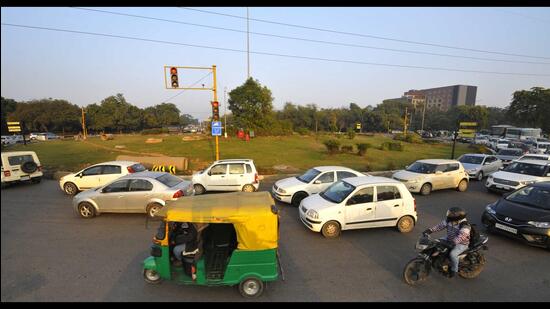
{{/usCountry}}It was being touted as a solution to the traffic mess in the vicinity of the busy Tribune Chowk. More than 1.43 lakh vehicles, including 1.35 lakh passenger car units (PCUs) cross Tribune Chowk — the rotary on the intersection of Dakshin Marg and Purva Marg — on a daily basis, as per traffic projections quoted then.
Initially, the UT administration had planned a 7-km flyover, but the Centre reduced the length to 3.5 km. Later, MoRTH further reduced the length to 1.6 km.
However, on November 20, 2019, the high court had stayed cutting of trees, acting on the plea of a local NGO, The Run Club, that had challenged the UT administration’s proposal to cut trees for the project.
Over four years later, on May 1 this year, the HC bench of acting chief justice GS Sandhawalia and justice Lapita Banerji lifted the stay on cutting of trees and allowed UT to proceed with the project in the manner in which it deems fit.
“The city was built up and conceptualised in 1950, and cannot continue to remain like that. Development as such is an ever going process...the town was planned for 5 lakh people. Today, we are dealing with the tricity, which is now bound by Panchkula, Mohali and New Chandigarh, having a population of over 15 lakh. The issue of access and travel to Chandigarh on account of being the capital of two states as such has to be taken into consideration,” the court held while rejecting arguments for preserving city’s original character.
It further recorded that traffic coming from Delhi/Dera Bassi into the city was held up for 90 minutes due to traffic jams.
Zirakpur with one lakh population has flourished due to high cost of living in Chandigarh and a large number of residents from there visit the city on a daily basis for various purposes. “Thus, all residents also flow continuously in and out of Chandigarh. The need as such is to ease the traffic in such situation rather than to block the development,” it said, while referring to a Supreme Court judgment, which said courts should be reluctant in interfering with infra projects and contracts involving technical issues as there was a requirement of the necessary expertise to adjudicate upon such issues.