
 E-Paper



Chandigarh: Rise in testing demand leaves labs overburdened, reports delayed
The Chandigarh health dept is dependent on PGIMER and GMCH-32 for testing, but both hospitals collect samples from their non-Covid patients as well

 Prefer HTon Google


The surging Covid-19 cases in Chandigarh have left testing laboratories in government health institutes overburdened and increased the waiting time for reports.
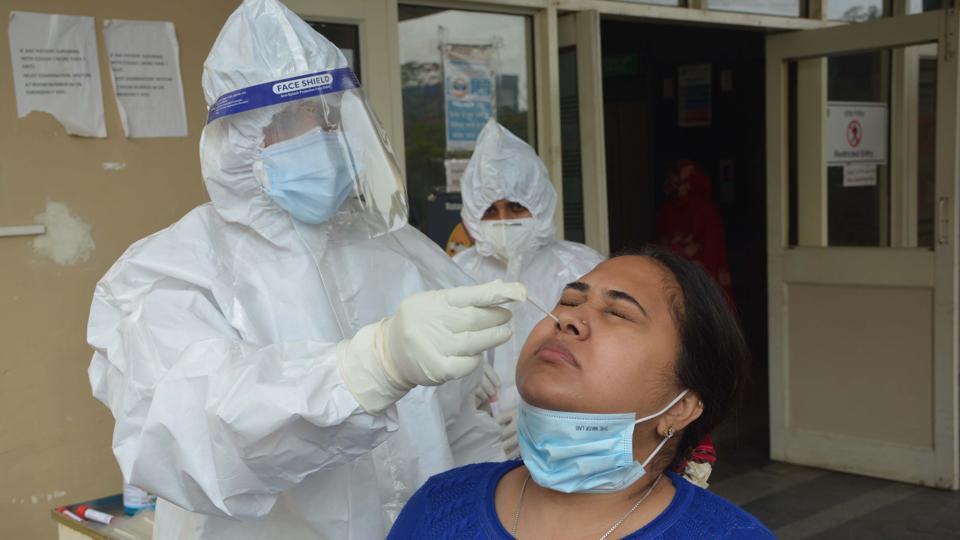
The UT health department is dependent on Government Medical College and Hospital (GMCH), Sector 32 and Post Graduate Institute of Medical Education and Research (PGIMER) for RT-PCR testing.
But as both hospitals collect samples from their own patients as well, sample load has multiplied manifold and so has the waiting time for reports.
“After I got symptoms for the virus, I voluntarily got tested at GMCH-32 on Sunday, but did not get my results till Wednesday morning. My testing registration number was also not generated timely, which further delayed my report,” said Vivek Singh, a resident of Sector 40.
“We send 400 samples to GMCH-32 and 1,500 to PGIMER on an average daily for RT-PCR testing. Besides, the health department is conducting 30% of its daily Covid tests through the rapid antigen testing kits. Generally, the RTPCR report is available within 12 hours for early morning samples, but when the samples are collected in the evening, the reports are available the next day. Also, it takes time to collect samples, transport them to the lab and update results on the central government’s portals,” said Dr Suman Singh, director, health services, Chandigarh.
“We are working hard to ensure that test reports are given in 24 hours. At present, there is no pendency in the testing labs,” she added.
‘Glitches in govt portal delaying results’
According to Dr Jasbinder Kaur, director-principal, GMCH-32, the hospital can conduct 2,000 RT-PCR tests per day. “But due to some technical glitches, the central government’s portal is taking more time for uploading the test results. As a result, people sometimes get the reports late. But we ensure that reports are given within 24-36 hours,” said, adding that they were working to increase the daily capacity to 2,500 tests.
Dr Mini P Singh, nodal officer for Covid-19 testing at PGIMER, said, “The institute has a capacity to conduct 2,500 RT-PCR tests per day and we are conducting tests round the clock. But some staff members are also down with the virus, limiting the number of available hands. We are still managing to give the reports within 24 hours.”
‘Adequate facility, GMSH-16 lab to be ready in 15 days’
Meanwhile, UT health secretary Yashpal Garg said an RT-PCR lab will soon be set up at Government Multi-Specialty Hospital (GMSH), Sector 16, so patients don’t need to turn to private laboratories.
“The lab at GMSH-16 will be made functional in the next 15 days. PGIMER and GMCH-32 also have adequate testing capacity and there is no pendency. Results are mostly provided within 24 hours, but got delayed recently due to glitches in the government portal,” he said.
During the peak of the first and second wave, the health department had to rope in private hospitals for testing after it found itself struggling to keep up with the testing targets fixed by the Union health ministry of Health.


