Himachal Pradesh chief minister Sukhvinder Singh Sukhu has directed all departments to complete pending development works in rural areas within the next three months, while reviewing the progress of various sectoral schemes sanctioned across the state.
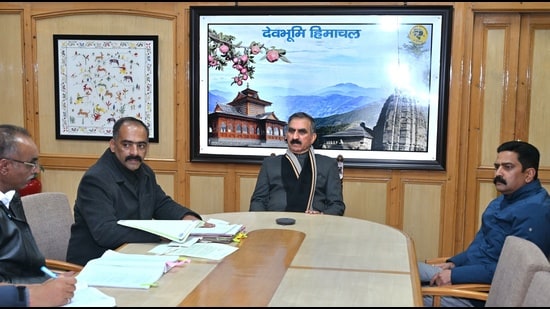
During the review meeting, it emerged that several works, despite having approved funds, were either yet to begin or were progressing at a very slow pace. These included projects under the Backward Area Sub Plan, MPLAD, Vidhayak Kshetra Vikas Nidhi Yojana, Local Area Development Fund, Mukhya Mantri Gram Path Yojana and other MLA-funded schemes.
Expressing concern, the CM said many small but essential works—such as installation of hand pumps, construction of footpaths, drains, community halls, retaining walls, footbridges, irrigation canals, boundary walls and village roads—had remained pending for a long time. He said such decentralised, need-based works were crucial for strengthening rural infrastructure and addressing local priorities.
Sukhu said that since the formation of the present government, “Vyavastha Parivartan” has been adopted as the guiding principle of governance to correct systemic imbalances and revive neglected rural development mechanisms. He noted that thousands of petty works had remained incomplete despite funds being released.
Providing details, the CM said 11,064 works worth ₹204 crore had not been started, while 16,834 works amounting to ₹348 crore had been under execution for long periods. He said strict directions had already been issued to deputy commissioners and field officers to expedite these works and report progress regularly.
{{/usCountry}}Providing details, the CM said 11,064 works worth ₹204 crore had not been started, while 16,834 works amounting to ₹348 crore had been under execution for long periods. He said strict directions had already been issued to deputy commissioners and field officers to expedite these works and report progress regularly.
{{/usCountry}}As a result of intensified monitoring, 18,262 works were completed between October 2025 and January 15, 2026. The progress is being tracked through a real-time dashboard, with field officers submitting daily reports.
Planning secretary Abhishek Jain said that 9,689 previously unstarted works worth ₹177 crore and 8,573 long-pending works amounting to ₹159 crore had been completed. The remaining works are expected to be finished within three months.
The CM reiterated the government’s commitment to transparent, need-based and equitable development across all constituencies.
CM orders launch of 4th phase of BPL identification survey from today
Chief minister Sukhvinder Singh Sukhu has directed the rural development and panchayati raj department to begin the fourth phase of the Below Poverty Line (BPL) identification survey from February 1, 2026.
Chairing a meeting of the department on Saturday, Sukhu said the state government was committed to ensuring that every eligible family was included in the BPL list so they could avail benefits under various government welfare schemes. He added that the survey was being conducted in five phases to ensure that no deserving poor family was deprived of its rightful entitlements.
In the first three phases of the survey, a total of 59,829 BPL families have been included in the BPL list across the state. District-wise, 2,204 families have been notified in Bilaspur, 13,786 in Chamba, 3,480 in Hamirpur, 10,807 in Kangra, 1,109 in Kinnaur, 2,957 in Kullu, 206 in Lahaul-Spiti, 12,045 in Mandi, 4,522 in Shimla, 1,277 in Sirmaur, 1,567 in Solan and 5,869 families in Una district.
The chief minister said that families eligible for inclusion in the BPL list also include orphans up to the age of 27 years, households having members above the age of 59 years and families having members with disabilities in the age group of 27 to 59 years. He further stated that families headed by women with no adult male members between 27 and 59 years of age, as well as families where the head of the household has a disability of 50% or more are also to be covered under BPL.
Additionally, families that worked for at least 100 days under MGNREGA during the previous financial year will be considered eligible. Households where earning members suffer from chronic diseases such as cancer, Alzheimer, Parkinson’s, muscular dystrophy, hemophilia or any other condition resulting in permanent disability will also be included. The government has also decided to include families living in concrete houses who have received financial assistance under state or Central housing schemes.