BATHINDA: As farmers are expecting a sharp rise in farm labourers’ demand to charge up to ₹6,000 per acre for paddy sowing this season, direct seeding of rice (DSR), which for the first time comes with an incentive of ₹1,500 per acre by the Punjab government, is getting more attention.
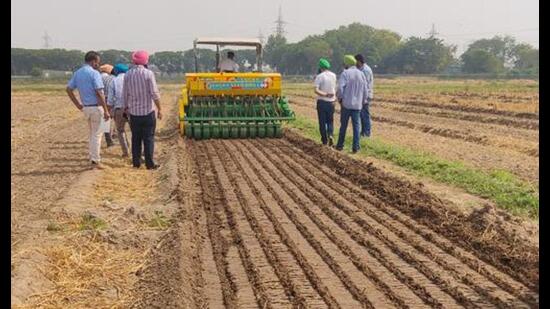
DSR ‘tar-wattar’ (good soil moisture), a low-cost mechanical sowing technique to reduce water footprint in the cultivation of water-guzzling rice by 20%, was indigenously developed by scientists of Ludhiana-based Punjab Agricultural University (PAU).
Sowing under this mechanical system will commence from May 20 where pre-germinated seeds are directly drilled in the fields with a tractor-powered machine under the water-conservation technique with no nursery preparation or transplantation unlike the conventional methods of sowing.
The Punjab government has been pushing the technique as an alternative to the traditional method as besides water conservation, the DSR also cuts the labour input cost.
During field trials, the DSR was done on 23,500 hectares in 2019 and the area under this technique jumped to 5.4 lakh hectares in 2020.
Last year, mechanical sowing was done on nearly 6 lakh hectares and the state agriculture department plans to take it to 10 lakh hectares in the 2022-23 kharif season.
{{/usCountry}}Last year, mechanical sowing was done on nearly 6 lakh hectares and the state agriculture department plans to take it to 10 lakh hectares in the 2022-23 kharif season.
{{/usCountry}}Agriculture experts say while there was no adverse impact on the yield, farmers can save more than ₹3,000 per acre of labour cost input for sowing by switching to mechanical sowing.
According to the official data, in 2021-22 kharif period, more than 26 lakh hectares area of Punjab was under cultivation of non-basmati varieties and rice growers of the state depend heavily on labourers from Bihar and Uttar Pradesh for sowing.
Farmers in Muktsar, Sangrur, Bathinda and other districts say the farm labourers are demanding ₹6,000 per acre against last year’s ₹3,500-4,200, besides sundry expenses.
Harcharan Singh, who owns 7 acres at Gurusar in Muktsar district, said the new technique has the potential to improve the economic condition of paddy growers, but a farmer needs to be vigilant in the first 21 days for weed management.
“When the input cost on labour is increasing every year, the DSR is a viable option to save more on the overall cost on production and conserve water. This technique maintains the balance of iron content and it does not cause fungal infection,” he said.
Harvinder Singh of Sangrur’s Dhanaula district is sowing ‘parmal’ varieties on 65 acres owned by his joint family using the DSR method since 2020 to save over ₹3,000 per acre. “As there was a shortage of labourers two years ago due to the pandemic-induced lockdown, I had to switch over to the DSR. I found it farmer-friendly as irrigation requirement is significantly low and it eliminates the dependence of farm labourers,” he added.
PAU principal agronomist MS Bhullar said the success of DSR ‘tar-wattar’ can be gauged from the adoption of the technique, which saw a surge of 96% in 2021 in comparison to 2019 during the trial run. When it was officially launched in 2020, there was no financial assistance but the area under the DSR increased with teething problems, he said.
“The DSR is a skill development for paddy growers to conserve water with hardly any impact on their earnings. Rodent attack and weed management are the only two aspects that a farmer is needed to be vigilant about. There are highly effective chemicals to deal with the two issues,” he added.
Gurpreet Singh from Mehraj in Bathinda said he has been producing 32-35 quintals of paddy per acre with the DSR technique and the yield is on a par with the traditional method. He said the DSR reduces chemical load as fungicide is not required under this technique.
An acre of land under the traditional rice cultivation involves a cost of ₹12,000-15,000 whereas under the DSR method, a farmer needs to spend only ₹8,000-12,000 on the same area, he said.
“The DSR improves soil quality and wheat produced on the same field gave me an additional 24 quintals per acre. Being a new technique, farmers should remain patient with manageable challenges of weeds and rodents,” he said.