The uptick in the infection numbers, which had started in the second week of March and transformed into a deadly second wave, caught the authorities off guard resulting in a crisis in the city.
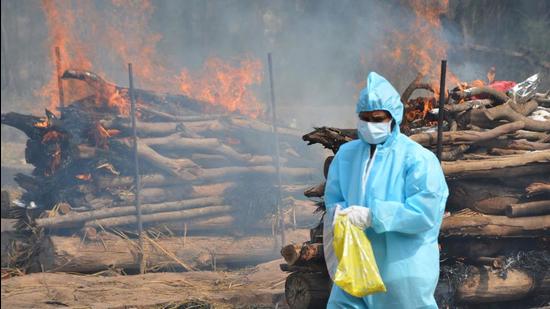
With limited resources available in government hospitals, the system trembled under the burden of widespread infections, amid influx of patients from the National Capital Region and neighbouring states. The experts, however, say it is time to look for loopholes in the system and fix them to deal with any urgency in the future.
Ventilator-supported intensive care units
The pandemic raged on in the first 15 days of May, leaving critical Covid-19 patients scrambling for intensive care beds in city hospitals. Even though the number of ICUs were doubled in the last one and a half months, the arrangements were not able to cater to the increased demand.
There were instances of patients dying while waiting for ventilators.
UT health secretary Arun Gupta said, “Despite being able to more than double the number of beds from the first wave, we were still left wanting. Government Medical College and Hospital, Sector 32 (GMCH-32), and GMSH-16, besides Post Graduate Institute of Medical Education and Research (PGIMER), will be adding more ventilator beds. We are preparing GMCH-32 to convert at least 50 more ICU beds.”
Testing in government facilities
{{/usCountry}}Testing in government facilities
{{/usCountry}}Failing to expand testing facilities in government institutions even till early March, the UT administration roped in private laboratories to meet the target set by the Union health ministry. The UT administration had asked PGIMER and GMCH-32 to expand testing, but the capacity could not be stretched beyond processing 950 samples a day.
With cases seeing a major rise in early April and more samples being collected for RT-PCR test, the turnaround period for reports also increased to 48 hours. Underlining the importance of prompt testing, Dr Rajesh Kumar, former head of community medicine department and school of public health at PGIMER, said, “If diagnosis is delayed, infection spreads. It takes just 6 hours to conduct the RT PCR test and my impression is that there are inadequate machines and workforce in the city. The testing capacity should be increased to reduce time from sample taking to availability reports which inturn will help better management of the pandemic.”
It was only after two months that authorities on May 24 announced that daily testing levels at GMCH-32 had been increased to 700 per day, from 400. PGIMER announced that they were presently testing 1,200 samples, which had now increased to 1,500 per day.
Coordination among government agencies
Amid the peak of second wave on May 8, a war of words had broken out between the Chandigarh administration and PGIMER after UT had directed a private refilling plant in Dera Bassi not to fill cylinders from PGIMER from the UT’s quota.
Though UT had later allowed PGIMER to partake in some of its oxygen share, the incident had opened the Pandora’s box. Though the administration always wanted PGIMER to convert more beds for Covid-19 patients, the premier institute has not been keen for the same, suggesting that being a tertiary care institute non-Covid service cannot be closed even though non-emergency surgeries and OPDs have been shut.
UT had also written to the Union health ministry seeking directions for PGIMER to put additional resources at disposal to deal with the pandemic. Administration at PGIMER is of the opinion that load should be proportionally divided among all the health facilities. “Situations like this require command and control centres in which representatives from every department and hospitals are present and they take decisions in real time,” said Dr Rajesh Kumar.
Inconsistency in policies in tricity area
Even though the tricity area is de facto a single urban complex, the three administrations have struggled to formulate a uniform policy on Covid management, with varied night curfew timings, lockdown restrictions and failure to assist each other.
It was only after the intervention of the Punjab and Haryana high court that three the administrations were forced into action to set up a unified command centre. Also, when the cases were hovering between 400 to 600 in the second week of April, UT had imposed night curfew. However when the daily infection numbers reached around 850, the restrictions were withdrawn. Later, the administration had to come up with stricter restrictions of allowing only essential services in the city.
UT adviser Manoj Parida said, “Decisions are taken keeping in view all worst-case scenarios. In some areas, restrictions can be common, but similar policies in the three administrative units are not always necessary.”