
 E-Paper



Women drive Himachal’s natural farming initiative
Of 1.65 lakh farmers practising chemical-free farming in the state under the Prakritik Kheti Khushal Kisan Yojana (PK3Y), introduced five years ago, 60% are women

 Prefer HTon Google


Ganga Sarni Bisht, 56, has emerged as a pioneer of natural farming in Himachal Pradesh’s tribal district of Kinnaur. An M.Phil in Hindi, she was a teacher in Delhi before she decided to return to her roots and has now become a role model for women in the field of natural or zero-budget farming.
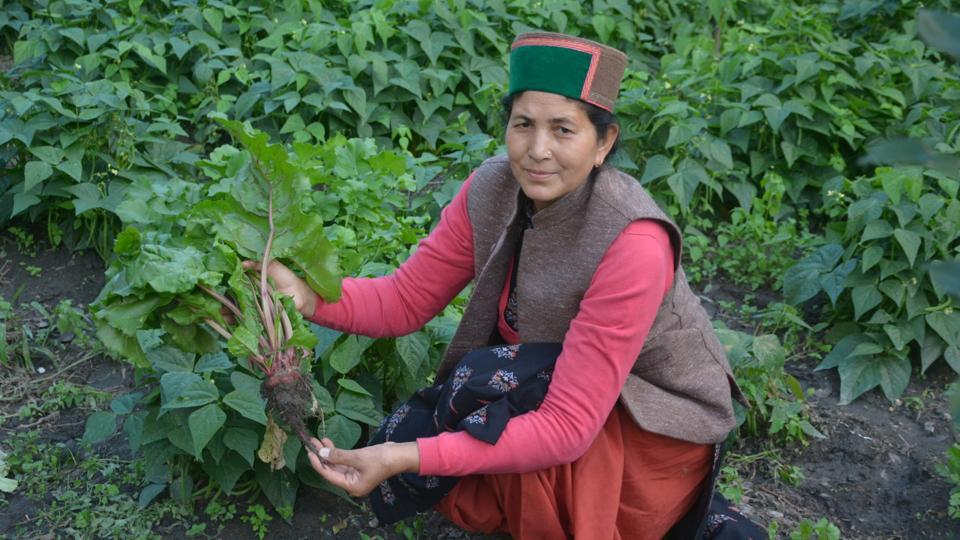
Ganga’s transformation began in 2013 when she discovered the growing demand for chemical-free produce in the bustling markets of Delhi. Determined to eliminate chemicals from her farming practices, she embarked on a quest for alternatives. This led her to the Subhash Palekar Natural Farming (SPNF) technique. Attending a training session conducted by Palekar, a Padma Shri awardee, at Kufri in Shimla district in 2018, Ganga was armed with knowledge that would change her life forever.
Also read: Himachal monsoon: 3 missing after pick-up truck falls into Sutlej in Kinnaur
With the support of her husband, Sushil Negi, a former Air India officer, Ganga adopted the SPNF technique on a trial basis. Buoyed by the success, she expanded its implementation across their 10-bigha land, including the barren patches. Initially, Ganga faced resistance from her in-laws, but she persevered and gained the freedom to farm in her innovative way. Alongside her husband, who took voluntary retirement six years earlier, Ganga dedicated herself to natural farming on six bighas. Their diversified crops, including beans, barley, peas, radish, carrot, beetroot, coriander, capsicum, garlic, and apple orchards, spanning 5 bighas, yielded fruitful results, with an annual income of ₹2.5 lakh from crops and seed savings of ₹5,000.
Reduces input cost
A significant benefit of adopting natural farming principles was the considerable reduction in farm expenditure. Ganga said her expenses have fallen from ₹12,000 to ₹3,000 per 6 bigha.
Her success story goes beyond financial gains. Embracing a mixed-farming approach allowed her to harvest and sell crops throughout the year, securing a loyal customer base, even in advance for marriages, due to the freshness and taste of the produce. Today, Ganga is inspiring other women make the shift to natural farming. Through her association with the Prakritik Kheti Khushhal Kisan Yojana, she got the knowledge to prepare inputs at home and gained independence from the market. Her husband secured an outlet at Tapri for selling natural produce.
In a bid to promote sustainable agriculture and reduce the dependence on chemical inputs, the Himachal Pradesh government introduced the Prakritik Kheti Khushal Kisan Yojana (PK3Y) five years ago. Initially, 2,669 farmers adopted natural farming and now 1.65 lakh farmers are practising it. Of them, more than 60% are women farmers. At present, the total area under natural farming in the state is 19,915 hectares.
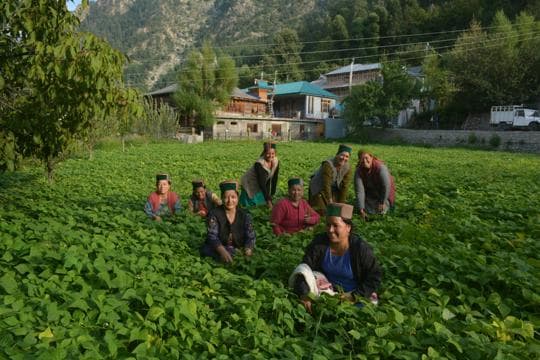
Climate-resilient techniques
This programme encourages non-chemical, low-cost, and climate-resilient natural farming techniques with a focus on enhancing the farmers’ incomes.
Nearly all panchayats in Himachal Pradesh have adopted natural farming models.
Natural farming discourages the use of chemical fertilisers and pesticides and relies on farm inputs derived from desi cow urine and dung, along with locally sourced leaves. This low-cost approach is not only in harmony with nature but also ensures the production of chemical-free and nutrient-rich crops.
“We are working on a business model for natural produce. We will consolidate the number of farmers practising natural farming and simultaneously increase the area under it,” says state project director, PK3Y, Himas Negi.
The scheme focuses on capacity building of farmers, particularly small and marginal ones, through regular contact and advisories on natural farming techniques.


