Housed in one of the iconic buildings of the Capitol Complex, designed by world-renowned architect Le Corbusier and declared a World Heritage Site by UNESCO for its global architectural significance, the Punjab and Haryana high court (HC) holds an important position in the judiciary of the country.
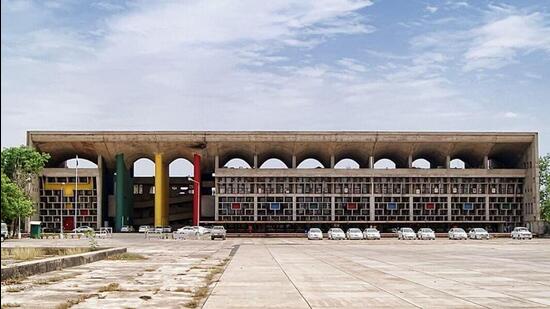
In recent years, the HC has been facing a shortage of space for members of the judiciary, supporting staff, lawyers, and the large volume of records generated on a day-to-day basis, besides the parking needs of the burgeoning number of advocates and litigants.
At the heart of these problems is the HC’s jurisdiction, spanning over two states — Punjab and Haryana — in addition to the Union Territory of Chandigarh. This, paired with a rise in the number of cases, thanks to a rapidly growing economy and greater awareness among citizens, necessitates that HC must be a constantly evolving body, located in a place that allows for futuristic expansion.
Over the years, efforts by the Chandigarh administration to address the space crunch have failed to meet the needs of the judiciary and its support system. The judiciary has been repeatedly pushing for additional space for courts, staff, litigants, the Bar, parking, and other allied services.
A proposal to set up a separate HC for Haryana was mooted when the state assembly passed a resolution in March 2002. In 2015, Haryana wrote to the Government of India, requesting for a separate HC on the grounds of inconvenience, high litigation costs and travel time for litigants. This was perhaps the best proposal at that time, which could facilitate delivery of justice to the masses of Haryana, reduce travel time and energy for the public, develop new areas and decongest Chandigarh, specifically the present HC complex. But the proposal did not find favour with the judiciary and the Bar, who were unwilling to move out of Chandigarh, a modern, well-planned city with strong infrastructure.
{{/usCountry}}A proposal to set up a separate HC for Haryana was mooted when the state assembly passed a resolution in March 2002. In 2015, Haryana wrote to the Government of India, requesting for a separate HC on the grounds of inconvenience, high litigation costs and travel time for litigants. This was perhaps the best proposal at that time, which could facilitate delivery of justice to the masses of Haryana, reduce travel time and energy for the public, develop new areas and decongest Chandigarh, specifically the present HC complex. But the proposal did not find favour with the judiciary and the Bar, who were unwilling to move out of Chandigarh, a modern, well-planned city with strong infrastructure.
{{/usCountry}}It is high time that we think beyond the expansion of the current HC. Setting up regional benches of the HC seems to be one option. For instance, in Uttar Pradesh, the Allahabad HC has a bench at Lucknow, and the Bombay HC, while having its principal seat in Mumbai, has benches at Aurangabad, Nagpur, and Panaji. Similarly, the Calcutta HC and the Guwahati HC also have multiple benches. These arrangements have been working well, ensuring faster, easier access to justice and helping reduce case pendency to some extent.
The Union Law Ministry, in consultation with the judiciary, must consider the idea of establishing regional benches of the Punjab and Haryana HC. They can be the guiding force in implementing such a proposal, if put up in the right context, and can also help in removing any roadblocks when required.
It is crucial to uphold basic urban planning principles for the holistic development of any state. The time is ripe to request the Supreme Court to sanction either a separate HC for Haryana or at least two regional benches for both states. The final decision should, of course, be taken in consultation with Punjab and Haryana to facilitate easier implementation. The location of these benches should be left to the states, as per the availability of land, connectivity and resources services etc. This, in turn, would help a large number of litigants from Punjab and Haryana, who would benefit from having justice available closer to their area of residence.
aks336@gmail.com
(The writer is a former chief architect of Haryana and vice-chancellor of the State University of Performing and Visual Arts, Rohtak)