Climate change is no longer a distant environmental concern for Punjab. It has become an economic, agricultural and fiscal challenge. Repeated floods, droughts, heatwaves, groundwater depletion and crop failures underline the urgent need to integrate climate resilience into the state’s financial planning.
Climate finance refers to local, national and international financial resources drawn from public, private and alternative sources to support climate mitigation and adaptation. The UN Framework Convention on Climate Change (UNFCCC), the Kyoto Protocol and the Paris Agreement recognise that developing regions require greater financial support because they are more vulnerable to climate impacts despite contributing comparatively less to global emissions. Punjab exemplifies this reality.
Global warming threatening agricultural productivity, water security
For decades, Punjab has served as India’s grain bowl, ensuring national food security. However, this achievement has come at a steep environmental cost. According to the Central Ground Water Board, the state’s groundwater development has crossed 170%, making it one of India’s most over-exploited aquifer systems. Climate projections under the Punjab State Action Plan on Climate Change also indicate rising temperatures, changing rainfall patterns and increasing climate variability, threatening agricultural productivity and water security.
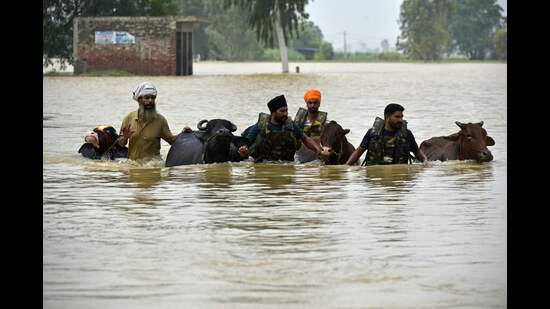
Punjab also faces the twin challenge of floods and droughts. The state witnessed devastating floods in 2004, 2008, 2010, 2013, 2019, 2023 and 2025. The 2025 floods alone affected nearly four lakh people, impacted about 2,000 villages, claimed 48 lives, and caused losses exceeding ₹13,000 crore. Simultaneously, Punjab is classified by the India Meteorological Department as a region frequently vulnerable to droughts. These recurring disasters demonstrate that climate resilience is now an economic necessity.
{{/usCountry}}Punjab also faces the twin challenge of floods and droughts. The state witnessed devastating floods in 2004, 2008, 2010, 2013, 2019, 2023 and 2025. The 2025 floods alone affected nearly four lakh people, impacted about 2,000 villages, claimed 48 lives, and caused losses exceeding ₹13,000 crore. Simultaneously, Punjab is classified by the India Meteorological Department as a region frequently vulnerable to droughts. These recurring disasters demonstrate that climate resilience is now an economic necessity.
{{/usCountry}}The Punjab budget 2026–27 has a total outlay of ₹2,60,437 crore, while net expenditure after debt repayment stands at ₹1,66,711 crore. Punjab’s projected gross state domestic product (GSDP) is ₹9,80,635 crore, with an expected annual growth of around 10%. Capital expenditure has increased to ₹18,381 crore, reflecting greater investment in public infrastructure.
Yet, unlike states such as Odisha, Bihar, Kerala and Assam, Punjab still does not publish a standalone climate budget statement. Climate-related expenditure is embedded across sectoral budgets, particularly agriculture, transport and infrastructure. While this approach has merit, it also makes climate expenditure difficult to identify, monitor and evaluate.
The agriculture and allied sectors have been allocated ₹15,377 crore, with notable climate-related initiatives, including ₹1,300 crore for climate-resilient horticulture, ₹600 crore for crop residue management to reduce stubble burning, and ₹40 crore for direct seeded rice (DSR) to conserve groundwater. Together, these explicit climate adaptation initiatives amount to around ₹1,940 crore, representing only 1.2% of Punjab’s net expenditure. This supports climate resilience indirectly through expansion of micro-irrigation, crop diversification, procurement of 1,279 eco-buses for cleaner public transport, and investments in healthcare, education and women’s empowerment that strengthen communities against climate-related shocks.
However, Punjab’s climate investments remain largely centered on agriculture, while climate change affects every sector of the economy. Floods damage roads, bridges and public infrastructure. Heatwaves strain healthcare systems and reduce labour productivity.
Groundwater depletion threatens agriculture, industry and drinking water supplies, while biodiversity loss weakens the ecosystems that sustain livelihoods.
Climate-related expenditures need to be clearly identified
Punjab now needs dedicated climate finance for wetland and floodplain restoration, urban forests, groundwater recharge, renewable energy, climate-resilient urban planning, biodiversity conservation, waste management through a circular economy, and climate-resilient public health systems. These investments reduce disaster losses, create employment, improve environmental quality and strengthen long-term economic resilience.
The state has already laid important groundwork. With support from the department of science, technology and environment, the Punjab State Council on Science and Technology and The Energy and Resources Institute (TERI) prepared an action plan for green budgeting. The next logical step is to institutionalise this process by publishing an annual climate budget statement that identifies climate-related expenditure across departments, distinguishes between adaptation and mitigation, establishes measurable outcomes, and improves transparency and accountability. Such a framework would also strengthen Punjab’s ability to attract national and international climate finance, including support from the green climate fund and other multilateral institutions.
Climate finance should not be viewed as an environmental expense but as an investment in economic stability. Every depleted aquifer increases irrigation costs. Every flood destroys public assets built with taxpayer money. Every heatwave affects productivity and public health, while every delayed adaptation measure raises the cost of future recovery.
Punjab has already demonstrated national leadership in ensuring India’s food security. It now has the opportunity to lead in climate-resilient governance. The state does not simply need larger allocations; it needs transparent climate budgeting, measurable outcomes and sustained investment across sectors.
In an era of increasing climate uncertainty, every budget must also become a climate budget. Only then can Punjab safeguard both its environmental future and its economic prosperity.
samitakaur1974@gmail.com
(The writer is director of Vatrukh Foundation, a Punjab-based NGO)