The Haryana assembly on Tuesday passed 11 Bills including the Haryana State Commission for Minorities Bill for setting up a state minorities commission to provide an institutional arrangement for evaluating the safeguards provided in the Constitution and laws for the protection of minorities.
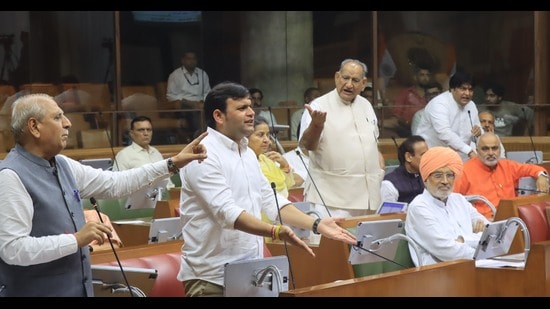
According to the statement of objects and reasons, the commission will make recommendations to ensure effective implementation of safeguards and laws in Haryana. “The commission with statutory status would infuse confidence among the minority communities about its working and effectiveness. It would also carry greater weight with the state government, its departments, boards, corporations, local authorities and other organisations concerned with the welfare and development of minorities,’’ the statement said.
The commission will consist of a chairperson and a vice-chairperson. The main task of the commission shall be to evaluate the progress of the development of minorities in the state, monitor the working of the safeguards provided in the Constitution and in laws enacted for the protection of the interests of minorities, and look into specific complaints regarding deprivation of rights and safeguards of minorities. The commission shall also undertake studies, research and analysis on issues relating to the socio-economic and educational development of minorities and make recommendations for effective implementation of safeguards and for appropriate measures to be undertaken by the state government.
The House passed the Haryana State Commission for Women (amendment) Bill, 2026, to increase the number of non-official members of the commission. The statement of objects and reasons of the Bill said that there has been an increase in the number of complaints, memoranda and other matters relating to women in the past few years.
{{/usCountry}}The House passed the Haryana State Commission for Women (amendment) Bill, 2026, to increase the number of non-official members of the commission. The statement of objects and reasons of the Bill said that there has been an increase in the number of complaints, memoranda and other matters relating to women in the past few years.
{{/usCountry}}“As a result, the workload and responsibilities of the commission have increased considerably. At present, there are five non-official members in the commission. In view of the increased workload, this number is not sufficient for the effective and expeditious disposal of the commission’s functions. Therefore, in order to strengthen the efficiency and institutional capacity of the commission, it has been considered necessary to amend section 3(2)(b) of the Haryana State Commission for Women Act, 2012. Under this, it is proposed to increase the number of non-official members from five to seven,” the statement said.
The assembly passed the Haryana Panchayati Raj (amendment) Bill, 2026 to amend the Haryana Panchayati Raj Act, 1994. According to the statement of objects and reasons of the Bill, under the existing provisions of the Act of 1994, a higher quorum than that required for an ordinary meeting has been prescribed for a gram sabha meeting for considering and approving eligible beneficiaries identified for government schemes and for preparing the gram panchayat development plan. “It is becoming difficult to achieve the prescribed quorum of 40 % attendance in the main meeting, 30% in the first adjourned meeting and 20 % in the second adjourned meeting, and the required proceedings are not taking place. Due to the required proceedings not being conducted in the meetings, there is a delay in implementing government schemes. Therefore, in order to rationalise the requirement of quorum, it is proposed to prescribe the attendance of 20 % of the total members in the main meeting, 15 % in the first adjourned meeting,’’ the statement said.
The House passed the Haryana Law Officers (Engagement) Amendment Bill, 2026 to increase the number of law officers. The Haryana Law Officers (Engagement) Act, 2016 was notified on September 14, 2016, with the objective of providing a transparent, fair and objective system for the engagement of law officers in the office of the Haryana advocate general and for matters connected therewith or incidental thereto. Keeping in view the changed scenario and particularly with the implementation of the Bharatiya Nyaya Sanhita (BNS), 2023, under which approximately twenty new offences have been added, imprisonment terms and the amount of fines have been increased for several offences, and provision has also been made for punishment of community service for certain offences, there is a need to increase the number of advocates to be appointed under the proviso to sub-section (3) of Section 6 of the Act, on the basis of special qualifications and experience, from 10 to 15 to deal with cases of a special nature, the Bill said.
The House also passed the Haryana Right to Business Bill to provide for self-certification, exemptions, expedited approvals, inspections through an enabling mechanism for facilitating the establishment and operation of eligible enterprises in the state. The Bill said that under the existing regulatory framework governing the establishment and operation of business enterprises in Haryana, entrepreneurs are required to obtain multiple approvals, licences and registrations from various government authorities before commencing operations. Such approvals are often processed sequentially by different state agencies, resulting in prolonged delays and significant procedural burdens for businesses, particularly micro, small and medium enterprises, which generally have limited financial and administrative resources.
The requirement to obtain all statutory approvals before establishment has hindered industrial development, entrepreneurship and innovation in the state. To address these challenges, it is proposed to introduce an enabling framework based on the principle of “Right to Business”, with the objective of promoting ease of doing business by reducing unnecessary procedural delays while ensuring compliance with applicable laws, regulatory standards and public safety requirements, the Bill said.