A combination of extreme weather abnormalities and rising summer temperatures over the last four-five years has pushed Punjab’s booming litchi industry into an economic crisis.
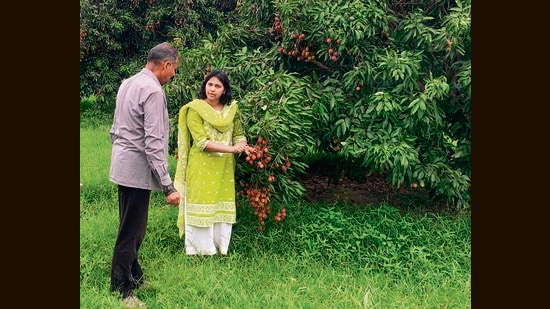
Despite an expansion in cultivation and an eager international market, orchardists across the state have been left reeling from severe crop degradation, stalling Punjab’s export momentum to Europe and the Middle East this season.
‘Dehradun’ and ‘Calcuttia’ are the main varieties grown in Punjab. The ‘Dehradun’ variety is distinguished by its deep red, round shape, while the ‘Calcuttia’ variety is slightly pointed and has a more squarish appearance.
According to the state horticulture department, Punjab’s litchi cultivation spans over 4,000 hectares across the semi-mountainous belt of Pathankot, Gurdaspur, Hoshiarpur and Rupnagar districts. Pathankot serves as the undisputed hub, commanding over 60% of the state’s total area.
While production has steadily scaled up to over 72,000 metric tonnes — contributing roughly 13% to India’s total litchi output — the vulnerability of the fruit to climatic shifts has exposed deep structural threats to its long-term viability.
Between 2021 and 2026, litchi cultivation in Pathankot grew by nearly 24%, expanding from 1,794 hectares to 2,222 hectares. During this same window, production more than doubled from 17,250 tonnes to 37,486 tonnes due to better orchard establishment. However, this growth has been heavily undercut by erratic annual weather patterns during the sensitive flowering and fruit development stages.
{{/usCountry}}Between 2021 and 2026, litchi cultivation in Pathankot grew by nearly 24%, expanding from 1,794 hectares to 2,222 hectares. During this same window, production more than doubled from 17,250 tonnes to 37,486 tonnes due to better orchard establishment. However, this growth has been heavily undercut by erratic annual weather patterns during the sensitive flowering and fruit development stages.
{{/usCountry}}Following highly successful trial shipments to the United Kingdom, the UAE and Qatar since 2023 via assistance from the Agricultural and Processed Food Products Export Development Authority (APEDA), growers were looking forward to aggressive trade expansion this year. Instead, a sudden, intense heat surge during the early summer harvest forced farmers to pluck their crops prematurely in June, forcing a total suspension of exports.
“The red colour of the skin is what dictates the premium cost in the market,” said Rachpal Singh, a 77-year-old veteran orchardist from Mammon village. Singh reported that persistent temperatures hovering between 40°C and 42°C severely discoloured his 2.5-acre crop, forcing a sudden ₹1.5 lakh loss on a ₹6.5 lakh contract. With input costs for labour, packaging, transport, and fertilizers averaging ₹4 lakh per acre, even minor quality dips push farmers into financial deficits. Current retail prices fluctuate unpredictably between ₹85 and ₹150 per kg depending entirely on appearance.
Pest attack and structural neglect
The climate shift has triggered biological complications as well. Dr Vinay Pathania, assistant professor of plant protection at krishi vigyan kendra (KVK), Pathankot, warned that prolonged high-temperature spells have made fruit cracking and severe sunburn routine events. Furthermore, the destructive litchi nut borer pest has thrived under these erratic conditions, forcing experts to advocate for immediate integrated insect and disease management (IPM) strategies. Compounding the environmental damage is a flawed local business model. KVK faculty member Manu Tyagi noted that a sizable portion of Punjab’s orchards are leased out to third-party contractors rather than being managed by the owners. “Since contractors focus heavily on maximising immediate, short-term returns, essential scientific orchard practices — such as canopy management and pruning for proper sunlight and air circulation — are routinely ignored, leading to declining tree health over time,” Tyagi said.
Scientific audits offer hope
As the state battles to protect a fruit that can remain commercially viable for 50 to 60 years, the horticulture department is looking toward agricultural science for survival. Jatinder Kumar, the state’s nodal officer for litchi promotion, said that the government was collaborating closely with national institutes to provide better training and exposure to Punjab growers. Concurrently, teams at the Punjab Agricultural University (PAU) are stepping up intervention.
A leading fruit science expert at the PAU, Dr Nav Prem Singh, revealed that scientists are currently running climate adaptability audits on several alternative litchi varieties sourced from Bihar and Uttarakhand. The goal is to identify and recommend harder strains capable of withstanding Punjab’s shifting soil and temperature profiles, ensuring that the state’s prized summer crop maintains its economic footprint on the global stage.