
 E-Paper



Mercury rises as sun makes an appearance in Chandigarh
Before this, Chandigarh experienced severe cold day conditions on Sunday and Monday, when the maximum temperature went over 6.5 degrees below normal


City’s maximum temperature rose from 11.2°C on Monday to 13°C on Tuesday as the sun made a comeback after a long gap, much to the residents’ delight.
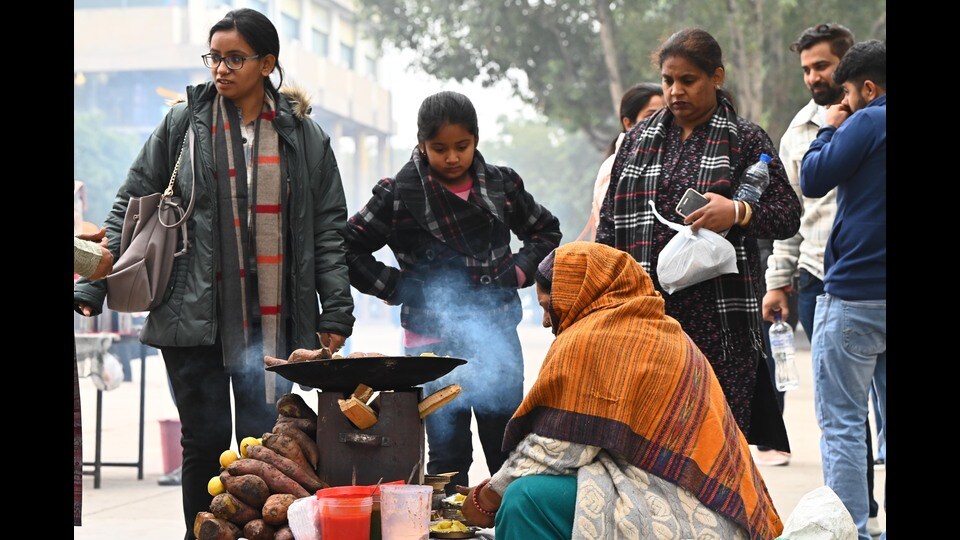
However, the maximum temperature was still 5.3 degrees below normal, making Tuesday a “cold day”, which is declared when the minimum temperature falls below 10°C and the maximum temperature goes 4.5°C to 6.4 degrees below normal.
The minimum temperature also fell from 6.5°C to 6°C, 1.4 degree below normal.
Before this, the city experienced severe cold day conditions on Sunday and Monday, when the maximum temperature went over 6.5 degrees below normal.
According to the India Meteorological Department (IMD), dense fog and below normal temperature are likely to continue for now.
The city was still colder than Manali (13.5°C), Dharamshala (17°C) and Solan (19°C). However, Shimla was colder with a maximum temperature of 12.2°C.
Speaking about this, IMD Chandigarh director AK Singh said, “Some sunlight is possible when fog exists in pockets and moves from time to time, but dense fog is likely to persist over the region in the coming days. The maximum temperature is also likely to remain below normal.”
An orange alert for cold day and cold wave conditions, and dense fog will continue in the city on Wednesday.
Orange alert is the second highest of the four-colour warnings used by IMD, asking people to stay alert and be prepared. A red alert has, meanwhile, been declared in adjoining parts of the region.
Visibility was initially at 1,500 metres at 5.30 am, but dropped significantly to 200 metres at 8.30 am, which is classified as dense fog as per IMD. It was still at 800 metres at 11.30 am, which is classified as shallow fog.
Five flights cancelled
Poor visibility impacted operations at Shaheed Bhagat Singh International Airport, where five flights were cancelled and 12 were delayed on Tuesday.
The cancelled flights included three that were to depart for Delhi, Mumbai and Hyderabad, and two that were to arrive from Pune and Jaipur.
Meanwhile, three departure flights to Delhi (IndiGo 6E-2177), Mumbai (IndiGo 6E-5261) and Hyderabad (IndiGo 6E-867) have been cancelled in advance for Wednesday, for the third day in a row.
Even at the Chandigarh railway station, the morning Shatabdi Express from New Delhi was rescheduled by 3 hours and 20 minutes, and reached here 4 hours and 20 minutes late.
The morning Shatabdi Express from Kalka to New Delhi also reached the Capital 47 minutes late.
Air quality still ‘very poor’
Air Quality Index (AQI) continued to remain “very poor” in several parts of the city for the second consecutive day on Tuesday.
At 376, the average AQI at 7 pm was highest at the Continuous Ambient Air Quality Monitoring Station (CAAQMS) in Sector 53, followed by 361 at the Sector 22 station, both in the “very poor” category (301-400) that can cause respiratory illness on prolonged exposure.
The air quality was “poor” (201-300) in Sector 25, where AQI was 295. It was 162 at the Haryana State Pollution Control Board station in Sector 6, Panchkula, which falls under the “moderate” bracket (101-200).
Chandigarh’s air quality was still worse than several parts of Delhi, such as Dwarka where the average AQI at 7 pm was 370, RK Puram (370) and Ashok Vihar (372). Even on Monday, AQI was in the “very poor” bracket, while on Saturday, it had crossed 400 to enter the “severe” bracket.


