Chief minister Omar Abdullah on Tuesday withdrew two bills proposing an increase in salaries and allowances of ministers and members of the Jammu and Kashmir legislature after objections from the BJP, the principal opposition party.
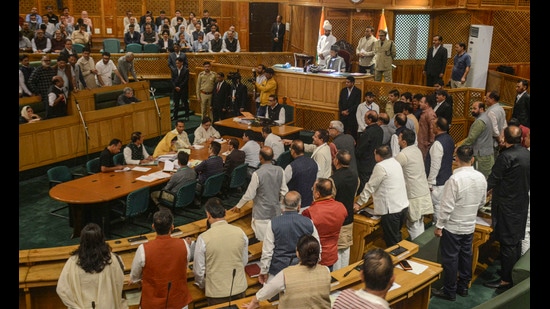
Responding to the objections, the chief minister said the House committee that had recommended the proposed hike had not recorded any dissenting note.
He also said that BJP members were privately seeking an increase in salaries and allowances, while attempting to politicise the issue by citing problems faced by daily wagers.
“I was never in favour of it. Ask my MLAs. I would repeatedly suggest to them against this. But there was pressure from both sides,” he said.
“But I told them that this will be done only when the whole House is ready for this. If a single member opposes, it will never pass. Now that the opposition is doing politics on this, I withdraw the bill,” Omar said.
An MLA in the J&K assembly draws a gross salary of around ₹1,50,000, while the proposed hike would have increased it by around ₹30,000.
{{/usCountry}}An MLA in the J&K assembly draws a gross salary of around ₹1,50,000, while the proposed hike would have increased it by around ₹30,000.
{{/usCountry}}The House subsequently approved the withdrawal of the bills by majority vote.
5 bills passed
The assembly passed five bills moved by the chief minister covering municipal governance, ease of doing business and ease of living, taxation, legislative members’ pension, and rationalisation and decriminalisation of offences.
The bills were introduced by Omar on September 24 and September 28.
The bills passed include the Jammu and Kashmir Municipal (Amendment) Bill, 2026, Ease of Doing Business Bill, 2026. The latter seeks to replace permission-based controls with rule-based governance and enable citizens and enterprises to plan, invest and work. The J&K Goods and Services Tax (Amendment) Bill, 2026, seeking amendments to the Goods and Services Tax Act, 2017, was also passed.
The J&K State Legislature Members’ Pension (Amendment) Bill, 2026, was also passed.
Another legislation, the Decriminalisation and Rationalisation of Offences Bill, 2026, was also passed. The bill seeks to amend certain enactments to decriminalise and rationalise offences, promote ease of living and ease of doing business, repeal certain enactments and address related matters.