
 E-Paper



One District One Product push: Bathinda farmers reap sweet dividends as honey production sees a 37% jump
The efforts of both the state and the central governments have started bearing fruits with Bathinda seeing a 37% jump in honey production 2023 to 1,100 tonnes.

 Prefer HTon Google


Apiculturist Kuldeep Singh from Bathinda’s Bandi village is earning ₹10 lakh to ₹15 lakh annually and is one of the many success stories as the central government-backed ‘One District One Product’ (ODOP) programme launched in 2021 gains a foothold in in the largest district of southwest Punjab. ODOP is an ambitious project aimed at holistic socioeconomic growth across all regions and Bathinda was earmarked to tap the potential of honey production. The initiative was conceptualised to help small and marginal farmers to boost their income.
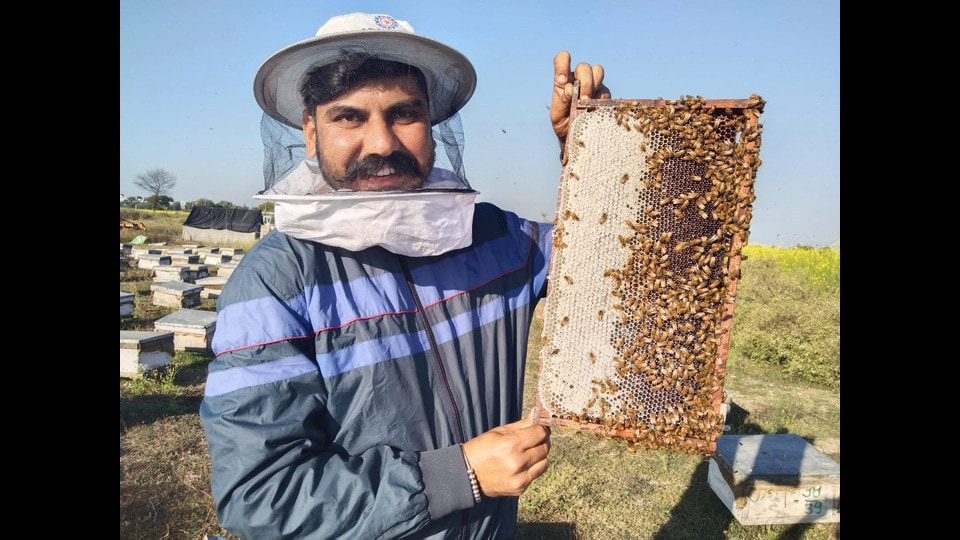
The efforts of both the state and the central governments have started bearing fruits with Bathinda seeing a 37% jump in honey production 2023 to 1,100 tonnes.
Despite the apiculture ushering in a new avenue for the farmers to boost their incomes, many challenges remain. The district has around 2,500 farmers engaged in apiary.
According to the general manager of Bathinda district industry centre (DIC), the implementing agency of ODOP, Preet Mohinder Brar the annual average honey production in the district was 800 tonnes, but last year it touched 1,100 tonnes for the first time. Authorities expect a further jump as more small farmers and landless are being covered under the project.
“A total of 22 honey processing units have been given to the beekeepers under the Pradhan Mantri Formalisation of Micro Food Processing Enterprises (PMFME),” Brar said.
Bandi’s Kuldeep is a second-generation beekeeper and recently got the Food Safety and Standards Authority of India (FSSAI) certification to gain the confidence of honey buyers.
“I am a second-generation beekeeper, and on the advice of experts Krishi Vigyan Kendra (KVK) and Punjab Agricultural University (PAU), I applied for FSSAI to ensure consumers about the quality of my product. In 2022, I produced honey worth ₹15 lakh, but in the next season, it dropped to ₹10 lakh. In April last year, ICAR-Central Institute of Post-Harvest Engineering and Technology (CIPHET) provided a unit to process raw honey under the Farmer First project in which we hope 20-25 beekeepers from Bandi and adjoining villages may join to reap the benefit,” he added.
Aparpal Singh, 43, from Tungwali village, has carved a niche for himself by harvesting honey from different flowers, including mustard, ajwain and ber (Indian jujube). Today, he has nearly 1,350 honeybee colonies that produce an average of 20 kg per box. However, the production has been hit partially due to the introduction of Bt cotton and few takers for the mustard crop in the region. The high use of pesticides and extended cold wave are other factors which he believes will lead to a fall in honey production.
“Earlier the bee colonies had ample vegetation to depend on with the traditional crops like desi cotton and mustard. After now almost the entire southwest Punjab switched to Bt cotton and I have witnessed a drop of 70-80% in nectar collection from cotton fields in the last decade. As mustard cultivation has also vanished in Bathinda and adjoining districts, we had to shift the bee boxes to far-off areas in Haryana and Rajasthan which means a surge in input cost,” he said.
But amidst all this new and budding farmers are now exploring other by-products of apiculture to reap more money.
A budding woman entrepreneur from Dialpura Bhaika village, Jasvir Kaur is exploring ways to earn more from selling beeswax, royal jelly, bee venom, propolis and pollen.
“A group of 13 women ventured into beekeeping two years back and now have 400 boxes. The horticulture department helps us sell our produce to government agencies and officials. We sell honey at Saras Melas held across India. After exposure of two years in beekeeping, I find that honey can be the last product as there is a huge market for five other products derived from bee boxes,” she said.
Another progressive farmer Gurpiar Singh said honey derived from mustard flowers is mainly exported to the West but the natural sweetener has few takers in the domestic market. He bats for a policy that compensates apiarists if the exporters pay them less than the existing cost of ₹130 per kg.


