
 E-Paper



Punjab governor Banwarilal Purohit resigns over personal reasons
In a short letter written to the President of India, Banwarilal Purohit, 83, cited personal reasons behind tendering his resignation

 Prefer HTon Google


In a surprise move, Punjab governor Banwarilal Purohit on Saturday resigned from the post, while also stepping down as the administrator of the Union territory (UT) of Chandigarh, the joint capital of the neighbouring states of Punjab and Haryana.
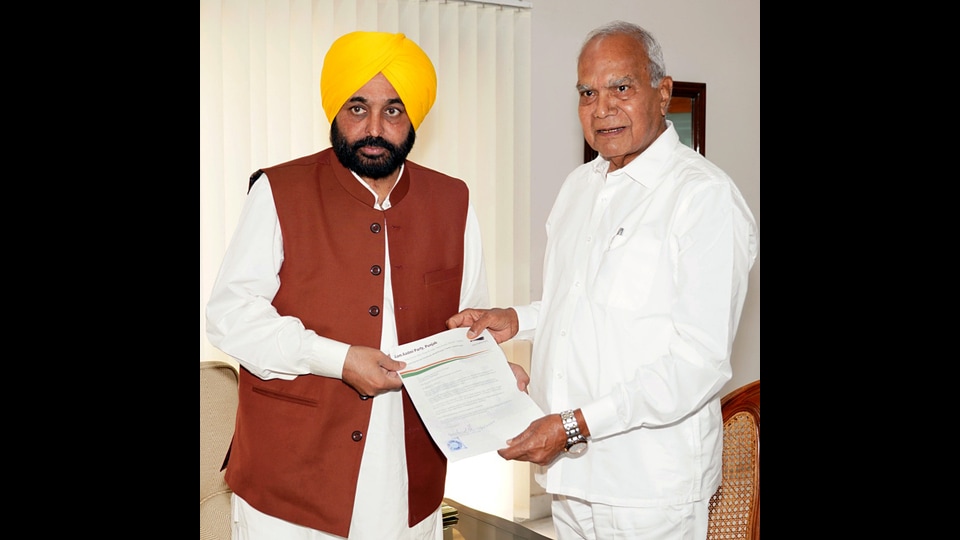
In a short letter written to the President of India, he cited personal reasons behind tendering his resignation.
Purohit, 83, in the letter, said, “Due to personal reasons and certain other commitments, I tender my resignation from post of governor and administrator of UT Chandigarh. Please accept the same and oblige.”
Purohit took charge as the Punjab governor in September 2021, after serving as the Tamil Nadu governor for four years.
He had an eventful tenure ever since, during which he remained at loggerheads with the Aam Aadmi Party (AAP) government in Punjab over several issues, including Punjab Raj Bhawan’s pending assent to legislations.
The AAP, including the CM, cabinet ministers, and official spokespersons, reacted sharply each time the governor raised any issue or sought answers from the government. They repeatedly accused Purohit of acting at the behest of the BJP and conspiring against their government.
Frequent run-ins with Punjab CM
Purohit withheld several important bills and termed multiple Vidhan Sabha sessions called by the speaker “illegal”, prompting the Bhagwant Mann-led AAP government to approach the Supreme Court twice in February and October 2023.
The two top constitutional functionaries didn’t remain on the best of terms since, shooting off letters and sniping at each other over issues such as appointments to various institutions, adherence to legal procedures, action against a minister and constitutional propriety.
In October 2022, when Mann skipped a civic reception held in honour of President Droupadi Murmu at Punjab Raj Bhawan, the governor took a dig at him, saying that constitutional obligations have to be met.
Purohit and Mann also sparred over the appointment of vice-chancellors (V-Cs) of Baba Farid University of Health Sciences (BFUHS) and Punjab Agricultural University (PAU).
After the governor refused to clear the state government’s choice for the post of V-C of BFUHS and sought removal of the PAU V-C due to its “failure to follow” the laid down procedures, Mann accused Purohit of interfering in the functioning of his government.
Things got rockier in February 2023 when the AAP government decided to call the budget session from March 3, and the governor said he will take a call on summoning the House after getting legal advice on the “derogatory and unconstitutional” letter sent by the CM.
Purohit had, in a letter, asked Mann to explain the selection process of 36 school principals sent abroad for training, besides raising some other issues, to which the CM replied that he was only answerable to 3 crore Punjabis, not to a Centre-appointed governor, and also questioned the criteria for appointing governors.
While disposing of the AAP government’s plea on February 28 as the governor had already issued a letter summoning the session, the Supreme Court had criticised both Mann and Purohit for being “derelict” in discharging their duties under the Constitution in this matter and counselled them to uphold the constitutional protocols.
Later, in October, the Punjab government again moved the Supreme Court against Purohit over alleged delay in clearing various bills approved by the state assembly, saying such “unconstitutional” inaction has brought the entire administration to a grinding halt.
The government also sought directions from the top court to the governor to approve all pending legislations forwarded by the assembly. A day later, Purohit gave his approval to two of the three Bills sent to him.
Financial prudence
Through his tenure, Purohit also came to be known for practising fiscal discipline, rolling out a slew of austerity measures at the Punjab Raj Bhawan and even in the UT administration.
No bottled water, no bouquets, only vegetarian food and paid meals for staff were some of the steps taken by the Punjab Raj Bhawan since Purohit took charge in September 2021.
His strict edict to adopt frugal approach in the bhawan’s daily operations translated into a 63% drop in expenses — from ₹22 lakh between September 2019 and August 2021 to ₹8 lakh between September 2021 and July 2023.
Whether it pertained to kitchen maintenance, housekeeping or electricity use, all departments were instructed to adhere to the principle of avoiding unnecessary expenditure.
Going beyond policy-level financial adjustments, such as opting for train travel over flights, Purohit also took the initiative to cover the costs of his meals from his personal funds.
He also prohibited UT officers from travelling by air and staying in luxury hotels during tours to Delhi, stressing it was officers’ moral responsibility to ensure prudent utilisation of public funds and avoid unnecessary expenditures.
Green-lit policies, red-lit projects
As the administrator of Chandigarh, while giving the go-ahead to several policies formulated by the UT administration, Purohit also axed several projects.
On August 4, 2023, he placed on hold Chandigarh Housing Board’s (CHB) ambitious housing scheme in Sector 53, terming it unnecessary. He had also told CHB not to pursue another housing scheme at IT Park, which has been caught in environmental clearance tangles. As a result, now, no housing scheme, either in the private or public sector, is in the works in the Union territory.
A much-touted non-motorised transport (NMT) green corridor conceived by the administration was also stalled by Purohit in September 2023 following a complaint with the Prime Minister’s Office (PMO).
Envisaged under the Chandigarh Master Plan-2031, the 8-km green corridor, with lighting facility, was to connect Capitol Complex in Sector 1 to Sector 56, while running along N-Choe from north to south of the city.
In November 2023, Purohit removed the cap on registration of all non-electric vehicles, a major feature of the UT administration’s ambitious Electric Vehicle (EV) Policy. By gradually stopping registration of fuel-run vehicles, UT had planned to make Chandigarh a “Model EV City” by achieving one of the highest penetrations of zero-emission vehicles by 2027. However, the cap on registrations had evoked sharp criticism from various stakeholders.
Earlier in August, Purohit directed the Chandigarh municipal corporation to roll back its decision of charging double parking rates from four-wheelers registered outside the tricity after much political furore in neighbouring Punjab and Haryana over the move.


