
 E-Paper



Readers’ take: Stem unplanned growth in planned city
While tricity residents agree that building violations need to be checked in the City Beautiful, most feel that an exponential increase in fines is unjustified as the onus is on officials to conduct regular inspections and ensure that building violations are promptly removed. Some also feel that only hefty penalties can deter the violators

 Prefer HTon Google


Senior citizens, traders will suffer most
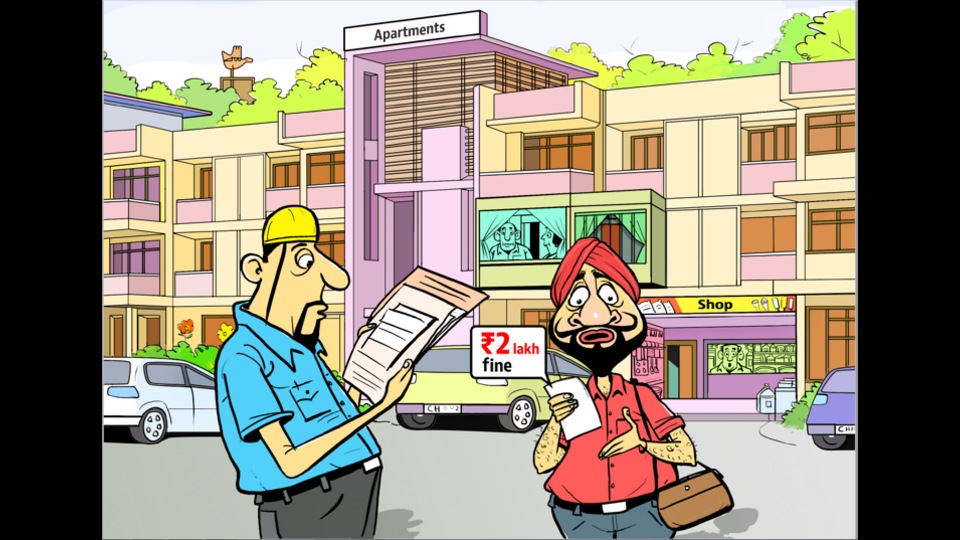
The administration’s decision to increase penalties on building violations exponentially is not justified. The city has a sizeable number of senior citizens who are living on a fixed pension. This penalty hike on building violations will directly hit them. Traders and small industrialists are already against this move as the administration has been increasing penalties year after year. It appears that the administration wants to profit from these violations. The hike needs to be immediately rolled back.
Sunny Dhaliwal, Chandigarh
Take other measures
Recurring building violations are the outcome of ill-conceived policies, which have emboldened residents to break the law without giving two hoots to building laws and bylaws. Now, the administration has proposed a 400-time hike. However, instead of increasing the penalty, the administration should think of other stringent measures to check wilful violations. People in position of power should also be made to pay penalties for building and bylaw violations.
Ramesh K Dhiman, Chandigarh
Admn’s knee-jerk reaction
The administration’s sudden decision to hike the penalty imposed for building violations, and misuse of premises seems to be a knee-jerk reaction. Saddling violators with such a huge financial burden is unjustified. Residents have already been demanding that the changes be regularised. Over the years, around 50,000 flats have made need-based changes. However, the administration had not regularised these properties and had issued notices to most of the allottees. The UT administration could have carried out this exercise in a consultative manner, which would have saved it long-drawn litigations. The UT administration should not introduce broad-brush penalties.
Anil Kumar Yadav, Chandigarh
Increase fine gradually
It is high time that the Capital of Punjab (Development and Regulation) Act, 1952, is amended and a ₹2 lakh penalty be imposed on those violating building bylaws. People will hesitate to break the law if a hefty penalty is imposed on them, but if the amount is meagre, they violate rules openly. Financial liabilities should be revised from time to time so that more people follow the law. However, the penalty should be increased gradually, not at once after several decades.
Avinash Goyal
Conduct regular checking
Increasing the penalty on building violations is justified. Misuse can only be checked if regular inspections are carried out and violaters are penalised to set an example for others so that they do not commit such mistakes in the future. It is essential to penalise those who do not abide by rules.
Ishita Nara
Hold officials accountable
Building bylaw violations have been frequently brought to the notice of the Chandigarh House Board, but no steps have been taken to penalise the defaulters. It appears that the officials were either wilfully ignoring the violations, or protecting violators under political pressure. The officials who dithered on taking action gainst violators should be punished. The high court ordering the demolition of the third floors of 76 buildings seems arbitrary as the people who violated the bylaws are either retired or have passed away. Why prolong the sufferings of the dependents? The Chandigarh administration should also answer for its guarded silence.
Kundan Lal Sharma, Mohali
Consult stakeholders
The Chandigarh administration’s proposal to increase the penalty on building violations from ₹500 to ₹2 lakh is being opposed by citizen groups and the business community. However, officials have clarified that the quantum of fine will depend on the misused area and ₹2 lakh is the maximum penalty that can be imposed. Penalty will be much lower, if the violations are smaller. Authorities should develop a formula to calculate the penalty due as per the magnitude of the violation. The administration should hold talks with all stakeholders and should also present the case for amendments through detailed presentation and dialogue as the hike has taken place for the first time since 1950s.
Sanjay Chopra, Mohali
Concession for first-time violators
The Chandigarh administration has decided to increase penalties on building violations to stop misuse of premises. The steep hike has not gone down well with industrialists, traders and Residents’ Welfare Associations as expected.They have formed the Chandigarh Co-ordination Committee to oppose the proposed charges. The administration has clarified that penalty will depend on the misused area, and all violations will not incur a penalty of ₹2 lakh. However, some concessions should be made for first-time violators and they should be allowed to pay the penalty in two or three instalments. The administration will frame detailed rules under the amended Capital of Panjab(Development&Regulation)ACTto link the quantum of penalty to the area misused.Mohali and Panchkula are expected to follow suit. At present there is an increase of 10% increase in penalty for the buildings under the Greater Mohali Development Authority(GMADA) The Haryana Sherri Vikas Adhikaran(HSVP)has a nodal officer from the Estate Office to check building violations. He would be assisted by an S.D.M. & the Deputy Commissioner of Police. The satellite towns may revise the penalty to deter the misuse of the buildings.
Usha Verma, Chandigarh
Too steep a penalty
In the 1960s and 70s, the administration had provided numerous incentives to bring people and businesses to the city, and in the last 50 years the city has transitioned from a sleepy town to a bustling metropolitan city. The proposed amendments to the Capital of Punjab Act, 1952, are harsh as people have been demanding city-based bylaws for decades. The administration should take into consideration the fact that a city built for 5 lakh people is now housing double the population. If the proposed penalty charges are not reduced, industries may move out of the city. Already, there has been a mass exodus from the Chandigarh Industrial Area, which is neither an industrial area or shopping centre. There should be no penalty on internal changes subject to approval from structural engineers. Red tape should be reduced so that businesses can make necessary changes without any hassle.
Sukhpal Singh, Chandigarh
Regularise need-based modifications
Increasing the penalty on building violations to up to ₹2 lakh is no solution to the problem of building bylaw violations. The administration should, as a goodwill gesture, regularise all need-based modifications if they are structurally sound. Non-governmental organisations, resident welfare associations, Federation of Sectors Welfare Association Chandigarh (FOSWAC) and businessmen should be consulted before hiking the penalty. A ₹2 lakh penalty is too harsh and must be rolled back. The coronavirus has already made the lives of common men miserable, and this new notification will add salt to their wounds.
Col TBS Bedi (retd), Mohali
Categorise building modifications
The administration should realise that need-based changes are a necessary evil. Firstly, the administration must frame a policy and define need-based changes, violations and misuse. Any need-based change made within the four walls of a premises,which does not affect the safety of the basic structure of the building or the neighbours’ property, does not encroach on government land, and does not violate the building bylaws should be allowed. The administration should also prescribe a fee for incorporating need-based changes if it deems fit.
AK Sharma, Chandigarh
Penalty an excuse to earn more revenue
It is the laxity of the Chandigarh administration which has allowed building violations to flourish. The steep hike in penalty is just a way to earn revenue, while not taking responsibility for the rampant violations. Had the officials been vigilant throughout the city would not have been grappling with such large-scale violations. The razing of Colony 3 and 4 symbolise the negligence of the administration. The Chandigarh administration should do its homework properly before harassing residents. A nominal fee should be charged for need-based modifications. Will charging a hefty amount on pretext of violations save buildings from disasters such as earthquake? The government should clarify to building owners at the time of registering properties that any violations will lead to cancellation of the said registration.
Abhilasha Gupta, Mohali
An administrative failure
The administration has failed to check building violations for years together, and now has decided to impose penalties. In neighbouring Panchkula, a weekly list of illegal structures is made, and after issuing a notice the illegal structure is razed to the ground. The same could also be done in Chandigarh as well. Sadly, bureaucrats from different states enjoy all facilities, complete their tenure and return. Nobody bothers to make any contribution to the city. The citizens have to run from pillar to post to affect a change.
RR Passi
Minor changes are not violation
The administration must define what exactly constitutes a building violation of such magnitude that it finds unstoppable without raising its penalty rates exponentially. Normally, a building violates rules, if its construction encroaches on government land or endangers the adjacent structure. Even if it stops the free flow of sun and air of an immediate neighbour, it constitutes a violation. If a building is used for any other reason other than what it was constructed for it will fall under the purview of a violation. Over 10,000 people have carried out need-based changes in their own houses, using their own money, which are within the boundary line and skyline of their properties and do not affect their structural stability. These residents have been waiting for a decade for the Chandigarh Housing Board to regularise need-based changes as the chairperson had verbally agreed to them. The decade-long delay has raised questions over the intentions of the UT administration, which will do well to regularise such changes by charging a nominal compounding fee as these minor changes cannot be treated as a violation by any stretch of imagination.
SC Luthra, Chandigarh
A punishing penalty hike
India is a welfare country and it is incumbent upon the state to look after the welfare of its residents, which is why the administration allotted houses and plots to persons belonging to middle class, lower middle class and poor strata of the society at reasonable rates. With the passage of time, the allottees made need-based changes to their houses, and since them they have been pressing the administration to regularise these changes without a tangible solution. The Sword of Damocles has always been hanging on their heads in the form of notices for cancellation of allotments and other heavy penalties. They are neither encroachers nor squatters, but genuine allottees, paying their dues, law-abiding citizens who are ready to pay reasonable fees for the purpose. They are not rich enough to purchase new houses according to their enhanced family requirements, and could not do without making certain need-based changes.The administration also cannot not escape responsibility for lingering over a decision for such a long time. The bureaucrats should not be so stone hearted to not visualise the issues being faced by the common man. Moreover, the proposed amendments in the act are in the jurisdiction of the parliament and not the local administration. Imposing exorbitant penalties is illegal , illogical, and inhuman.
Kidar Nath Sharma, Chandigarh
Chandigarh is one of the youngest and well-planned cities of India. Building laws have been made to ensure that the city remains as is. The advantage is that we have enough manpower to check and curb any violation immediately. Politicians have to stop interfering and backing any illegal encroachment and support the administration in keeping city beautiful worthy of its name.
Amandeep Bajwa
Nip violations in the bud.
Both the defaulter and the official incharge of an area should be penalised if the building is over three months old. Since initial violations are not checked or demolished, more and more people are comfortable violating the bylaws, which has led to higher violations. If defaulters have to pay, a 10% penalty should also be imposed on the official responsible for letting the violations take place.
Chander Vij
Penalties are no solution
Imposing heavy penalties will not solve the issue at hand, and cannot be justified. The violations should be removed within the stipulated time so that City Beautiful’s qualities and status remain unchanged. Genuine suggestions should be taken into consideration to amend the Capital of Punjab Act, 1952. The administration has taken a stringent step by increasing the penalty on building bylaw violations and the misuse of premises. On the other hand, corruption will increase due to this increase in penalty rates, and the common man will try to find out a jugaad.The basic structure of City Beautiful cannot be kept intact by increasing penalties. Meetings should be held between authorities, industrialists, traders and Resident Welfare Associations. The administration must allow need-based changes and define violations and misuse. The hike must be withdrawn.
Sumesh Kumar Badhwar, Mohali
Expert takes
Preserve city’s original character
Violations have the potential of changing the original character of a city. The administration is duty bound and well within its powers to apply all preventive and curative means to ensure compliance. However, a mechanism for consultation with residents should be worked out for an amicable solution.
Baldev Setia, director, Punjab Engineering College (PEC)
Will take up issue with admn
Allowing genuine need-based changes will prevent violations. We will also take up the issue of proposed hike in penalty with the administration.
Poonam Sharma, ex-mayor, non-official director, CHB
Inhumane move
The administration’s move to exponentially increase penalties is inhumane. A meeting must be called with stakeholders to arrive at a better solution. Small need0based changes like putting up a shed-roof on balconies is a must to protect the house from rain and sun.
MN Shukla, convener, Voice of Housing Societies
Fix responsibility
Increasing the penalty is not the solution. It is sad that the authorities concerned keep sleeping and encroachments continue for years. Nodal officers should be out incharge of different areas and responsibility should be fixed in time. Officers should supervise and monitor the areas as well as prepare timelines.
Sardul Singh Poonian, president, RWA, Sector 80, Mohali
Categorise violations
There is need to categorise violations. Only serious violations which affect the facade of house and zoning areas should be penalised. Sanctity of the master plan must be maintained at all cost.
RP Malhotra, President Federation of Residents Associations Panchkula
Reader of the week
Annual building audit a must
It is essential to penalise building violations so as to discourage non-approved changes to building plans. The structural viability of buildings suffers as a result of these changes. Residents do not understand that short-term changes lead to long-term consequences. We often hear of building collapses but do not realise that the structural stability of buildings is affected. An annual audit is needed to check for violations. Buildings should also be given safety certificates every year.
Gurnoor Grewal, Chandigarh


