The year 1947 was most eventful as it was the year that India attained Independence. For those associated with the institution, there was the added significance of it being the Centenary of the foundation of The Lawrence School, Sanawar.
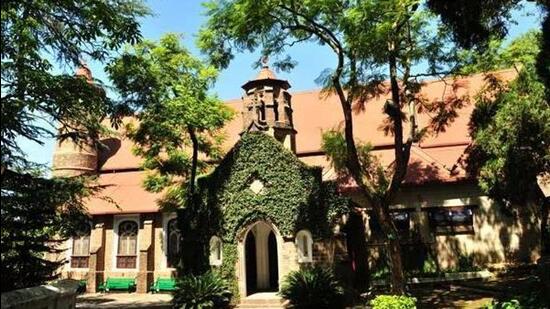
As the year progressed, the school witnessed a hugely diminished student and staff population as after the declaration of India’s independence, most chose to leave for England. It was most evident that the fate of the school hung in a precarious balance. There was every possibility that the institution would have crumbled even as the gargantuan empire on which the sun never set was packing up.
However, true to the motto of “Never Give In”, the institution soldiered on under the care and guidance of Carter, the then Principal. In August 1948, the students and teachers at Sanawar planted trees to mark the first anniversary of the independence of India. And these were not any random species, but the magnificent Himalayan deodar, known as the Cedrus deodara. And these noble trees can still be seen in the Independence Garden at Sanawar! It is one of the greatest pleasures of the sylvan Sanawar campus to take a night walk amidst the stately deodars that add an almost mystical dimension to the Independence Garden.
Incidentally, the majestic deodar is the state tree of Himachal Pradesh.
{{/usCountry}}Incidentally, the majestic deodar is the state tree of Himachal Pradesh.
{{/usCountry}}The interesting fact is that these deodars have only thrived with the passage of time. The altitude of Sanawar is around 1,750 metres and deodars are usually found at a higher altitude, are most suited to an elevation of around 1,800 to 2,600 metres, and can be found aplenty in the environs of Shimla.
And each year, the students and the staff carried on that wonderful tradition. Pits were dug in the hard stony terrain. Where there was a dearth of earth, sacks of soil were carried from a nearby hillock that was given the name Chocolate Hill on account of the rich soil found there. And then just on the eve of monsoon rains, saplings were procured and looked after until the rains came. Parties of boys and girls set off amidst the monsoon showers to remote hidden spots all over the 139-acre campus where there is scope to plant more trees. Of course, there were spills and falls and abrasions galore but this determined band of boys and girls only returned back to civilization after their mission was successful! Excellent for the formation of character and the embedding of values!
And, it was just not enough to carefully and lovingly plant saplings into the ground, one was obliged to take care of it till it became a tree. This involved going in the dry season with a plastic mug full of water to nurture a tree planted the previous year!
Those who have known and experienced the beautiful estate discern and appreciate how a once bare ridge has become a verdant forested area which is a haven for all manner of birds and mammals.
In the Springtime one sees trees of all hues: the sap green of the English oak, the chartreuse green of the Hackberry celtis australis the russet leaves of the “kakkar”. Not only the entire campus lights up in a myriad hues of green and takes on a magical aspect, but the same is true of the hills around Sanawar. It is as if an artist has taken charge of the entire vista and painted a most glorious masterpiece.
Interestingly, this year the students and staff planted 250 deodars among other species during the monsoons.
In a volatile and uncertain world what is certain is that these beautiful deodars will only go from strength to strength and that generations to come will draw sustenance from their therapeutic shade as they dance in the sweet mountain breeze. Do visit, and, if you care to listen to the susurration of their branches, they will tell you the most wonderful stories!