Even as Haryana went big on its mega-vaccination drive, inoculating 2.48 lakh individuals on Monday itself, the state registered a rise of 2,074 fresh coronavirus infections last week (March 15-21) in comparison to the week before.
Increase in the number of Covid cases has been on for six weeks now after 11 successive weeks of decline.
The state reported 4,691 new infections last week as compared to 2,617 the week before (March 8-14). Last time these many infections were reported during the virus climb was between July 6-12 last year, when 4,235 weekly infections were detected.
Additional chief secretary (ACS), health, Rajeev Arora said the health department on Monday vaccinated 2.48 lakh individuals during the first day of the weekly mega-vaccination drive.
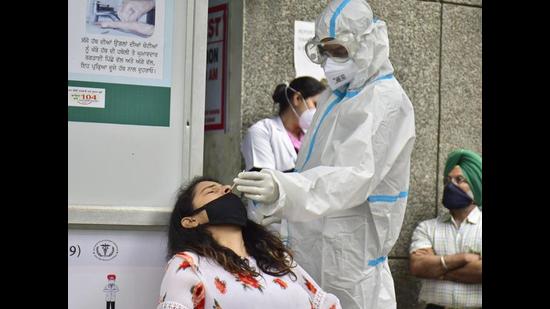
“Our sample positivity rate has dipped to 4.6% from 4.7%. We have again ramped up sampling. Last week, the department tested about 1.33 lakh persons as compared to about a lakh last week. The department had tested 1.27 lakh persons between March 1-7 and 1.15 lakh persons in February 22-28. About 99% of the testing is being done using reverse transcription polymerase chain reaction (RT-PCR) kits,” Arora said.
NCR, Ambala push vax pedal, Panchkula lags
{{/usCountry}}NCR, Ambala push vax pedal, Panchkula lags
{{/usCountry}}The ACS said that the twice a week mega vaccination drive is aimed at extensive coverage. “The vaccination target for Monday was 2.43 lakh persons and 2.48 lakh shots were given. Last Monday, we had inoculated about 1.50 lakh persons. As on Monday, the department has vaccinated 11.56 lakh persons,” Arora said.
Gurugram with about 25,000 inoculations. Ambala with about 23,000, Faridabad with about 21,000, and Sonepat with about 18,000 were the leading districts in terms of Monday’s vaccination coverage, while Panchkula lagged behind with just 5,169 inoculations, data showed.
3 districts still in critical category
Health department data showed that despite increase in the number of infections, only three districts - Faridabad (8.4%), Gurugram and Rewari (6.7% each) continue to have a critical positivity rate of over 6%.
Sixteen districts still have a positivity rate in the range of 2.5% to 5.5%, meaning it is lower than the critical positivity rate of over 6%, but higher than the desirable positivity rate of less than 2%.
Three districts - Nuh (0.8%), Charkhi Dadri (1.1%) and Jhajjar (1.8%) continue to have a desirable positivity rate of less than 2% for past several weeks.