Photographing wildlife can be educative if the lensman is observant rather than one merely interested in clicking a proverbial “pretty picture”. In his ongoing series of hunting-action photographs from the Saketri grasslands east of the Sukhna lake, Anuj Jain captured a vivid contrast of emotional expressions.
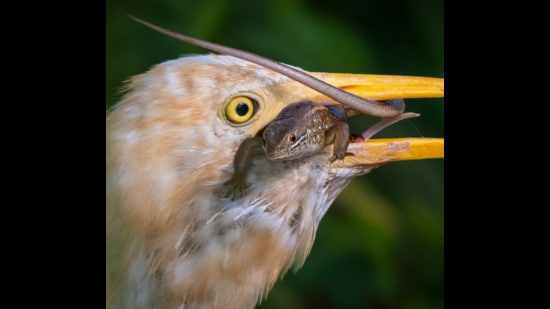
An eastern cattle egret had seized in her bill an Indian three-banded skink (Eutropis trivittata, as identified from Jain’s photograph by Kaushik Deuti, a Zoological Survey of India scientist and lead author of the volume, Skinks of India). There was terror reflected in the skink’s bulging eyes as she took her last glance of the cosmos. The flailing tail seemed a half-mast, an augury of her impending doom. The egret’s eyes radiated a stony look.
Jain has frequently photographed egrets killing skinks. But with this one, he observed a different dispatch. “Once caught in the egret’s bill, the skink has no chance of escape. Egrets pierce the skink with their stiletto bills to immobilise/kill it before swallowing. This one, the egret swallowed alive without first piercing it through, even as the little reptile shook its body vigorously to escape,’’ Jain told this writer.
The presence of a black drongo, a feisty avian pirate, was the motive for the egret’s snappy ingestion. “Drongos and egrets follow cattle to predate on insects, etc, flushed by bovine movements through grasses. But drongos are also ‘snatchers’, quick to hound egrets when the latter catch something and rob them of hard-earned shikar. A drongo began hovering around the egret with the struggling skink. Its presence created enough panic for the egret to finish its meal in double-quick time, i.e., before ensuring the skink’s stillness with a knifing, the egret gulped the skink along with her wriggles and jiggles!” said Jain.
{{/usCountry}}The presence of a black drongo, a feisty avian pirate, was the motive for the egret’s snappy ingestion. “Drongos and egrets follow cattle to predate on insects, etc, flushed by bovine movements through grasses. But drongos are also ‘snatchers’, quick to hound egrets when the latter catch something and rob them of hard-earned shikar. A drongo began hovering around the egret with the struggling skink. Its presence created enough panic for the egret to finish its meal in double-quick time, i.e., before ensuring the skink’s stillness with a knifing, the egret gulped the skink along with her wriggles and jiggles!” said Jain.
{{/usCountry}}A real Shiva temple cobra
Shiva temples have spectacled/Indian cobras woven into mythical iconography. Live cobras also “surface” mysteriously in shrines to kindle devotee fervour around the time of religious/cultural events. In New Delhi’s Pusa institutional area, a cobra was rescued from the Shri Shiva Hanuman Mandir on Dev Prakash Shastri Marg recently.
A genuine resident of the temple, it had been living quietly in the dark, cluttered storeroom and had gained impressive size and distinction of physical feature, indicating it was many years old. Storerooms and godowns often harbour serpents, who utilise the hideouts afforded by clutter. Rodents frequent the same haunt of disuse. For cobras and Russell’s vipers, rodents are preferred prey, a delicacy much like ‘kaala gulab jamuns’ for humans!
The temple priest spotted the snake and mistook it as a non-venomous rat snake. But choosing discretion over valour, he summoned the rescue team of Wildlife SOS. After methodically clearing and shifting a substantial amount of material, the team located the hiding cobra. “Despite the challenging circumstances and confined surroundings, the cobra remained unusually calm throughout the rescue operation allowing our trained team to safely secure and contain it. I assess that the cobra’s calm demeanour was due to it being an adult. Like mature humans, who maintain a sober approach in critical situations, the cobra remained calm. Also, our rescue team is experienced and it handled the cobra with a deftness that ensured the snake did not panic and get aggressive. In contrast, juvenile cobras can be very aggressive,” Baiju Raj MV, Director, Conservation Projects, Wildlife SOS, and a veteran snake rescue expert, told this writer.
If not handled adroitly, cobras have wrapped the tail around the rescue personnel’s hand/arm and leveraged the grip to deliver a bite. That said, a cobra is generally reckoned a ‘’good snake’’. By resort to bouts of harmless hissing and flaring of hood, the cobra delivers ample warning to keep away. In contrast, a common krait will bite without a warning hiss or a pronounced display such as a flared hood. Even the viper will retreat into ‘jalebi-like’ coils and vocalise hisses so pronounced that they mimic a pressure cooker’s warning whistles of being done with delicious ‘rajmas’ for lunch!
vjswild2@gmail.com